Curriculum
Index
Four years to explore expression and cultivate the ability to shine in society.
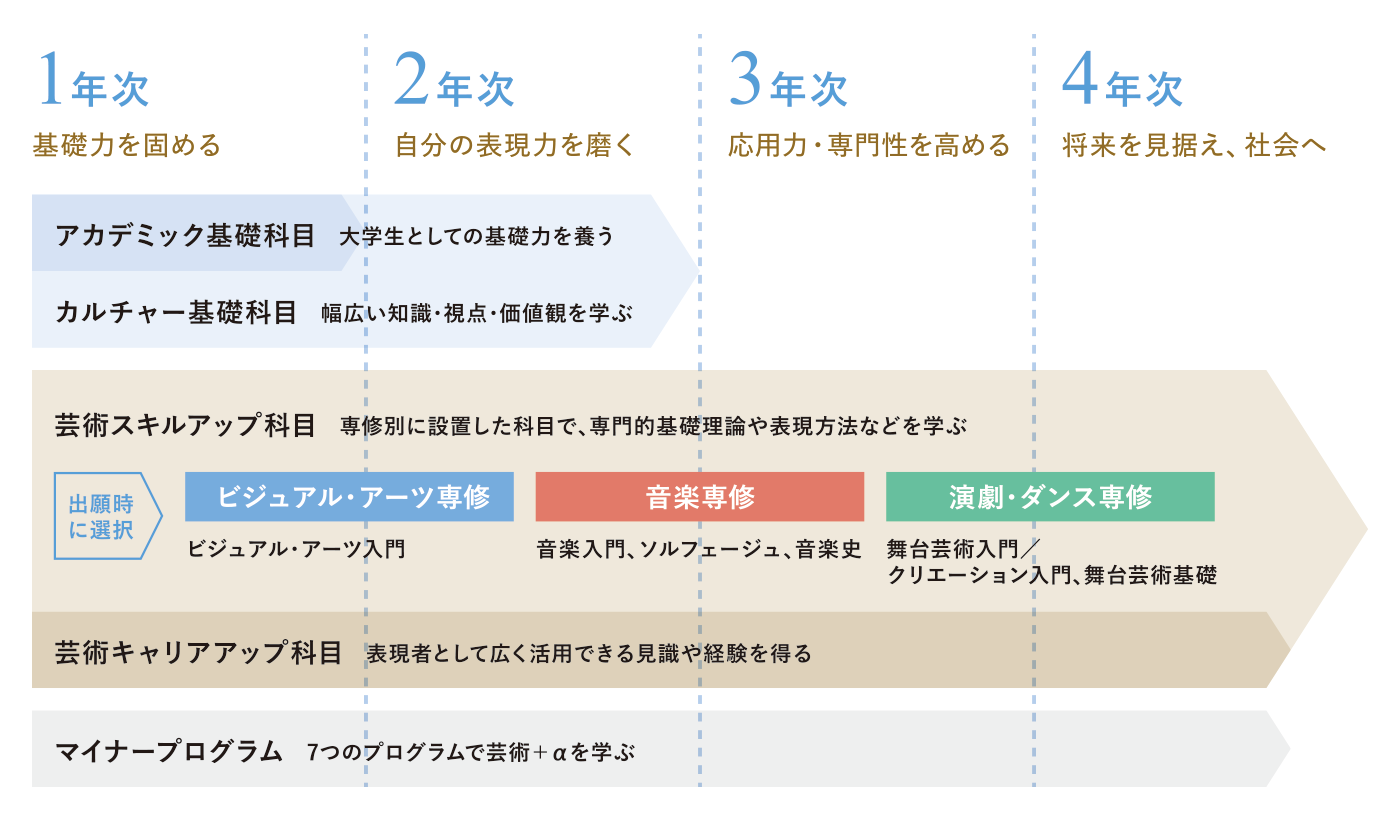
It's not just about learning specialized expressive techniques; it's a process of discovering your own expression through a wide range of artistic experiences and refining it through practice.
In their first year, students explore diverse fields of expression, discovering their interests and aptitudes and laying the foundation for considering their future direction. From their second year, they select a specialization and systematically acquire knowledge and skills in their respective fields, such as theater, dance, music, art, and film. In their third year, they take on challenges such as off-campus performances and exhibitions, and projects that connect with society, gaining experience in bringing their expression to the real world in collaboration with their peers. Finally, in their fourth year, through their graduation research and production, they cultivate an "art + α" perspective and disseminate their own expression to society. Whether they specialize in art or fuse different fields to create new value, each student acquires the power to forge their own future.
In their first year, students explore diverse fields of expression, discovering their interests and aptitudes and laying the foundation for considering their future direction. From their second year, they select a specialization and systematically acquire knowledge and skills in their respective fields, such as theater, dance, music, art, and film. In their third year, they take on challenges such as off-campus performances and exhibitions, and projects that connect with society, gaining experience in bringing their expression to the real world in collaboration with their peers. Finally, in their fourth year, through their graduation research and production, they cultivate an "art + α" perspective and disseminate their own expression to society. Whether they specialize in art or fuse different fields to create new value, each student acquires the power to forge their own future.
First year: Expand your possibilities by being exposed to diverse forms of expression.
Through foundational subjects that are easy for beginners to try, you will be exposed to diverse fields of expression such as theater, dance, music, video, and fine arts. By gaining a wide range of experiences, you will understand your interests and aptitudes, laying the foundation for considering your future professional Area. There are many opportunities for collaborative work and presentations with peers, making it a time to nurture a spirit of inquiry while experiencing the joy of learning.
Second year: Identify your area of specialization and deepen your learning.
Based on the experiences gained in the first year, students choose a specialized field they truly want to explore and begin seriously learning the necessary knowledge and skills. Through seminars, practical training, and creative activities, they hone their expertise and build the skills necessary for creating works and performing on stage. Working on assignments in collaboration with peers and faculty members is an important step in gradually developing self-awareness and responsibility as performers.
Third year: Test your abilities through student-led practical projects.
As a step towards opening up their learning to society, students proactively take on challenges such as performances, exhibitions, and contests. They collaborate with their peers, participating in planning and management, to create their works. Through experiences connecting with society via expression, they enhance their practical skills, adaptability, and communication abilities. By repeatedly challenging themselves and learning from their failures, they further expand their potential as expressive artists.
Fourth year: Communicating your expression to society and shaping the future.
As the culmination of their studies so far, students work on their graduation research and graduation projects. Utilizing minor programs, they develop an "art + something extra" perspective by combining art with other fields. This is the final stage where they present their work and research to society and concretely envision their future paths and careers. They take a step towards the future, aiming for independence as expressive individuals.
Learning from Each Major
- Theater & Dance Major
- Music Major
- Visual Arts Major
Curriculum tree
Curriculum Model
- Theater & Dance Major (Dancer & Choreographer) _2025 Curriculum Enrollment ModelPDF file
- Theater & Dance Major (Dance Facilitator) _2025 Curriculum Enrollment ModelPDF file
- Theater & Dance Major (Dance Teacher & Instructor) - 2025 Curriculum Enrollment ModelPDF file
- Theater & Dance Major (Musical Actor) _2025 Curriculum Enrollment ModelPDF file
- Theater & Dance Major (Director & Playwright) _2025 Curriculum Enrollment ModelPDF file
- Theater & Dance Major (Actor) _2025 Curriculum Enrollment ModelPDF file
- Theater & Dance Major (Stage Costumes) - 2025 Curriculum Enrollment ModelPDF file
- Theater & Dance Major (Stage Sound) _2025 Curriculum Enrollment ModelPDF file
- Theater & Dance Major (Stage Manager) _2025 Curriculum Enrollment ModelPDF file
- Theater & Dance Major (Stage Lighting) _2025 Curriculum Enrollment ModelPDF file
- Theater & Dance Major (Stage Design) _2025 Curriculum Enrollment ModelPDF file
List of minor subjects
- Art Management (List of Minor Subjects to be Completed in the 2025 Academic Year Curriculum)PDF file
- Global Career_2025 Curriculum Minor Subject List)PDF file
- Community Art (List of Minor Subjects to be Acquired in the 2025 Academic Year Curriculum)PDF file
- Sound Technology (List of Minor Subjects to be Acquired in the 2025 Academic Year Curriculum)PDF file
- (List of minor subjects to be acquired in the Design Management curriculum for the 2025 academic year)PDF file
- Fashion & Culture - List of Minor Subjects to be Acquired in the 2025 Academic Year Curriculum)PDF file
- Musical Crossing - 2025 Curriculum Minor Subject List)PDF file
Major/Minor System
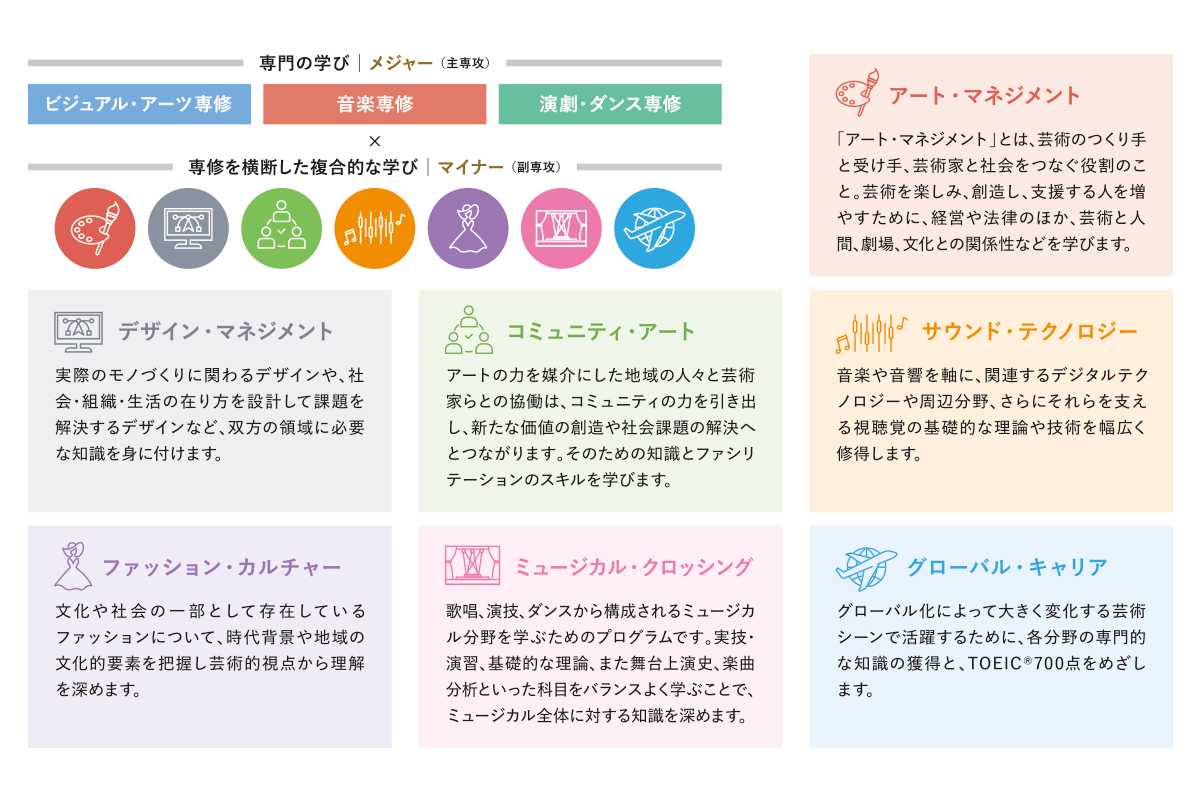
You can create your own original learning experience tailored to your interests and aspirations. The "Major-Minor System" makes this possible. While completing a major program or course within your affiliated academic group is a graduation requirement, you can combine it with other areas of study as a minor. Expand your learning possibilities and aim for your own unique goals.
College of Performing and Visual Arts Unique curriculum structure
Combining your major and minor fields of study broadens your learning and leads to new discoveries. It can provide opportunities to view artistic expression objectively and to find your future direction.
Characteristics of the academic group
Open list of subpages
Content of learning
Open list of subpages
Career paths, qualifications, and achievements
Open list of subpages
Student life/environment