Curriculum
Index
Four years to cultivate advanced skills and practical abilities
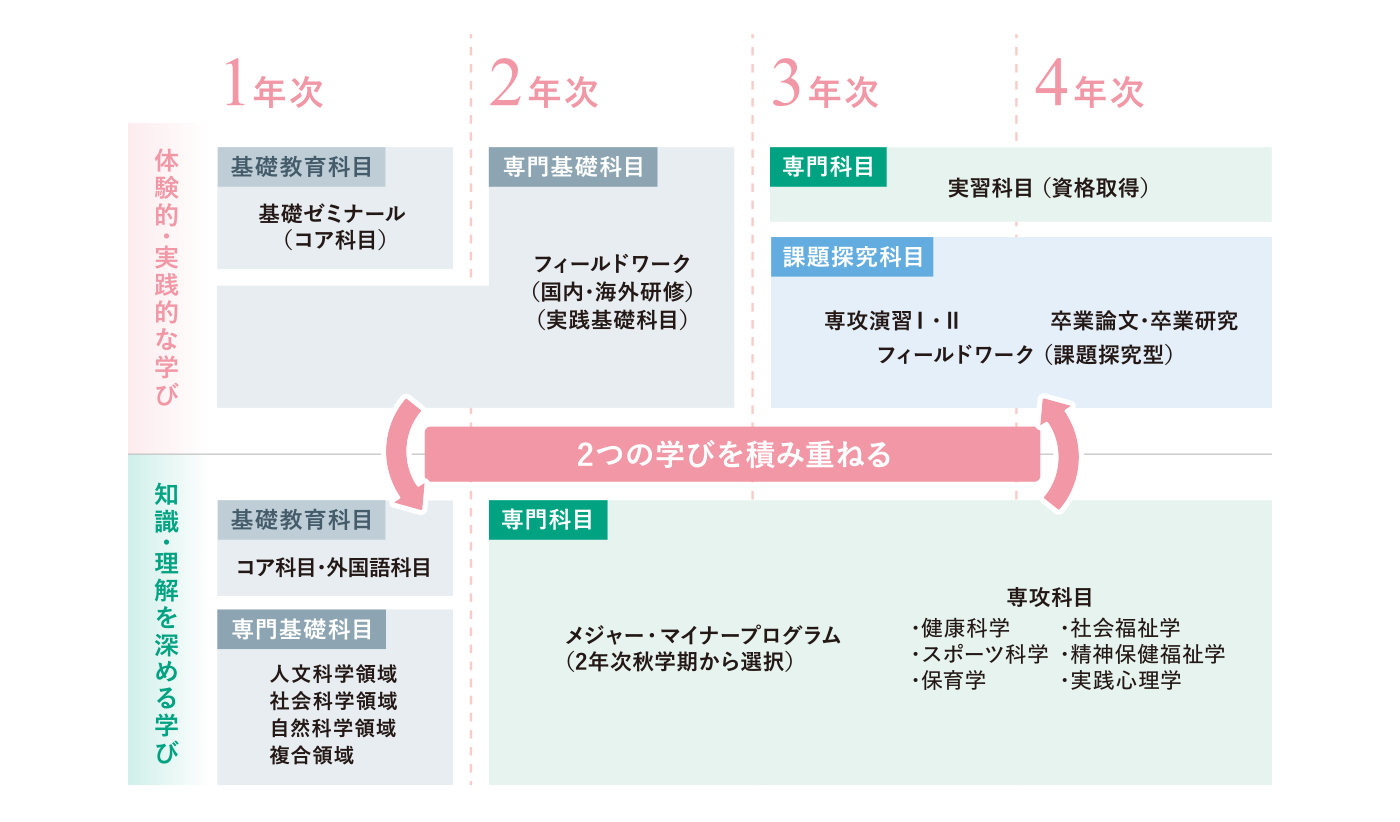
Students deepen their learning step by step from the basics to their specialties, combining adjacent Area with their main major according to their interests and interests, thereby fostering an interdisciplinary perspective. Through fieldwork, practical training, and inquiry activities, students develop expertise and problem-solving skills, and through research and social dissemination, they achieve results over four years.
Year 1: Developing fundamental skills and building a foundation for learning.
In addition to basic education subjects that develop thinking skills, writing skills, and information gathering abilities, students study specialized foundational subjects tailored to the chosen Area (humanities, social sciences, natural sciences, composite). In the "Basic Seminar," students acquire the basics of learning at university and can be recurred from the first year in fieldwork, allowing students to freely choose from over 50 diverse programs across six categories beyond their major. Through experiential and practical learning, students broaden their horizons and increase their enthusiasm and interest in their specialized fields.
Furthermore, through community contribution Events through sports, student-run children's cafeterias, and interaction activities with local residents, we foster an attitude of viewing social issues as personal matters.
3 Area 6 Majors for Becoming a Professional
The three Area of "Health and Sports," "Welfare and Psychology," and "Childcare" are fields of study that support lifelong physical and mental health and improve quality of life. Within these Area, six majors are arranged to deepen learning in each specialized field. Additionally, by broadly studying across the three Area, you can gain a broader perspective and expertise.
The three Area of "Health and Sports," "Welfare and Psychology," and "Childcare" are fields of study that support lifelong physical and mental health and improve quality of life. Within these Area, six majors are arranged to deepen learning in each specialized field. Additionally, by broadly studying across the three Area, you can gain a broader perspective and expertise.
Health & Sports Area
Welfare & Psychology Area
Childcare Area
About fieldwork
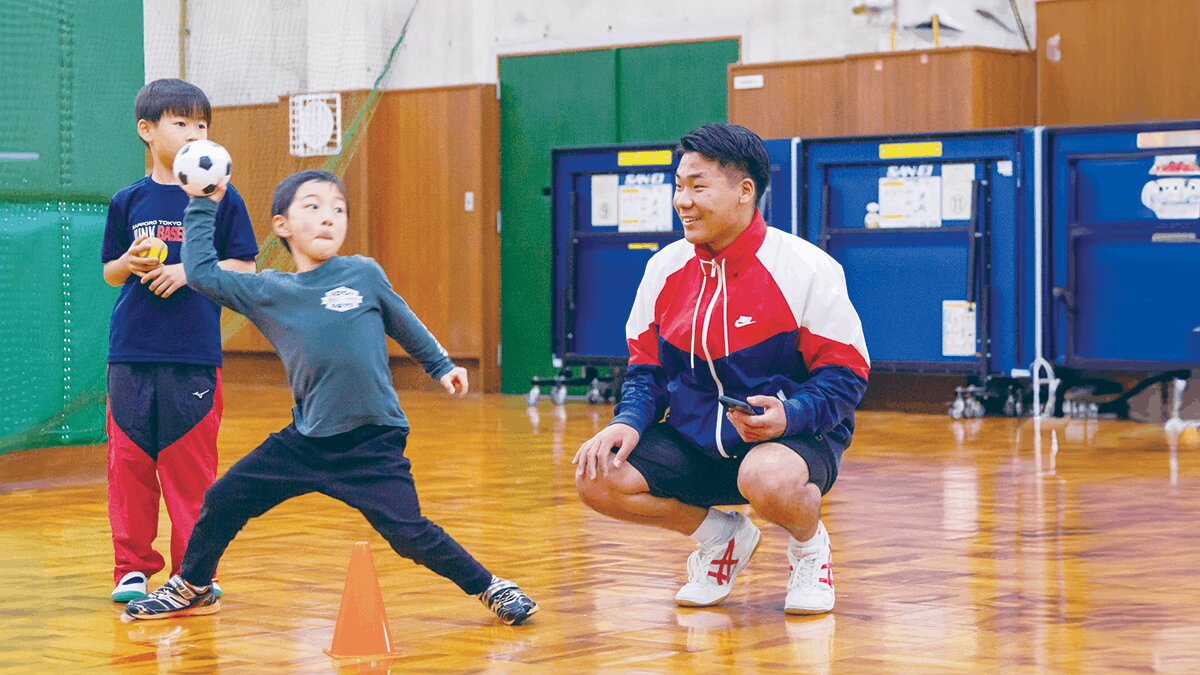
Fieldwork, available from the first year, can be freely selected from over 50 programs across six categories. It encourages students to consider what society needs and what they can contribute.
Health and Sports: Participation in sports classes / Exercise guidance for lifestyle-related diseases / Support for universal sports
Community Exchange: Park cleaning / Support for children's cafeteria operations / Events planning in community interaction spaces
Food-related activities: Supporting meal services for the elderly at NPOs, etc. / Food distribution / Operating children's cafeterias
Child support: Support for adventure playground activities / Support for free school activities / Support for sports for children with disabilities
Support for children and adults with disabilities: Experiential activities in employment support programs for people with mental disabilities, etc. / Experiential activities in special needs schools
Overseas training programs: American sports training / Singapore welfare training / Welfare and poverty issues training
Second year: Major/minor selection to broaden specialization and interdisciplinary knowledge
3. In addition to the major (major) selected from the 3 Area ('Health & Sports', 'Welfare & Psychology', 'Childcare'), students also select a minor from the fall semester of the second year. By combining majors and minors according to your interests, you can design your own four-year learning. Multiple minor courses are also possible, and by combining fields different from your major, you gain a broader perspective. Additionally, we will continue hands-on fieldwork experiences, nurturing both expertise and flexible thinking.
Major/Minor System
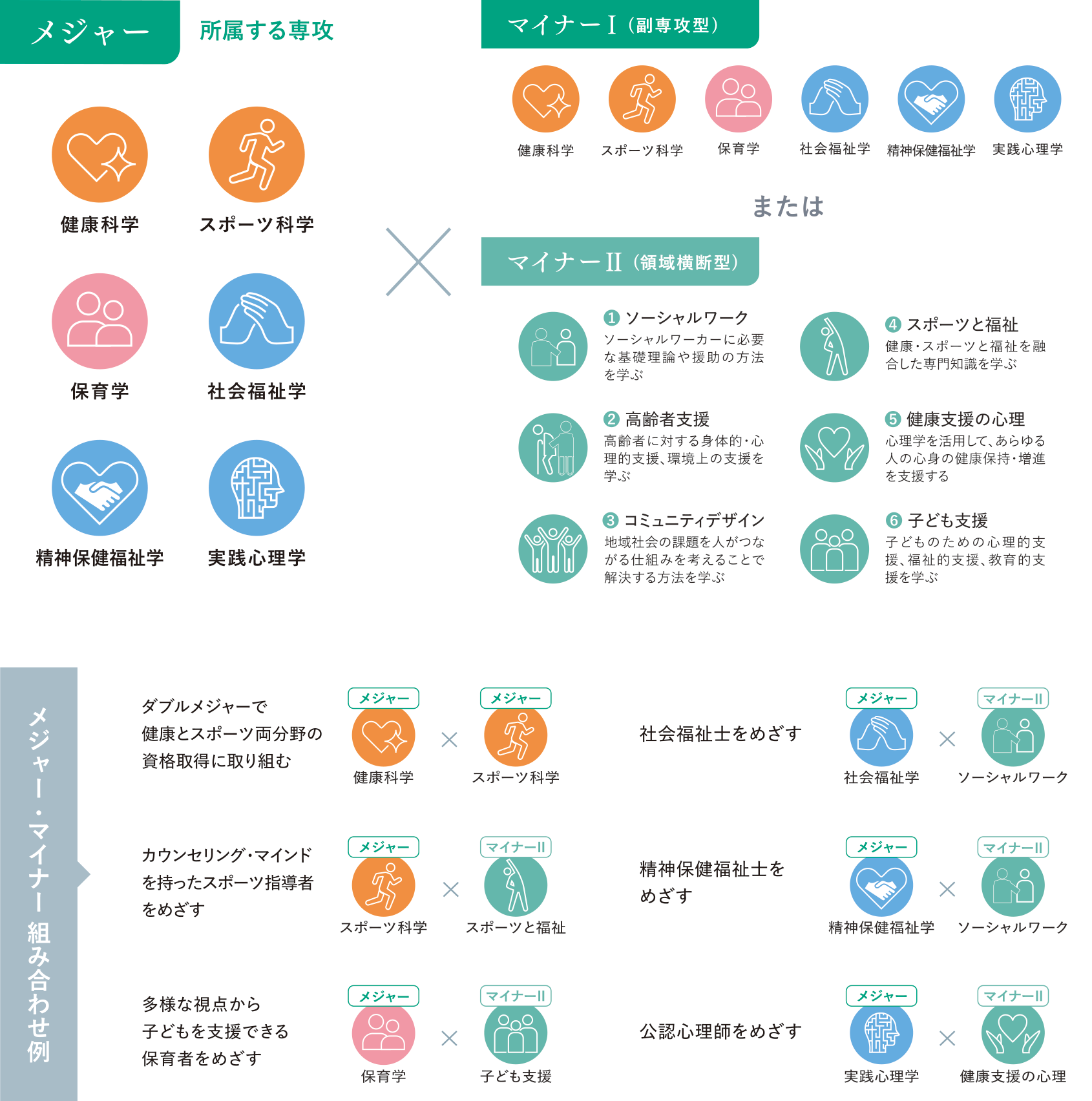
The "Major-Minor System" allows students to freely structure their studies according to their interests and future aspirations. In addition to the major program selected at admission (major: main major), graduation requires completion of at least one of 12 minor programs (Minor I.6 Area / Minor II6 Area).
You can greatly expand your learning opportunities and possibilities as you pursue a career and goals that are uniquely yours.
By deepening expertise in the major while simultaneously learning relevant Area in the minor, the goal is to foster a multifaceted perspective and acquire more comprehensive knowledge and skills related to "health and wellbeing."
To learn more about "health and welfare" and broaden one's perspective
You will use both major and minor programs to design your own four years of learning. You can combine the major you choose at admission with a minor I minor or a minor II that spans academic Area. Additionally, it is recommended to choose and study multiple minor programs.
You will use both major and minor programs to design your own four years of learning. You can combine the major you choose at admission with a minor I minor or a minor II that spans academic Area. Additionally, it is recommended to choose and study multiple minor programs.
major
The major consists of 36 credits worth of foundational and specialized subjects, a series of courses that demonstrate the expertise acquired, and is linked to the type of degree awarded.
Minor I (Sub-major type)
This program (Minor I) consists of 20 credits each of foundational and specialized subjects, allowing students to choose a minor in a field closely related to their major. It is not possible to register for a Minor I with the same name as your major.
health science
To ensure that everyone can lead a rich life based on "health," we aim to acquire knowledge and practical skills related to health science Area (health psychology, health education, public health) for people with disabilities across all lifelong life stages from infants to the elderly. The goal is to comprehensively understand the relationship between health and physical activities such as exercise and sports from both the "body" and "mind" perspectives. Through the education of this major, we also cultivate individuals with high human qualities such as communication skills, common sense, and morals.
Sports Science
To address various needs related to sports—whether you want to connect society through sports, support athletes, or enhance competitive performance—you will study the sports science Area (conditioning, high performance, sports business, sports policy) necessary to address various needs related to sports, with scientific rigor as the key to solving them. By leveraging each person's expertise, we cultivate the ability to analyze and solve problems logically and persuasively, while also fostering individuals who can support and master sports for people with diverse needs.
social welfare science
Social welfare studies is a discipline that examines various events and issues directly related to people's lives, and aims to support and resolve those issues for individuals and communities facing them. Throughout a person's life, they face various life challenges. To solve these challenges, it is essential to understand "people" from multiple perspectives and to understand the "environment" (such as the community and institutions) surrounding them. Social welfare studies is composed of various disciplines, including sciences and legal systems, that enable such a multifaceted understanding of "people." Based on these disciplines, this program cultivates practitioners who will put social welfare into practice. We aim to cultivate individuals who will contribute to people and society by preparing students to take the national social worker certification exam and to develop broad practitioners with a social welfare perspective and competence.
Mental health welfare science
In this major, you will learn methods for promoting the mental health of all people, from children to the elderly, and welfare support for people with mental disorders. By taking these subjects as your major, you can earn a Bachelor of Science in Mental Health and Welfare upon graduation.
The program focuses on educating those who aspire to become mental health social workers. Mental health social workers (MHSWs), who hold a national qualification in the field of mental health, are a vital profession that provides various consultations to people with mental disabilities and assists them in their daily lives and social reintegration. Mental health social workers play an increasingly important role as members of teams in medical institutions and as supporters of people with mental disabilities living in the community. In recent years, there has been a growing demand to address diverse mental health and welfare issues in fields such as the judiciary, education, and industry. In today's stressful society, mental illness is no longer something unusual; everyone lives with the risk of crisis present. Therefore, it is important to create a system that allows people to receive treatment and recover with peace of mind when their mental health is compromised. This program aims to cultivate personnel who will take on the role of mental health social workers in response to these demands of the times.
Practical Psychology
Psychology is the scientific study of the human 'mind.' In the Practical Psychology major, you will study the fundamentals and applications of psychological theories broadly and systematically, while also employing practical approaches to interpersonal assistance for all people across various Area of society. Furthermore, by combining the health and welfare subjects characteristic of our college, we can apply these to comprehensive support for mental and physical health. In today's stressful society, we cultivate highly specialized personnel who can help people better cope with mental and social issues, maintain good physical, mental, and social well-being, and lead fulfilling lives.
Childcare science
In today's globalized society, the needs for childcare are diversifying, and the roles of caregivers are being questioned. In this major, students acquire knowledge and skills about the nature and purpose of childcare, the children who are subject to care, and the content and methods of childcare. Furthermore, students broadly study adjacent Area such as health sciences, sports science, social welfare studies, mental health welfare studies, and practical psychology, fostering childcare professionals with expertise who can support both children and parents physically and mentally. We also emphasize experiential learning, aiming to enhance practical childcare skills through exchange programs with local children and parents, fostering rich human qualities.
Minor II (Academic Area Cross-sectional Type)
It consists of 20 credits of specialized foundational and specialized subjects, and is a Area cross-disciplinary program designed to expand learning in health, welfare, and related fields. There are also minors that can be combined with a major to meet the requirements for the qualification's subjects.
Social work
You will learn the fundamental theories that form the backbone of social work practice. On top of that, you will acquire the basic methods necessary for actual aid deployment. Through these generic studies, social work practices applicable to various social welfare Area can be expected.
The assigned subject groups are support technical courses that teach foundational theory and social work practice necessary for individual Area counseling practice in social welfare for the elderly, disabled, children, and those facing economic hardship. This course group also includes compulsory subjects for the Social Worker and Mental Health Social Worker exams. Therefore, students aiming to obtain the qualification to take the Social Worker exam should take this minor in addition to the major in social welfare. Students aiming to obtain the qualification to take the Mental Health Social Worker exam take this minor in addition to the Major in Mental Health and Welfare Studies.
*Note: For information on other subjects required to be eligible to take the national examination for Certified Social Worker or Certified Mental Health Social Worker, please refer to "Licenses and Qualifications You Can Obtain."
Support for the elderly
As the population ages and life expectancy increases, the growing social need has led to the development of a public service and industry sector: long-term care services. Furthermore, Japan, a super-aging society, has built a high level of long-term care service supply system and care techniques, making it an attractive field for international students, particularly from Asia. In the Elderly Support minor, students learn the fundamental theories of elderly welfare and the practical aspects of psychological, physical, and environmental support for the elderly, acquiring the ability to address the various challenges arising from an aging society.
The curriculum is structured around social welfare studies, gerontology, and health sciences focused on preventative care for the elderly. It also includes courses that provide practical knowledge and methods useful in real-world caregiving situations.
Community Design
Amidst a declining population and an aging society, the broadening complexity of problems, coupled with financial limitations, is shifting the focus of social policy from public institutions to residents. While expectations for local communities and residents are expanding, a closer look reveals that the weakening of social ties is increasingly making local communities more vulnerable. This minor program aims to bridge this gap by focusing on community design—the creation of mechanisms that connect people. Participants will learn community design methods, that is, methodologies for solving local community problems through resident-led initiatives.
The curriculum is structured around social welfare, health promotion, health science, psychology, and law, and consists of subjects that contribute to the realization of community design using knowledge and skills related to welfare and health. The foundational subjects of the program are "Fieldwork (Domestic)" and "Community Design for Contemporary Food and Health," while the applied subjects consist of 12 subjects excluding two advanced subjects, and the advanced subjects include "Theory and Practice of Long-Term Care Prevention" and "Community Empowerment Methodology."
Sports and Welfare
Until now, expertise in exercise and sports and expertise in welfare related to the elderly and people with disabilities have been treated as belonging to different fields. However, in order for people of all ages and abilities to enjoy sports, improve or maintain their physical abilities, an integration of expertise in health, sports, and welfare is necessary. This program provides interdisciplinary expertise by combining health and sports science with welfare studies related to the elderly and people with disabilities.
The curriculum consists of 16 subjects related to physical function, welfare systems for the elderly and disabled, and preventative care and exercise practice. Building upon a foundation of knowledge in exercise, sports, and welfare, students can learn practical skills for improving sports and physical function for the elderly and people with disabilities. It is also possible to obtain the "Junior Disability Sports Instructor" qualification.
Psychology of health support
In today's rapidly changing social environment, people's health challenges are becoming increasingly diverse and complex. This minor program aims to provide students with the fundamental knowledge and methods to support people's health improvement, with "health" of mind and body as key themes. It also aims to enable students to build a foundation for maintaining and improving their own health.
The curriculum is structured to include the main subjects for the Certified Health Psychologist qualification, and consists mainly of psychology and health science subjects such as "Introduction to Health Psychology," "Health Psychology Counseling," "Health Behavioral Science," and "Health Support Studies." In addition, this curriculum includes required subjects designated for Certified Psychologists, such as "Responsibilities of a Certified Psychologist" and "Psychological Statistics I & II." Students aiming to become Certified Psychologists can fulfill the course requirements for the undergraduate program by taking both the Practical Psychology major and this minor, as well as the required "Psychological Seminar" in the third year and "Psychological Internship" in the fourth year.
Child support
This comprehensive and interdisciplinary program provides a holistic understanding of children as distinct individuals, distinct from adults, and explores welfare, psychology, education, and legal approaches to child support—essential for various settings involving children. Children, as potentials for development, possess unique developmental needs and rights. Therefore, support tailored to their developmental needs and characteristics is essential. Furthermore, support for families is necessary to enable them to function as a natural environment for their child's growth and well-being. In modern society, the problems children face are becoming increasingly complex, requiring support from multiple perspectives, not just from a single specialized field.
The program's curriculum is structured to allow students to first learn about the developmental needs and characteristics of children from the perspectives of psychology, early childhood education, health science, and law. Furthermore, students will learn about the practical applications of psychological, social, and educational support to help children grow and develop. This program is beneficial not only for students aiming for careers in social welfare and psychology, but also for those aspiring to become teachers.
Third year: Deepen your expertise through research activities.
Through specialized seminars, commonly known as "seminars," problem-solving fieldwork, and practical training aimed at obtaining qualifications, students deepen their specialized knowledge and understanding necessary to solve problems in their areas of interest. By directly confronting contemporary social and real-world issues, and repeatedly conducting research, analysis, and presentations, they cultivate practical problem-solving skills. Furthermore, through collaboration with students from other majors, they can acquire the ability to view and approach things from multiple perspectives.
Fourth year: The culmination of learning and sharing with society
Based on the specialized knowledge and practical skills you have cultivated so far, you can engage in "practical training" aimed at obtaining qualifications, as well as work on your graduation thesis or research project. In your graduation thesis or research project, you will deepen your exploration of a self-selected theme, conducting literature reviews, field research, and analyses to compile the results of your four years of learning. Furthermore, through research presentations and reports, you will develop the ability to communicate your findings to society, while also acquiring solid expertise and practical skills for future academic pursuits or employment.
Characteristics of the academic group
Open list of subpages
Content of learning
Career paths, qualifications, and achievements
Open list of subpages
Experiential and practical learning