Four years to cultivate advanced skills and practical abilities
As Japan's only academic group specializing in aeronautics, we train specialists in air traffic control, aircraft management, airport management, and operations to lead tomorrow's aviation in Japan and the world. While developing "learning" in fields specialized in aviation law, physics, mathematics, engineering, and economics/management, we incorporate overseas training and training to develop a curriculum that enables students to acquire advanced expertise and outstanding English skills. Students studying at College of Aviation are expected to have the foundational skills to fully prepare for education that fosters the qualities and attitudes needed for employment.
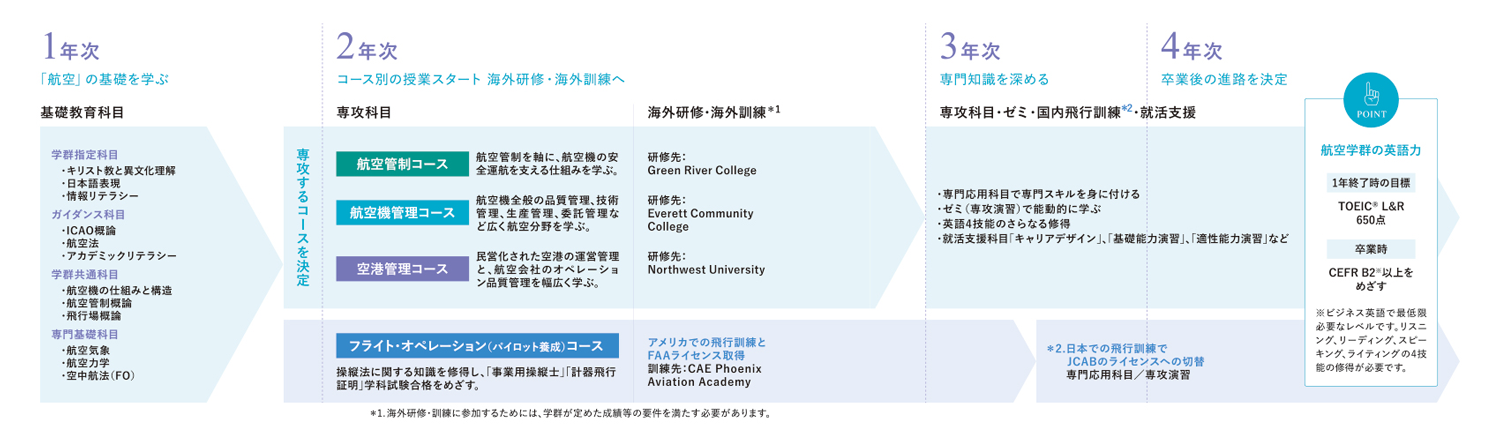
Year 1: Acquire broad foundational knowledge of aviation.
In the first year, students acquire the fundamental knowledge and skills necessary for university studies. Without specializing in a particular course, they acquire a broad range of foundational knowledge that should be studied within the Aviation and Management program. In addition, they cultivate a multifaceted perspective through numerous courses designed to foster a broader viewpoint.
Second year: Course-specific classes begin; overseas training/study abroad program begins.
Students take specialized courses according to their chosen major. Those who achieve a TOEIC® score of 650 or higher will participate in an overseas training program starting in the fall.
You will learn about the tasks necessary for the safe operation of aircraft, primarily focusing on air traffic control.
Training location: Green River College (Seattle, Washington, USA)
You will learn about a wide range of aviation-related fields, including quality control, technical management, production management, and outsourcing management for all aspects of aircraft.
Training location: Everett Community College (Seattle, Washington, USA)
Seminars (specialized workshops) where students investigate and research their areas of interest.
In their third and fourth years, students can take seminars on topics of interest, regardless of their chosen course of study. Through research, presentations, discussions, and extracurricular activities, they cultivate the skills necessary to succeed in society.
Fourth year: Deciding on post-graduation career path
Acquire specialized skills through applied specialized subjects.
Actively learn in seminars (specialized workshops)
Further acquisition of the four English language skills
Job-hunting support courses include "Career Design," "Basic Skills Practice," and "Aptitude Skills Practice."
Learning in each course
Air Traffic Control Course
Aircraft Management Course
Airport Management Course
Flight Operations (Pilot Training) Course
The Air Traffic Control course provides students with knowledge applicable to all aviation-related tasks, from learning air traffic control itself to managing airspace, aircraft operations, and flight conditions. Those aiming to become air traffic controllers must take and pass the "Air Traffic Controller Recruitment Examination" from their third year onward. Upon passing, they enter the Aviation Safety College as national civil servants, undergo training, and are then assigned to various air traffic control facilities. The "Air Traffic Controller Recruitment Examination" is a highly competitive exam, so we provide comprehensive preparation for civil service examinations.
Specialized Applied Subjects
Airport management and operation / Air traffic control and weather / Airport and local community coexistence / Safety Management System / Air traffic control mechanisms / Aptitude training / Airport Law / TRM / Radio facilities and flight paths / Performance and FMS operation training / Airspace management / Future air traffic control systems, etc.
Students will gain a comprehensive understanding of fundamental knowledge across various fields of aviation, including aircraft quality control, technical management, and production management, as well as a broad understanding of airline operations management and ground handling at airports. They will also become familiar with various regulations written in English. Through practical training abroad, they will experience parts of aircraft management operations and acquire a foundation in economics and business administration, as well as a business mindset. They will learn about aviation-related management not only in the maintenance department but also in other areas.
Specialized Applied Subjects
Safety Management Systems / Aircraft and Equipment Maintenance Mechanisms / Aviation Manuals in English / Aviation Business Planning / Reliability Management / Quality Management / Basic Maintenance Operations Exercises / Airport Ground Handling / Practical Aviation Law / Aircraft Design and Engines, etc.
We manage and operate the entire airport, including runways and terminal buildings, at privatized airports such as Narita International Airport and Kansai International Airport, as well as airport management and aviation expertise, along with regional production
Students will learn about the relationship between industry, tourism, and airports, fostering a broad perspective. Furthermore, they will broadly study the latest operational control and airport transportation operations to cultivate individuals aiming for careers in airline operations.
Specialized Applied Subjects
Logistics / Air transport / Transport economics / Transport management / Aviation policy / Airport facilities / Airport management and airport economics / Airport privatization and related laws / Microeconomics / Business statistics and analysis / ICAO detailed explanation of airports, etc.
To cultivate outstanding pilots, we employ a full-boarding system that provides a thorough, individualized instruction environment. Our curriculum emphasizes language and international education, with overseas flight training starting in the fall semester of the second year.
Specialized Applied Subjects
Advanced Flight Operations I-IV / Health Management and Aviation Physiology / Fundamentals of Piloting / Upset Recovery / Aircraft Design and Engines / Introduction to FAA Manuals / FAA Basic Aeronautics I (PPL Course) / FAA Basic Aeronautics II (IR Course) / FAA Basic Aeronautics III (CPL Course) / Practical Piloting I-V / Piloting Techniques and Knowledge / Practical Aviation Meteorology / Safety Awareness Exercises I-II
Year 1: Learn the basics at J. F. Oberlin University 's domestic campus
To become a pilot, who is entrusted with people's lives, it is essential to acquire a rich education, communication skills, and a responsible character. In the first year, students learn the fundamentals of becoming a pilot, as well as cultivate general knowledge, basic academic skills, and a rich sensibility as a member of society.
Develop practical English skills
To acquire the intelligence and culture required of pilots, J. F. Oberlin University leverages its strengths in foreign language education to acquire basic academic skills and offer specialized classes such as Aviation English (Aviation English) and TOEIC®*, aiming to improve English skills to withstand lectures and flight training in Arizona.
Obtain an Aeronautical Radio Operator license
This course provides the foundational knowledge necessary for aspiring pilots. It includes easy-to-understand mathematics and physics lectures, even for students who have primarily studied humanities, as well as comprehensive coverage of fundamental topics such as kinematics, fluid properties, material properties, and electrical and electronic equipment, which form the basis for studying aerodynamics and aircraft systems. Simultaneously, the course aims to help students acquire the "Aeronautical Radio Operator" qualification required for aircraft operation.
Learn the fundamentals of becoming a pilot
You will study more specialized subjects related to flight training, such as aerodynamics, aircraft structure and systems, engines, navigation, meteorology, and aviation regulations. Going forward, you will also acquire knowledge to safely operate increasingly high-tech passenger aircraft. For flight training in Arizona, you will also learn flight training using PC simulators at the domestic campus (Flight Training Center). Regarding English proficiency, native teachers are responsible for achieving a TOEIC®score of 650 or higher, which is a travel requirement, and classes are organized according to achievement level, providing high-quality, detailed support. Additionally, through voluntary online learning and follow-up with peers, we intensively strengthen your English skills and help you achieve your goals.
Second year: During the spring semester, prepare domestically, and from the fall semester onwards, aim to obtain qualifications overseas.
By the spring semester, you will have passed the written exam set by the Ministry of Land, Infrastructure, Transport and Tourism's Civil Aviation Bureau and achieved a TOEIC® score of 650 or higher. In the fall semester, you will finally travel to Arizona. Flight training, including classroom instruction in English, will begin immediately, and you will experience solo flight, an unforgettable moment in your pilot's career.
Spring Semester: Intensive Learning in Preparation for Training in Arizona – Experiencing Flight Training Equipment –
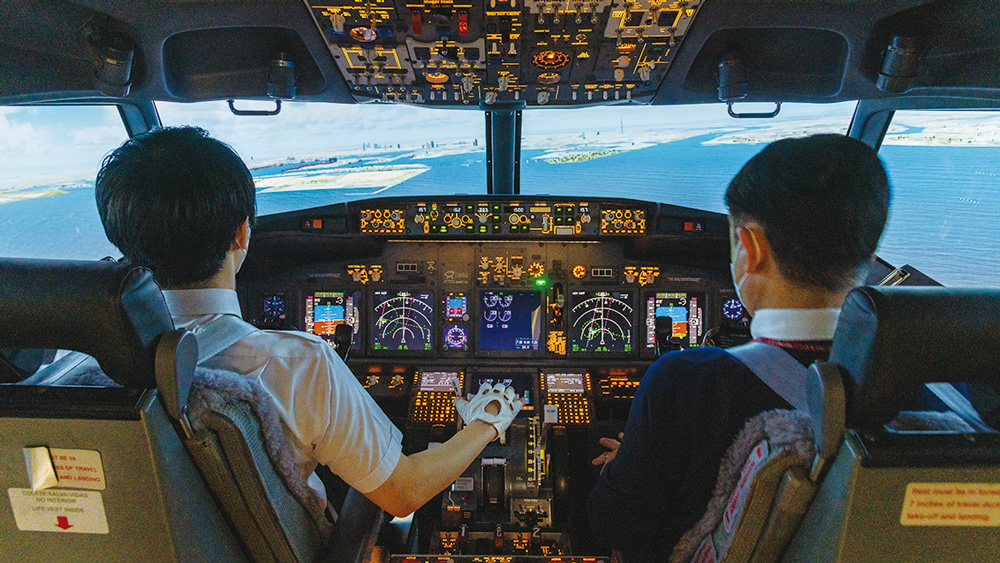
During this period, students aim to pass the written exams for both their "Commercial Pilot License" and "Instrument Rating." Experienced instructors will also support students in improving their English communication and aviation English skills in preparation for their trip to Arizona. Furthermore, flight training using on-campus PC simulators is available. In these classes, students receive one-on-one instruction from instructors, allowing them to resolve any questions they may have and experience flying in a realistic setting.
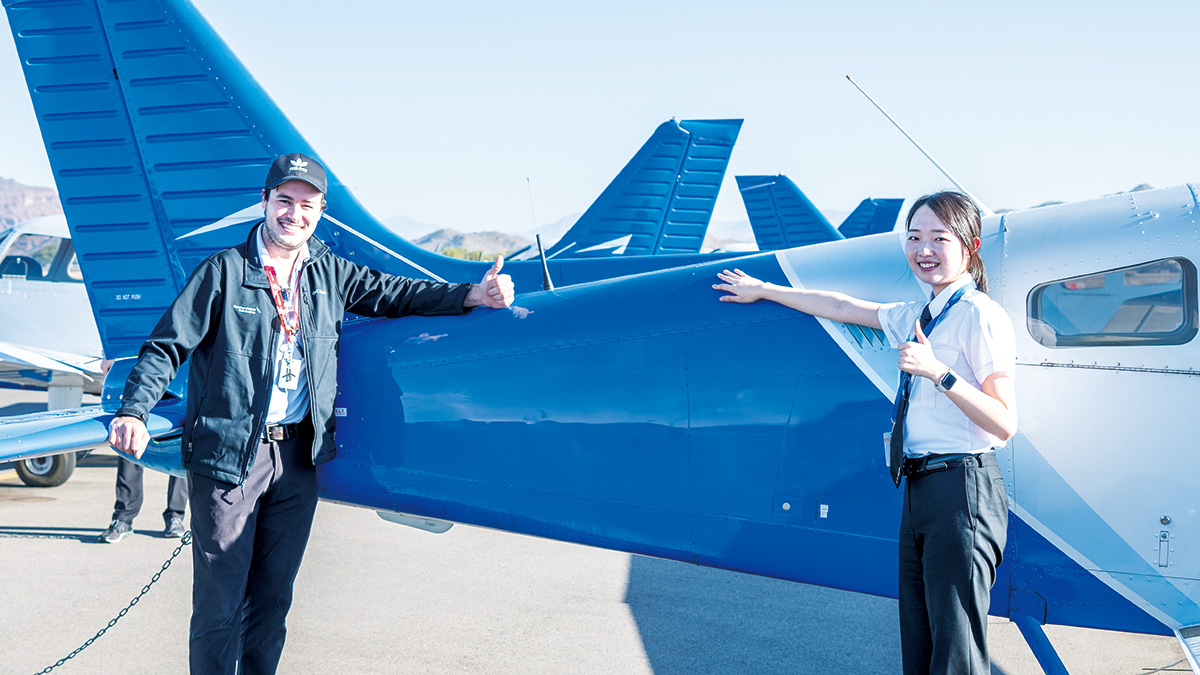
Fall Semester: Training at CAE Phoenix - Aviation Academy, Arizona Flight Training Facility
CAE Phoenix - Aviation Academy located at Falcon Field Airport in Mesa, Arizona, USA, is equipped with modern facilities and equipment, including FTDs, on a vast grounds, providing an efficient training environment. Based on the partnership between CAE and our university, students undergo thorough training as "J. F. Oberlin University Flight Training Center" trainees under the guidance of CAE instructors and our faculty. The first step toward licensing is obtaining the FAA* "Private Pilot" license. Training begins with instructor-accompanied piloting using a single-engine aircraft, then moves on to the first challenging solo flight. This is a time to test the knowledge, skills, and judgment you have acquired so far. Under the strict and careful guidance of instructors, the days began with pilot training and classroom studies for the first solo flight. Spend precious time with your companions and embark on an unforgettable first flight in your lifetime.
Third year: Step up to more advanced and specialized training.
In their third year, students acquire advanced skills and accumulate extensive knowledge to become highly skilled and specialized pilots. Simultaneously, they aim to obtain licenses from the United States and the Japan Civil Aviation Bureau of the Ministry of Land, Infrastructure, Transport and Tourism, developing into personnel capable of operating passenger aircraft.
Aiming for even greater heights as a passenger aircraft pilot.
After obtaining a FAA* Private Pilot License, the goal is to obtain an FAA* Instrument Rating. An Instrument Rating certifies that you can control an aircraft solely by reading information such as speed, altitude, attitude, heading, and current position from instruments, without relying on the outside scenery. This certification is essential for anyone aspiring to become an airline pilot. Therefore, both lectures and practical training become more advanced, developing the ability to accurately control the aircraft by understanding the situation from various information, primarily from instruments, even in adverse conditions such as bad weather or poor visibility. At the same time, training is also provided on the division of roles and responsibilities among pilots in the cockpit, communication methods, and communication with air traffic control.
Earn the mark of a professional pilot
After obtaining an FAA* "Instrument Rating," you will undergo more specialized lectures and flight training to obtain an FAA* "Commercial Pilot" license, which is proof of being a professional pilot. This training requires more advanced knowledge, skills, and judgment, such as responding to changing weather conditions and approaching and departing from airports used by many aircraft.
Mastering multi-engine aircraft operation and making a final push to obtain all necessary qualifications.
In actual air transport operations, multi-engine aircraft are used more frequently than single-engine aircraft. Multi-engine aircraft require a higher level of skill, not only because their systems are more advanced and complex, but also because they fly at higher speeds and involve asymmetrical power operation. You will actually handle these multi-engine aircraft and master the piloting techniques. Then, in order to take flight as a professional pilot in Japan, you will begin training to convert your previously obtained FAA license into a JCAB* "Commercial Pilot Certificate" and "Instrument Rating." Flight training using the DA42FTD (Flight Training Device)* will begin at the domestic campus.
*JCAB (Japan Civil Aviation Bureau): Ministry of Land, Infrastructure, Transport and Tourism *FTD (Flight Training Device): A flight training device equipped with the same control system as an actual aircraft, and displaying a screen with scenery similar to that of a real flight. This course uses the DA42FTD manufactured by Diamond. You can experience simulated flight while staying at our domestic campus, accelerating your skill acquisition.
Fourth year: Aiming to obtain a JCAB license and become a professional pilot.
Based on the J. F. Oberlin University campus, we aim to obtain a JCAB license through domestic training contractors. At the same time, job hunting as a pilot began. At our university, we provide thorough and detailed support all the way to your career path after graduation.
The culmination of four intense years of university life, and the goal of working for an airline.
After returning home, students will return to the J. F. Oberlin University campus to consolidate their learning. Students earn the credits required for graduation and also study the aviation industry as a business to deepen their comprehensive understanding. In the major seminar, students engage in active learning through various proactive activities in collaboration with adjacent courses, understanding resource management, leadership, and followership. Also, B737FTD flight training begins. It is also the time to successfully search for a pilot job by leveraging the knowledge and skills you have acquired about piloting skills, practical English proficiency, and the qualifications you have obtained. At our university, we conduct various job search support activities to help students find jobs that meet their wishes. Please take flight with pride as a valuable talent who will lead the skies of Japan and the world from now on.