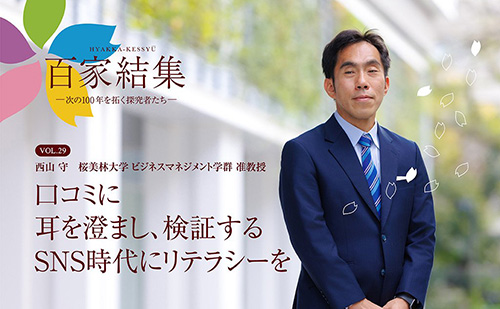
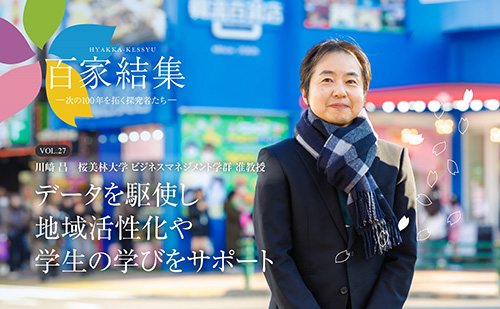
[Collection of Schools of Thought] 29. Mamoru Nishiyama
Faculty and President Dialogue
In the reviews Listen carefully and verify. Media literacy in the age of social media
College of Business Management
Mamoru Nishiyama Associate Professor
Main content
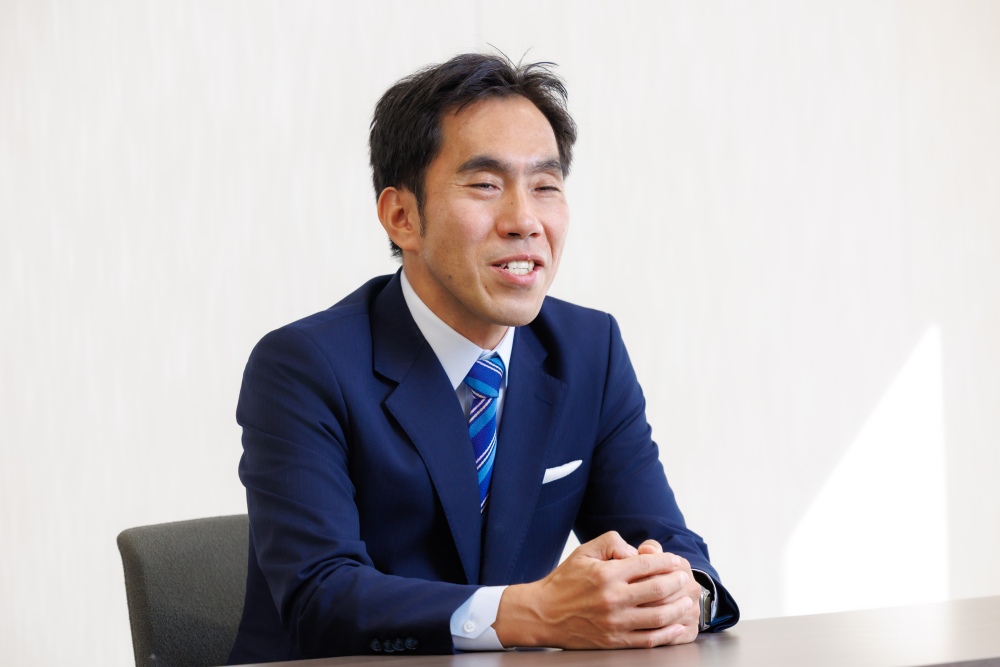
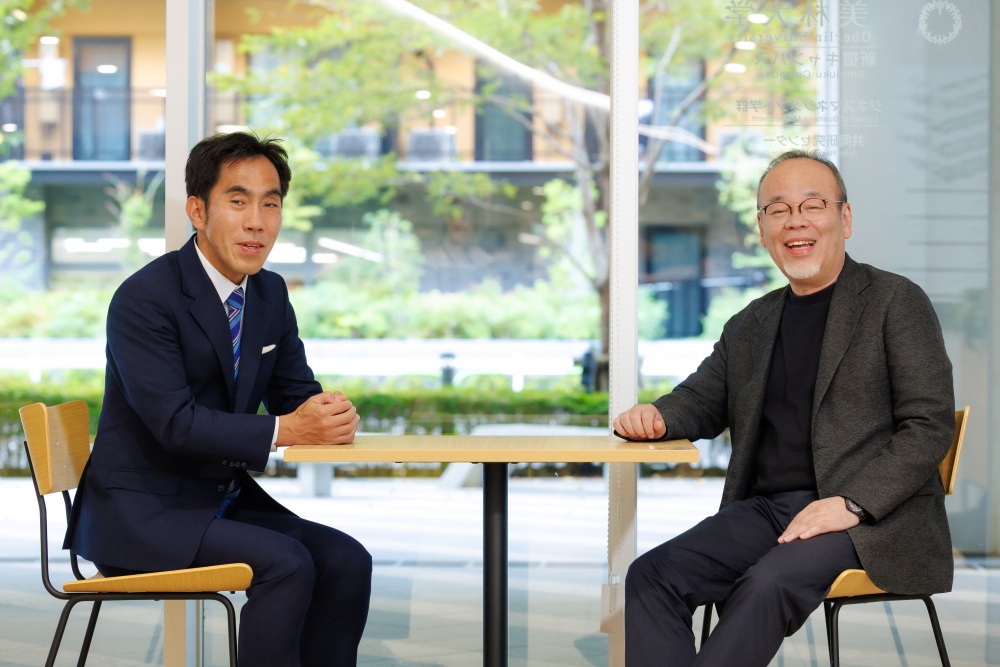
Associate Professor Mamoru Nishiyama, who studied physics in graduate school and has many years of experience in marketing at an advertising agency. In today's society, where "going viral" and "going viral" are a fine line between going viral, what do you want to convey to College of Business Management students? We asked about the origins of communication that he personally values (interviewer: President J. F. Oberlin University Hiroaki Hatayama).
analytical skills cultivated in science and engineering fields Use it in advertising and marketing
Hatayama: Professor Nishiyama, you graduated from the Department of Applied Physics (at the time) in the Faculty of Engineering at Osaka University, and then completed your master's degree at the Graduate School of Science at the University of Tokyo, is that correct?
Nishiyama: Yes. After that, I worked for a major advertising agency for 19 years, and in 2021, I came to J. F. Oberlin University. Originally, I was a science and engineering student aiming to become a researcher, but the path of research was quite narrow and deeply ....... As a result, I started thinking, "I want to communicate widely with the world," and I decided to pursue a career in media and advertising. However, at that time, the advertising industry was not a world where people from science and engineering could fit in. However, as digitalization progressed and social media appeared, society transformed into a place where various types of data could be utilized. It has been about the past 20 years that I have been able to utilize my analytical skills in science and engineering.
Hatayama: What kind of work did you do when you were working at an advertising agency?
Nishiyama: I was involved in developing marketing strategies behind advertisements and paying attention to word-of-mouth on social media. I would research how companies and products were being talked about through word-of-mouth and propose improvements. This was around the time when customers were starting to share information and there was a movement to "listen to their voices." However, instead of simply looking at it, I developed a method to analyze it as data...that might be an exaggeration, but I was researching how to effectively apply the know-how that existed at the time to the world of advertising.
Specifically, we developed a tool to analyze reviews by applying an existing technique called "text mining." It processes reviews using natural language processing, extracts frequently occurring words and characteristic words, and investigates things like how many reviews there were and what their content was. It would be difficult to look at each one individually, but this tool maps them as a whole, giving you an overview of "what topics are being discussed."
Hatayama: When you say word of mouth, do you mean something like, for example, going to a restaurant and saying, "The [dish name] was delicious"?
Nishiyama: That's right. Blogs were the main medium I was researching in the 2000s, but I also looked at review sites specializing in restaurants, cosmetics, and other products. I structurally analyzed how to get an overview of 100 or 1000 reviews.
Hatayama: I've heard that the most important and difficult job in "data science" is to "organize and arrange the data so that it can be used." This is directly related to Professor Nishiyama's "text mining." It's quite pioneering. I think it's an idea that only someone with a science and engineering background could come up with. Did you come up with the logistics (system) yourself?
Nishiyama: We applied various existing qualitative research methods and interview analysis techniques, but it was actually quite challenging. A purely scientific approach wasn't enough; the important thing was how to interpret the results and utilize them in our advertising strategy. That's where art and sensibility became necessary. My scientific background and my desire to "do something different from being a researcher" finally came together.
To communicate First and foremost, it's important to listen to what the other person has to say.
Hatayama: That's a perfect example of the "integration of humanities and sciences" that's being talked about so much these days. By the way, since the internet became widespread, has the way people spend money on promoting products and services changed?
Nishiyama: Things have changed, but the reality is that we still haven't found the rules for it. While social media and internet advertising are increasing, there's still no theory on how much to allocate to traditional mass media and how much to the internet, or how much effect and sales can be expected from the advertising invested.
For example, is there a relationship between the amount of word-of-mouth and product sales? If there is a correlation, it would be great if we could say something like, "If you increase word-of-mouth, product sales will increase," but it's difficult to figure that out. Although, I think that's what makes it interesting.
Hatayama: There's no guarantee that customers will use a product in the way the company intends, and sometimes they use it in unexpected ways, post about it on social media, and it generates a lot of buzz. Are you also tracking such cases, Professor Nishiyama?
Nishiyama: We've been pursuing exactly that kind of thing from a very early stage. When we tell companies, "Actually, this product is being talked about in such an unexpected way," they're surprised and say, "Really?" We use that as a hint to develop various new strategies.
Hatayama: For example, even if J. F. Oberlin University promotes itself as a "global university," some students see it as a "relaxed and good school." The value we offer is not always perceived by society as it is. That's a challenge.
Nishiyama: I've been aware of the gap between the sender and the receiver since coming to this university. From the perspective of "university education," what I'm trying to do is to create classes that students will find "understandable" and "interesting." I think the ideas I've cultivated in the advertising industry and from observing word-of-mouth on social media are useful in this regard.
Hatayama: What exactly is "social listening," which Professor Nishiyama sometimes mentions?
Nishiyama: It's about exploring consumers' feelings and thoughts through word-of-mouth on social media. I believe that true communication is about listening to what the other person has to say and responding to them, but with the advent of social media, it's no longer "one-on-one" communication, but rather we can communicate with many people simultaneously. The idea is to listen to each and every one of those voices and then think about what we should do and what kind of information we should disseminate.
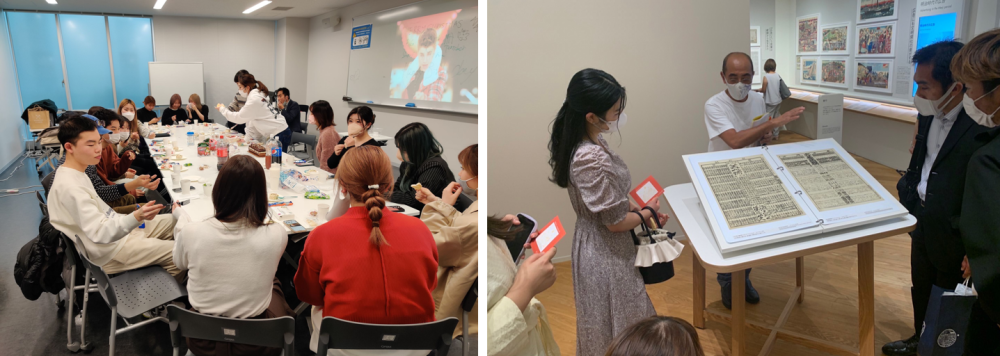
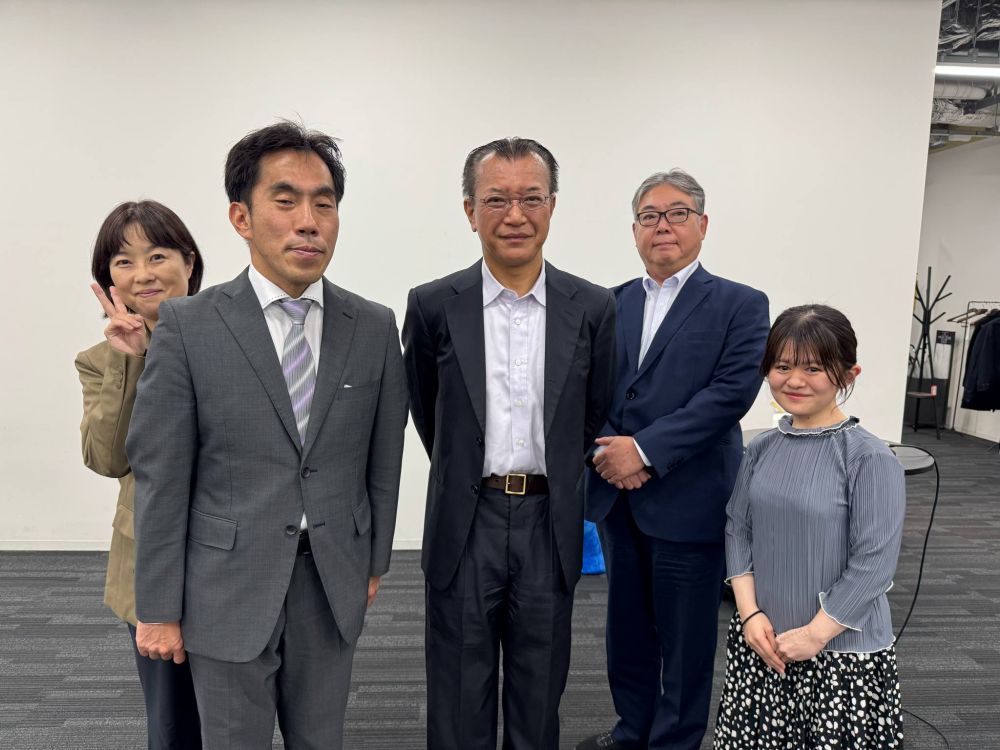
Left: Group work in a seminar Right: Visiting the "Ad Museum Tokyo," which houses historical and contemporary materials related to advertising, with students.
If it goes viral Returning to the fundamentals of communication
Hatayama: Just now that we're talking about social media, in Professor Nishiyama's seminar at College of Business Management, there is content shared together with students, right?
Nishiyama: Yes, TikTok and Instagram. However, the difficult part is that just because a university student is sharing information doesn't necessarily mean it will resonate with high school and university students of the same age. There is definitely know-how to create effective information. I'm using my knowledge and the network I built during my time as a company employee to teach that know-how.
Hatayama: So you're also teaching people "how to make something go viral" and creating buzz? Won't that cause a "controversy"?
Nishiyama: That's right. Dealing with online backlash is a very difficult issue. In the age of social media, if you go in one direction, you'll face backlash, and if you go in another direction, you'll be praised. It's a double-edged sword. When you share information and it stands out, you're bound to get criticized. You have to find a balance to create positive buzz while skillfully avoiding criticism.
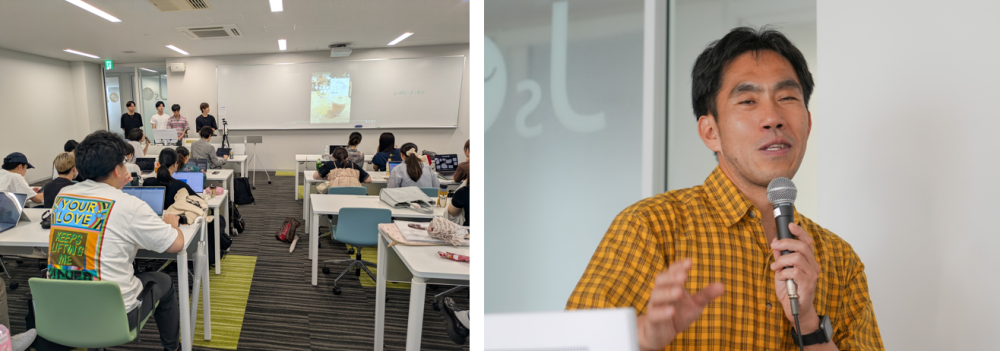
Offering advice to students working on university public relations using social media.
Hatayama: For example, what advice did you give when a company was embroiled in a social media firestorm?
Nishiyama: When something goes viral on social media, people tend to think, "Oh no!" But strictly speaking, it's still about communication between people. We should go back to basics and consider whether we've done anything wrong. We need to reflect on whether we've said anything that a person shouldn't say, and whether it's something that's appropriate to say directly to someone who actually exists in the world. It's not about "taking it down and apologizing immediately if it goes viral," but rather, we should consider whether we've done anything wrong as a person. That's the fundamental point we should be focusing on.
Hatayama: Professor Nishiyama, you currently appear on television as a commentator and write articles for magazines. You have to make comments without any guarantee that viewers and readers will understand the topics you're discussing. I imagine there will be some backlash, so are there any difficulties or tips when it comes to making comments?
Nishiyama: That's where my experience with "social listening" comes in handy. Especially on television, I try to avoid using difficult words. If I don't consider how much my co-stars and viewers understand before I speak, I might be misunderstood or not understood at all. I try to speak without assuming that the other person understands up to a certain point.
For example, while business management experts tend to use terms like "governance" and "compliance," I would rephrase it as "in order to run a company in a sound manner." If I feel that there is insufficient information, I may also add background information on the topic.
My principle is to "avoid criticizing others as much as possible." When I have no choice but to criticize, I do so with evidence and always offer suggestions on "how things can be improved." As a risk management expert, I have handled crisis management, and I always make it a point to add what needs to be done to improve things.
Hatayama: The opinions and comments that are sought are always what we would call "controversial" in English. I think it must be difficult to speak out when you're already biased from the start.
Nishiyama: That's right. On the other hand, I also think that my strength lies in properly delving into controversial areas. "This is the subject of debate, but isn't the essence of it this?" I believe that there is a need for me in topics that are causing a stir in the media and on social media, so I deliberately dig into them.
At a lecture I was invited to give, I reunited with graduates from my seminar and my former bosses and senior colleagues from my time as a company employee.
Learning that is relevant to the times and I want to impart knowledge that will be useful across generations.
Hatayama: How would you ideally cultivate the internet literacy of students who are "SNS natives"?
Nishiyama: The academic world and the trends in public discourse move at different speeds. On social media, all sorts of things are said whose veracity is unknown. If you try to properly verify the truthfulness of these things, it takes time, and by the time you've done so, the trend has already passed. Even in such a situation, I want people to have the skill of "critical thinking," which is the ability to stop and think, "Isn't this wrong?"
Hatayama: J. F. Oberlin University has a class called 'Academic Literacy,' right?
Nishiyama: Yes. It's about building up facts and drawing conclusions from them. If you master that way of thinking, you won't easily believe all sorts of random things that appear on social media. I want you to acquire this skill thoroughly at university.
Today's students are exposed to the vast space of social media, and they never know what might happen or where. They could become either victims or perpetrators. They might not be able to judge the situation correctly, and they might blindly believe the information they receive, leading them to slander and defame others. This is where literacy becomes crucial, and it connects to the academic world as well. Academic inquiry and the ability to correctly understand and appropriately judge phenomena occurring in the world are absolutely interconnected. In this age where anyone can disseminate information, it is essential to have literacy regarding the information we receive and transmit.
However, between remaining silent to avoid backlash and criticism, and carefully expressing oneself despite the potential for criticism, I believe the latter is the correct approach.
Hatayama: What are your future career plans and prospects regarding education and research?
Nishiyama: The world of advertising and marketing moves at a very fast pace. And with the advent of AI, it's changing dramatically again. In my classes, the materials have to be constantly updated or they become outdated, so I have to recreate them every year. I feel it's a lot of work, but if I don't do it, I won't be able to create something that resonates with today's students. One of my challenges is to keep updating myself even as I get older.
One more thing. However, "keeping up with the times" is not the only purpose of university education. It is important that students acquire knowledge that will remain relevant even as times change, as they build their careers over 30 or 40 years after graduation. So, what can students gain from studying at Obirin for four years? I want to reconcile these two seemingly contradictory things and reflect them in our education. It's a grand and not easily resolved issue, but that's what I'm thinking about.
*The service names and product names mentioned in this content are trademarks or registered trademarks of their respective companies.
J. F. Oberlin University College of Business Management Associate Professor
Mamoru Nishiyama
Born in Tottori Prefecture in 1971. After graduating from the Department of Applied Physics, Faculty of Engineering, Osaka University, completed the master's program in physics at the Graduate School of Science, University of Tokyo. From April 1998, worked for a major advertising company for 19 years, engaging in research, marketing, and PR work. Regarding social listening Area within SNS marketing, he has been involved in developing analytical methods and strategy frameworks since its early days, specializing in strategic PR and data analysis as well Area. After leaving the company, he became an independent marketing consultant, engaged in planning and implementing advertising and marketing strategies for numerous major companies. Has held his current position since April 2021. He has received the New Wave Award at the Toyo Keizai Online Award 2023 and MVP at the Toyo Keizai Online Award 2025, and has appeared in numerous media outlets. His books include the sole author 'How to Create a Mechanism That Generates Buzz' (Senden Kaigi) and co-authored 'Word-of-Mouth Utilization Marketing That Won't Lose to Controversy' (Sairyusha), among others.
Text: Naoki Kaga, Photos: Takuma Imamura
Interview date: *This interview was conducted in October 2025.