Using data Regional revitalization and Supporting student learning
College of Business Management
Sho Kawasaki Associate Professor
Main content
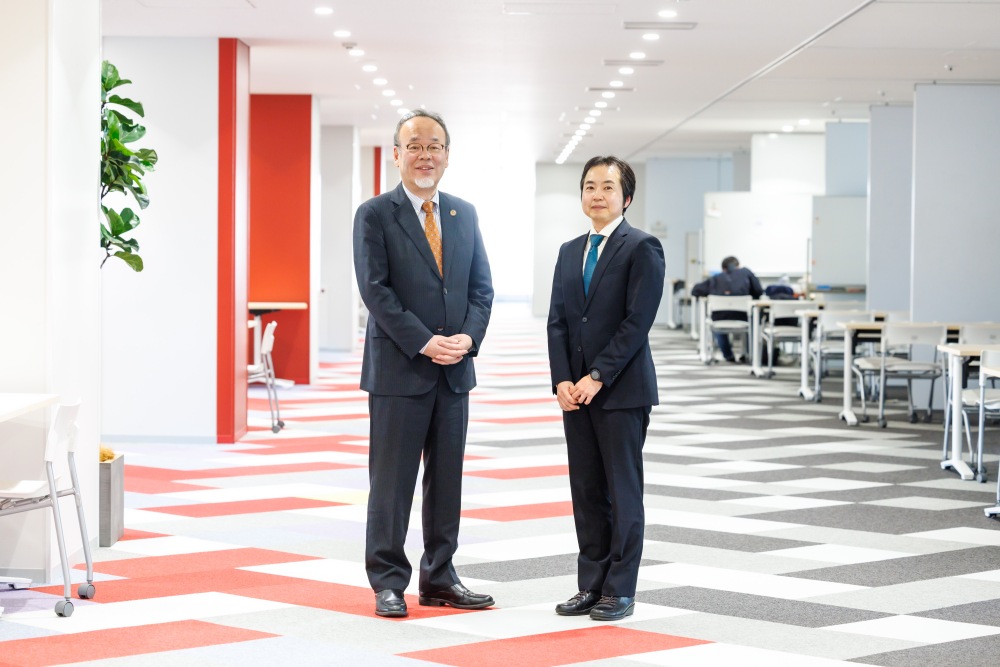
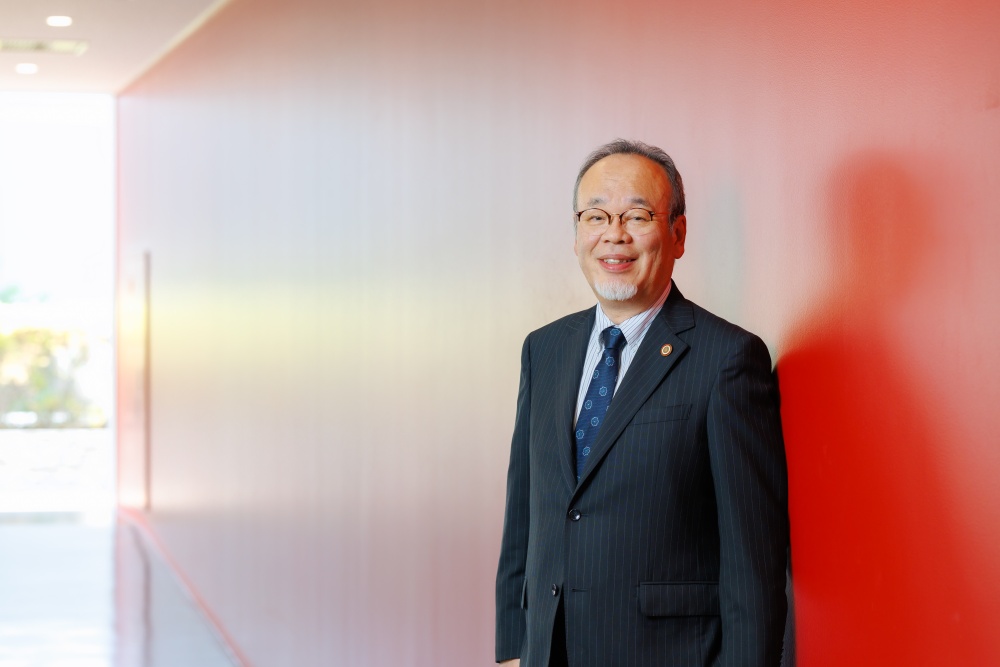
Associate Professor Sho Kawasaki, who worked in marketing research and conducted business administration research as a working student, began teaching at J. F. Oberlin University College of Business Management. We asked about efforts to revitalize communities and support student learning by utilizing data, as well as the "career integration" that led to this (interviewer: President J. F. Oberlin University Hiroaki Hatayama).
"I don't want to work for a big company." "I want to be independent by the time I'm 30." With that in mind, I went to a market research company.
Hatayama: Professor Kawasaki has experience working as a sole proprietor and at a company, attended graduate school, completed his doctoral program, and is now in J. F. Oberlin University. Originally, you were from Nagasaki, right?
Kawasaki: Yes. I lived on an outlying island in Nagasaki until I graduated from high school. It's a place with beautiful seas and delicious fish.
Hatayama: What led you to study sociology at a university in Yamanashi Prefecture, which is far away from there?
Kawasaki: I wanted to deepen my studies in social psychology. At the time, psychology and human relations were popular subjects, but I was more interested in the relationships between multiple people and the workings of groups and organizations than in approaching individual psychology. So, my high school teacher researched universities that met my criteria and recommended one to me, which was the starting point.
Social psychology deals with things like the psychology of people who hoarded toilet paper when it became scarce during the oil crisis. More recently, there was the hoarding of masks during the COVID-19 pandemic, and rice during the rice shortage. Also, even the same person can adapt or not adapt, thrive or fail depending on the environment. I found those kinds of things interesting.
Hatayama: I see. You mainly studied social psychology, but what kind of job did you end up doing after graduation?
Kawasaki: When I thought about how I wanted to live my life, I thought, "I don't want to work for a big company." I couldn't picture myself working in a formal suit at all. My family home in Nagasaki was a liquor store, so I was not familiar with the salaried worker lifestyle. I decided to become independent when I turned 30, and before that, I thought I should acquire some skills, so I joined a market research company for small and medium-sized enterprises.
After becoming a working student "Integrating careers" and becoming a university professor
Hatayama: So, your idea of "starting a business" or "creating a company" came from your family's influence, right? What kind of work did you do in market research?
Kawasaki: I mainly worked on market research for pharmaceuticals and other products, commissioned by manufacturers. I would receive requests from pharmaceutical companies to conduct questionnaires and interviews with doctors about new drugs. Without revealing the name of the pharmaceutical company, I would interview them about things like, "What do you think about this drug?" and "How many patients could potentially be prescribed this drug right now?" and then compile the results into a report and give a presentation.
Hatayama: That's exactly what marketing research is. The internet wasn't widespread back then, so it must have been very difficult.
Kawasaki: I remember rushing out to buy a personal computer in 1995, the year I joined the company, when Windows 95 (*) was released. I thought, "I have to learn this quickly!" Personal computers also became widespread in the company, and email addresses started to be included on business cards.
Hatayama: So, it was a time when the marketing environment changed drastically. What kind of work did you do after that?
Kawasaki: When I thought about what I wanted to do, I thought, "Yes, I want to do work that energizes people working in small and medium-sized enterprises." However, it seemed difficult to do it on my own. Around that time, "EAP (Employee Assistance Program)" was introduced to Japan from the United States, and companies that provide EAP were established. They provide services such as counseling and stress management to employees and families of contracted companies. After obtaining several qualifications and working for one of those companies, I became independent.
Hatayama: I see. And then another major turning point came when you decided to go to graduate school. What was the reason for that?
Kawasaki: When I was around 40 years old, I volunteered to participate in a clinical trial for medical research. Gradually, I began to want to deepen my own research, so I asked my professor in charge, and he advised me to go to graduate school. To study under that professor, I needed a master's degree, and he said it didn't have to be in the medical field, so I decided to study business administration, which I was interested in.
I continued working because I needed to cover my tuition fees, but it was around the time of the Lehman Shock, and it was tough being an unstable self-employed person. Luckily, one of my clients was setting up a human resources department, and they asked me to join them, so I started working there.
Due to various circumstances, I initially couldn't study under the professor who recommended me for graduate school, but a professor who helped me in my master's program recommended that I move on to a doctoral program, and I thought, 'Maybe I'll give it a try.' Alongside my research in management data analysis, I continued working and spent my days supporting tasks such as organizational HR consulting, research, and data management. Later, when my professor in the doctoral program recommended me to start looking for university faculty positions, I saw a J. F. Oberlin University open recruitment and decided to give it a try. It's a new path starting in my late 40s, but I believe it's not a career change, but rather a 'career integration' that leverages my experience.
Hatayama: That's where J. F. Oberlin University! You appeared at the perfect timing (laughs). Currently, you mainly teach in the field of data science.
Kawasaki: In terms of required courses like orientation, I teach an introductory statistics course called "Data Science," which is taught to 130 to 150 first-year students. I also teach practical courses such as "Management Research Workshop" and "Business Workshop (DX)."
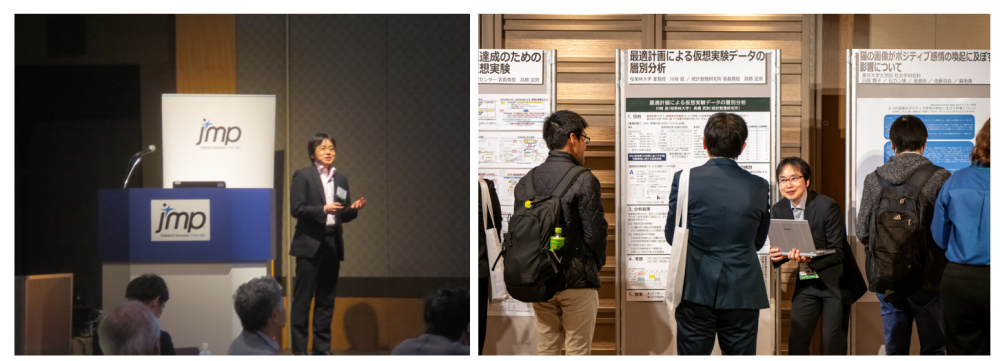
At the Discovery Summit Japan for the statistical analysis software JMP® (SAS Institute Inc., Cary, NC, USA), research results are presented annually (left: oral presentation in 2016, right: poster presentation in 2023).
While utilizing data We are developing projects that contribute to the local community.
Hatayama: Among the projects underway at this Shinjuku campus, Professor Kawasaki is also working on a collaborative project with the Shin-Okubo shopping district, right? What exactly does that entail?
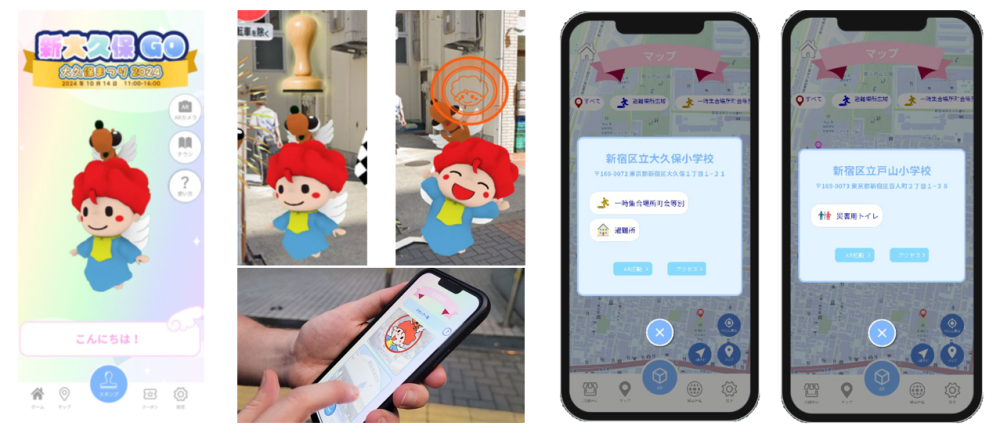
Kawasaki: We use a fixed-point camera in front of JR Shin-Okubo Station to collect data on the number of people getting on and off the station, and we analyze it for things like correlations with the weather and relationships with the sales of cooperating stores. If there is a causal relationship, we conduct analyses with the students to determine things like, "If this many people come, we can predict this much in sales." The data also includes predictions of gender and age, so we hope to use this to contribute to the community. We are also working on developing an original AR (augmented reality) app for the shopping street, and we are developing practical learning in collaboration with the community and businesses.
An image of the display of the original AR app for Shin-Okubo Shopping Street, developed in collaboration with local businesses. It features a stamp rally function where users can collect characters by holding their smartphones over each spot, as well as a disaster map function. *The AR app uses the angel character of Shin-Okubo Shopping Street. *The app image is quoted from materials created by the development partner company, Premium Arts Co., Ltd.
Hatayama: And you're also working on a project to visualize students' learning and use that information to support them, right?
Kawasaki: This is a project that utilizes the learning portfolio of the Learning Support System. When I joined J. F. Oberlin University in 2020, the project was being launched mainly by the then head of the school district. We visualize students' learning data and enable predictable grades. Once every six months, for example, in the fall semester, we use data such as spring semester grades, activity levels on campus, attendance and absence, and data up to the second month of the fall semester to predict the end of the fall semester and feed it back into the students' portfolios. By saying, "If things continue like this, your grades will be about this level at the end of the semester," students will think, "This is bad!" and then focus on their studies for the rest of the period. When I talk about the prediction system in class, students listen with interest.
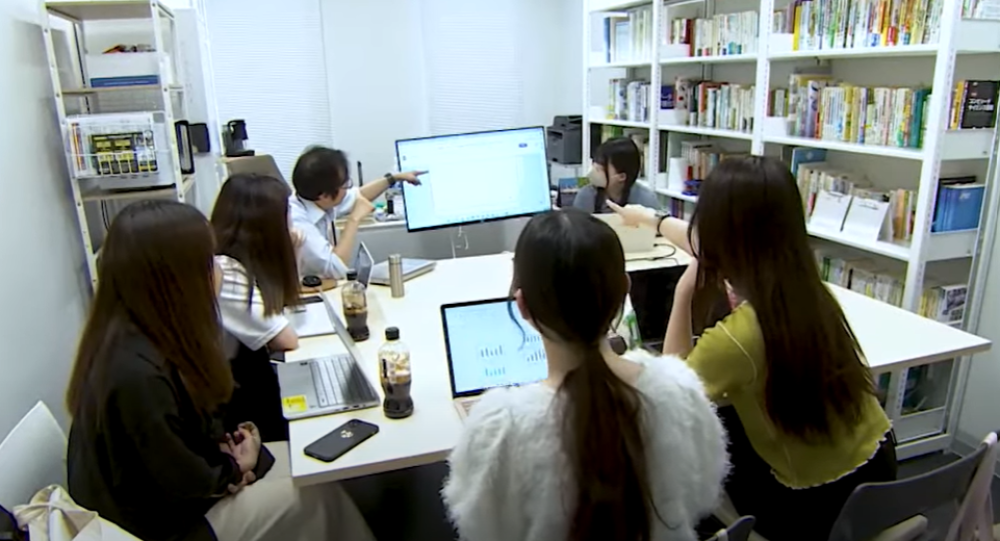
Scenes from a seminar in the research lab
Hatayama: So, what is your vision for the future?
Kawasaki: I've always thought, 'Someday, in places where universities aren't nearby, we can create a place where young people and people living in the area can experience higher education,' and someday, I want to take on such challenges. Right now, I'm working hard at J. F. Oberlin University College of Business Management, focusing on classes and research, but recently I've also been paying attention to the newly established 'College of Education and Social Transformation' on campus, and my interests have expanded significantly.
Hatayama: I believe that creating a system where high-quality education is available to everyone, regardless of location, is not just a "survival strategy" for universities, but a "responsibility" for them. Listening to you, Professor Kawasaki, you seem like a truly kind person. You always keep an eye on struggling business owners in small and medium-sized enterprises, people waiting to be saved by clinical trials, and people who happen to be born in areas without schools—you are a truly valuable person. At the same time, I was impressed by how you have pursued your research career, seemingly guided by the connections you've made with those around you.
Kawasaki: I think there might be some truth to the idea of being "guided." I truly feel I have to be grateful.
#Proviso
*Windows 95 is a registered trademark of Microsoft Corp. in the United States and other countries.
J. F. Oberlin University College of Business Management Associate Professor
Sho Kawasaki
Graduated from the Department of Sociology, Faculty of Letters, Tsuru University in 1995. Completed the master's program in Business Administration at Mejiro University Graduate School of Business Administration in 2013. Completed the doctoral program at the same university in 2017. 1995~2003: After working at a marketing research-related company, established a limited company (representative). 2003~2012: After working at an EAP-related company, established a general incorporated association (representative). 2011~2023: Executive Officer in Organizational Human Resources at an EC-related business company. Co-established 'FREELY LLC' as an organizational HR and research analysis consultant. 2020~2023: J. F. Oberlin University College of Business Management Specially Appointed Lecturer. Current position since April 2023
Text: Naoki Kaga, Photos: Takuma Imamura
Interview date: *This interview was conducted in December 2024.