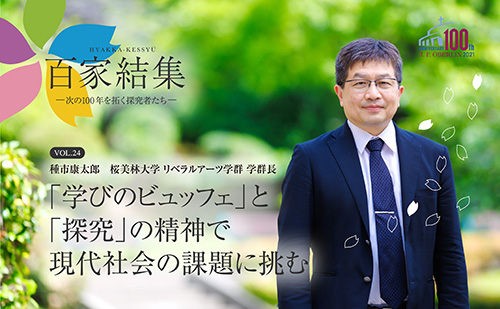
[Collection of Schools of Thought] 24. Taneichi Kotaro
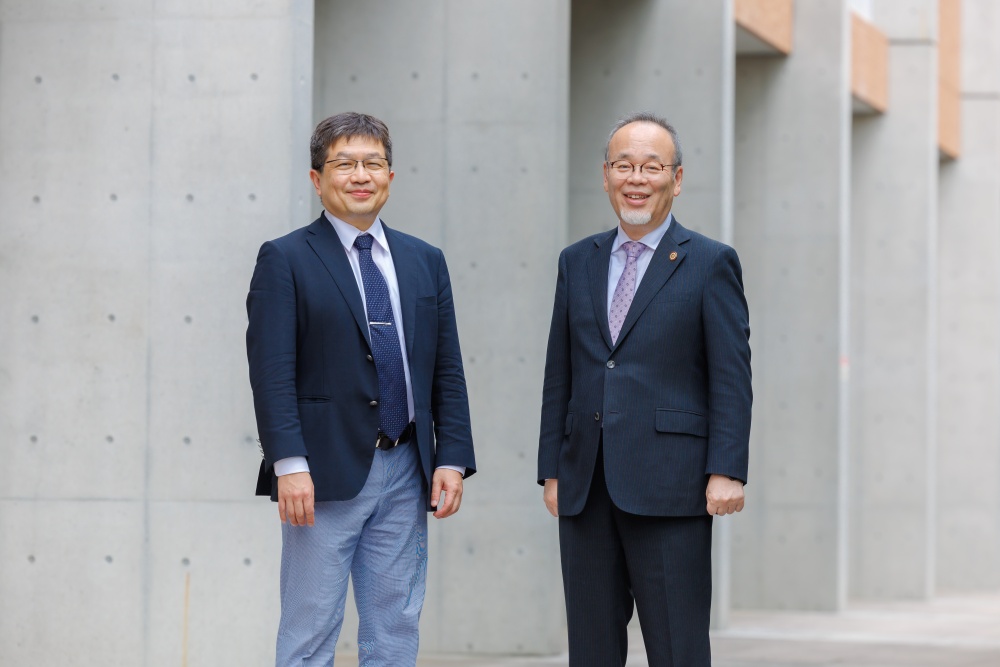
Faculty and President Dialogue
"Learning Buffet" and With a spirit of inquiry Tackling the challenges of modern society
College of Arts and Sciences
Taneichi Kotaro Professor
Main content
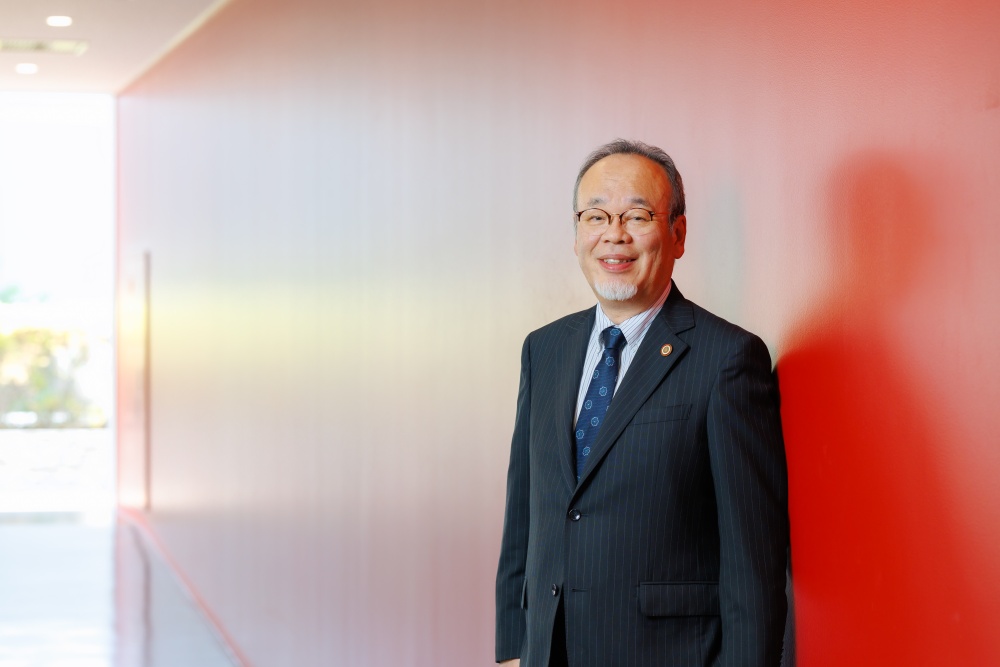
Professor Taneichi Kotaro has been appointed as the head of the university's largest College of Arts and Sciences. He talks about a dynamic program described as a "buffet of learning," the spirit of "inquiry" at its core, and his research field of "workplace mental health" (Interviewer: President J. F. Oberlin University Hiroaki Hatayama).
I have been involved in psychological support for working people since my graduate school days, and I also give 50 lectures a year.
Hatayama: The Liberal Arts (LA) program aims to deepen expertise in each field while simultaneously exposing students to a wide range of disciplines and fostering interdisciplinary thinking. Professor Taneichi assumed the position of Dean of the program this spring. His specialty is psychology, but what led him to pursue this path?
Taneichi: When I was in high school, I started making short films with my friends, and that made me want to work in theater and film production. I aimed for Waseda University, where those activities were thriving. However, during my year of studying for the entrance exams, I began to worry that I wasn't really suited to the arts, so I consulted with a staff member at the cram school I was attending. I learned that this person was studying psychology and working in counseling, and I thought I'd like to pursue that myself. I still loved being exposed to the arts, so after entering university, I mainly watched plays in the tent huts on campus and also dedicated myself to rugby club activities.
Hatayama: Currently, Professor Taneichi gives lectures about 50 times a year, and is in demand all over Japan. He has also written many books on mental health. I imagine he leads a very busy life.
Taneichi: My specialty is "workplace mental health," and I research stress and mental health among workers, as well as providing psychological support in industrial settings. Cases of employees taking leave or resigning due to workplace stress are all too common. I am involved in training and consulting to prevent and address these issues, and I also have opportunities to conduct training for employees of companies and government agencies.
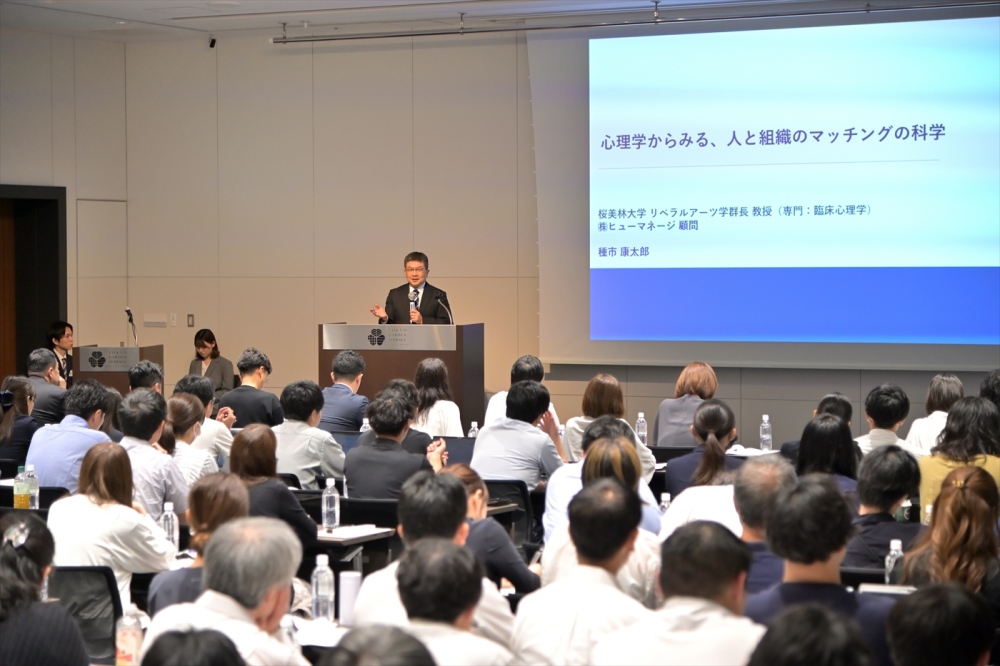
A presentation at a seminar for HR professionals.
My undergraduate and graduate school mentors were in charge of counseling at two locations: a research institute for an automobile manufacturer and a construction company. I initially began my research activities by apprenticing under them. My research involved quite practical activities such as interviewing employees, providing counseling, and conducting stress surveys. I engaged in this work for about eight years, from immediately after entering graduate school until I finished my term as a university assistant. After that, I worked in a medical institution providing return-to-work support while also teaching at Seitoku University.
Hatayama: What kinds of requests do you receive most often from external organizations and companies?
Taneichi: We receive many requests for "training for managers" and "something to be done about the managers who engage in harassment." During the 2011 Great East Japan Earthquake, I traveled around the four prefectures of Tohoku and was involved in supporting businesses. In many cases, people who were working there, no matter how much damage they had suffered from the earthquake, would come to work and endure it without saying anything. The challenge was how to approach that situation.
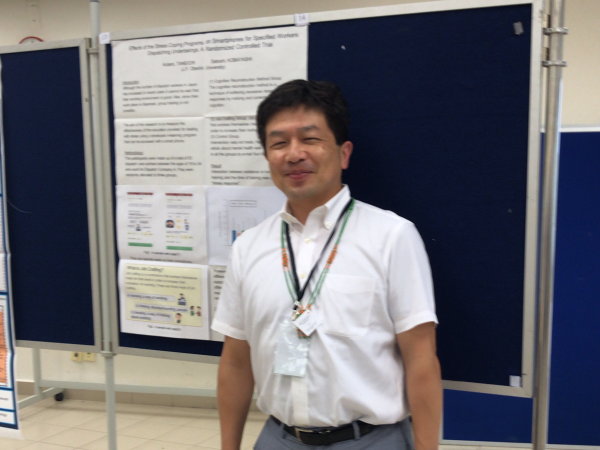
Left: Poster presentation at an international conference held in Malaysia
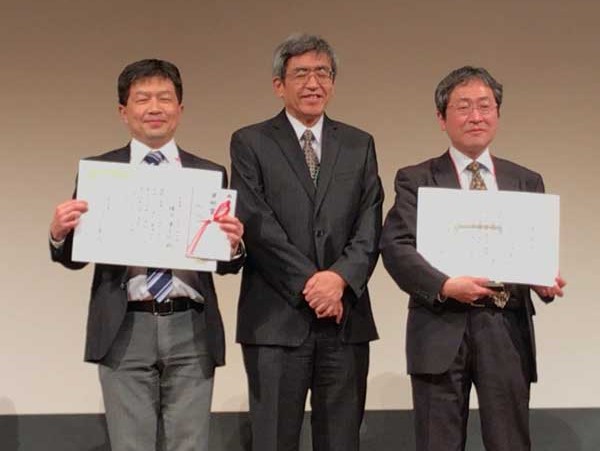
Right: At the 27th Annual Meeting of the Japan Society for Industrial Stress, awarded the Encouragement Award in recognition of outstanding achievements in research and practice of industrial stress Area and contributions to the society's development (photo left).
Learning College of Arts and Sciences through trial and error and tasting
Hatayama: You maintain an academic track while always maintaining connections with the outside world. And at J. F. Oberlin University, you have been teaching since 2008. The LA School Complex currently has about 4,000 students, the largest number on campus.
Taneichi: Since I meet with each student individually on a daily basis, it's difficult to really grasp the scale of the organization, but liberal arts is like a living organism, so I want to keep changing the shape of the academic group in a positive way. Because there are so many people, there are many different ways of thinking, so I want to move forward while bringing together everyone's opinions. Up until now, I've been conducting management training as an instructor, but now that I'm in charge as the head of the academic group, I feel like everything I said in the training is coming back to me (laughs).
Hatayama: I can relate to that point. Professor Taneichi described the LA group as a "buffet of learning." I think that's a wonderful way to put it, could you tell me more about it?
Taneichi: Generally, faculties and departments are like "specialty restaurants"—you can enjoy one category of cuisine, but it's hard to try other dishes. In contrast, the LA School of J. F. Oberlin University offers 4 Area 30 programs, and if you compare it to a restaurant, you could call it a "buffet" style with a variety of menu items.
You can choose several things that interest you, try them out, and decide on your major and minor later (in the fall semester of your second year). This is called "late specialization," and its greatest appeal is the freedom to experiment and "go back and forth" in your learning.
Hatayama: What kind of guidance do you provide to first-year students?
Taneichi: I'm urging students to take a step forward with curiosity, even towards things they haven't tackled or known about before. Even for students who already know which field they want to study, I tell them that it's important to think from multiple perspectives, rather than just looking in one direction. I often use the example of "how to cut a watermelon." When you cut a watermelon, most people cut it vertically, but if you cut it horizontally, the way you see the seeds is different, right? Actually, if you cut it horizontally and then cut along the seeds, the seeds are clustered in one place, making them easier to remove.
Hatayama: I see, so it's about "trying a different approach."
Taneichi: Instead of thinking only in the direction you believe in, by changing your perspective, what emerges is quite different. By taking minor courses in a field different from what you want to do, your learning expands. At LA School School, you can find the learning that suits you from over 1,000 subjects in Humanities Area, Social Area, Natural Area, and Integrated Area. There are as many as 610 combinations of major and minor keys.
Hatayama: There are other universities that advocate liberal arts, but our LA (Learning and Learning) program is on a different scale. It's like setting sail into the vast ocean of learning. The image is of faculty and students communicating with each other, adjusting which direction to set sail, and combining different learning experiences.
I hear that many students in the LA (Learning and Assistance) program are also engaged in "service learning," where they apply their learning to contribute to society by putting it into practice within the local community.
Taneichi: For example, some students have visited child support facilities near Machida in Tokyo, where our campus is located, and come back having realized the gap between what they learned in their classrooms and the reality of providing support. We often see students growing through their interactions with people on the ground. It's deeply moving to see students who were shy in their first year now behaving like working adults and talking to younger students.
Combining multiple Area and programs to address social issues
Hatayama: That's truly wonderful. By the way, among the four Area of the LA School of Economics I mentioned earlier, there was an "Integrated Area." What kind of program does it specifically consist of?
Taneichi: Integrated Area encompasses 13 programs. This program aims to study fields that are currently facing social challenges such as "environmental studies," "regional design," and "multicultural coexistence," combining it with other programs in humanities, social sciences, and nature Area to create new things. For example, "environmental studies" can be considered not only from the natural perspective but also from ethics, philosophy, economics, politics, and other perspectives. The SDGs, which have been attracting attention in recent years, are also issues that require consideration from multiple fields.
Hatayama: So, you tackle challenges from multiple fields based on a theme or topic. In high schools, "Inquiry-Based Learning" classes began in the 2022 academic year, and the high school students who have been working on these classes are now approaching the time when they will be going on to university.
Taneichi: In the LA (Learning and Service Learning) program, first-year students take an introductory course on service learning, which involves going out into the community to learn. In their third year, students choose to either pursue their own research topic while enrolled in a specialized seminar, or take a course called "Inquiry-Based Service Learning," deepening their proactive learning. I have been involved in the creation of the current curriculum for about seven years. As times change, we will continue to maintain the foundational academic fields while considering what is needed next and what society demands, and we will also consider creating new programs.
Hatayama: With Professor Taneichi's leadership, the LA group will undoubtedly undergo significant changes in the future. Could you tell us about your recent research activities?
Taneichi: Amidst the changes in working styles due to the COVID-19 pandemic, I've been researching the mental health of people working remotely. What I've found is that, in the relationship between superiors and subordinates, people working remotely are more susceptible to the "negative influence" of their superiors. For example, I've found that if a superior is not good at communication, the subordinate's motivation decreases more than in cases where they work face-to-face. People working remotely have to be more careful in imagining the feelings of others. That's what the research has shown.
Hatayama: I also need to be extra careful when I'm having online meetings.
Left: Co-edited book "Competencies for Industrial Psychologists: Practical and Professional Methods for Acquiring and Enhancing Them" (Kawashima Shoten), which explains the knowledge, skills, and attitudes required of psychology professionals who support the mental health of working people.
Right: Co-authored book "Introduction to Job Crafting for HR Professionals" (Kobundo), which proposes human resource management methods that enhance the happiness of individuals and organizations and promote growth.
Taneichi: Another theme is how people in their 50s and 60s can stay motivated to work. With the extension of the retirement age and the resulting increase in the number of people working longer, it is said that many people lose their motivation. However, on the other hand, there is a phenomenon called the "aging paradox," in which, despite a decline in physical function and other abilities in old age, feelings of happiness do not tend to decline. I am interested in what these contradictory examples indicate, and whether there are individual differences.
Hatayama: I'm very interested in that too, so I'm looking forward to your research results. Please write the book soon (laughs). I'm looking forward to it, along with the future of the LA School.
J. F. Oberlin University College of Arts and Sciences Student Council Head
Taneichi Kotaro
In 1994, he graduated from the Department of Psychology, Department of Philosophy, School of Humanities and Sciences, Waseda University, Major. In 1997, he completed the master's program in psychology at the Graduate School of Letters, Akio University. In 2001, he completed all credits for the doctoral program at the same university but withdrew before obtaining the required credits. PhD (Literature). 2001~2002: Assistant at the Faculty of Letters, Waseda University. 2002~2006: Lecturer in the Department of Psychology, Faculty of Humanities, Seitoku University. From 2006 to 2008, he served as associate professor and associate professor at the same university. 2008~2016, Associate Professor at J. F. Oberlin University College of Arts and Sciences. 2016~, Professor at the same university. 2015~, Visiting Researcher at the Mental Health Research Institute, National Center for Neurology and Psychiatry, Stress and Disaster Information Support Center. 2018~2024, Head of J. F. Oberlin University College of Arts and Sciences Area (Humanities). Has held his current position since April 2024. Certified psychologist, clinical psychologist, mental health social worker, and career consultant qualifications