[Collection of Schools of Thought] 23. Enmin Li Mr. -Alumni and Student Interviews
Faculty and President Dialogue
Multilingual education and learning that acknowledges differences Improve your communication skills
College of Global Communication
Enmin Li Professor
Main content
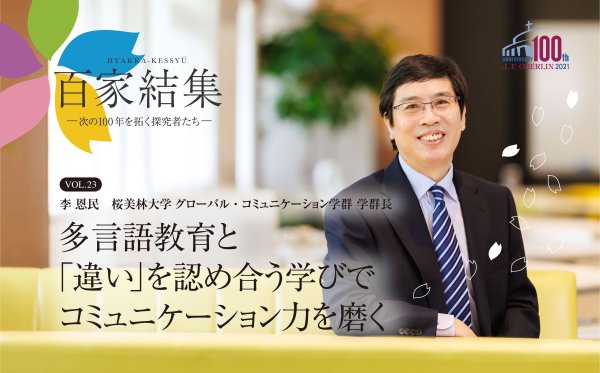
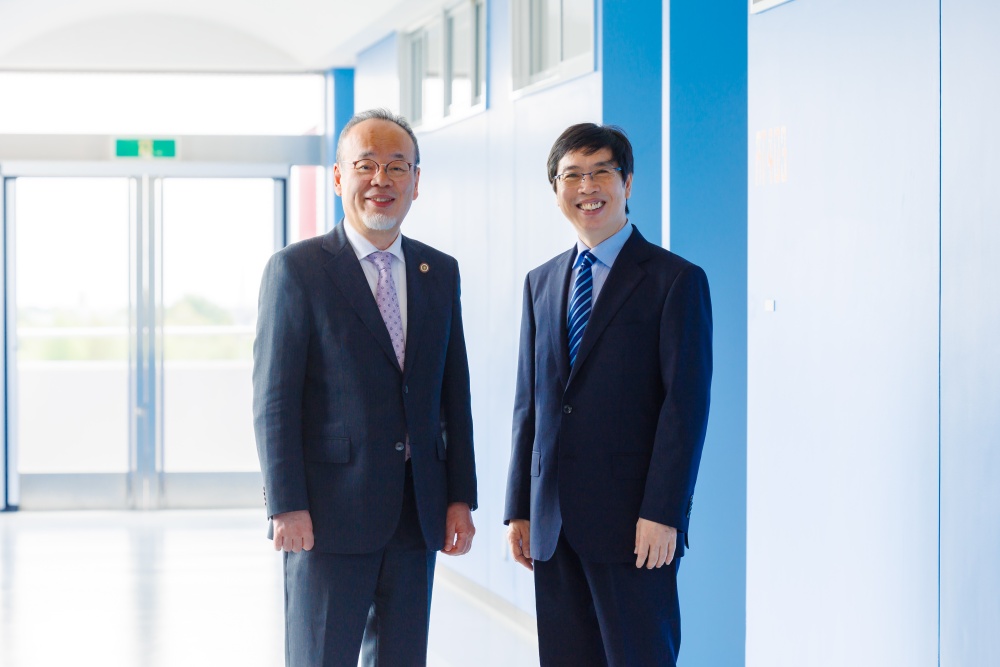
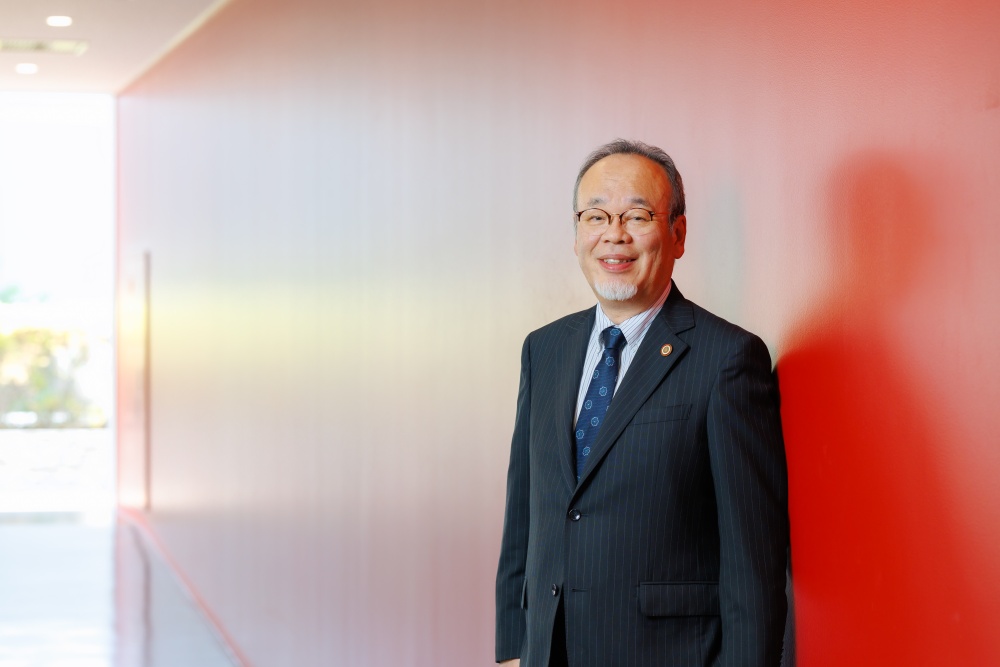
With the motto "Recognizing each other's perspectives and differences," Professor Enmin Li leads the College of Global Communication where multinational students study. I myself once came to Japan after being shocked by the differences in historical perceptions between Japan and China. We will delve into the prospects for expanding educational programs for foreigners, including trilingual education, and the commitment to historic reconciliation in East Asia (Interviewer: President J. F. Oberlin University Hiroaki Hatayama).
Thorough language education and learning through extensive discussions
Hatayama: Professor Lee, you were appointed Dean of the Global Communication (GC) School in the spring of 2024. I understand that the GC School offers many opportunities for presentations and discussions.
Li: Yes. J. F. Oberlin University Among the seven academic clusters, there are clearly many of them, and I think that's their biggest feature. Both students and faculty understand this as a culture, and there is a shared consensus. Classes are not only held in classrooms but also include fieldwork. Students present their learning and research processes and their results in a foreign language presentation. Based on this, group discussions are held, with comments from students and faculty from diverse backgrounds to deepen understanding.
Hatayama: Many of the students come from diverse cultural backgrounds. What challenges do you face in terms of discussion?
Li: For example, when I cover US-China relations in my classes, and we have discussions about the "South China Sea issue," there are differences in the viewpoints of students from China, Japan, Taiwan, Vietnam, and Mongolia. Chinese students basically express their opinions based on information they receive from the Chinese government, so naturally, there is resistance from students from other countries. However, we deepen our understanding through discussion. The important point is not to ask us to "reach a common conclusion," but to "acknowledge the differences in each other's viewpoints and positions." I think this is exactly the kind of learning that is characteristic of the "Global Communication" program.
Hatayama: What you just said reminds me of the episode when Professor Li decided to study in Japan. When he was pursuing his doctoral studies while working as a full-time lecturer at Nankai University in Tianjin, China, some Japanese students who attended his classes told him, "Professor, you have prejudices against Japan. You should try to understand Japan."
Li: It was a huge shock for me. The theme of the class was "The Diplomatic History of Modern China." The Chinese interpretation is that it is a history of Western countries' aggression against China, and based on the education I had received, I had a critical view of Japan as well. However, a Japanese exchange student told me, "Lu Xun and Premier Zhou Enlai, who graduated from Nankai University, also studied and grew up in Japan. Even during the Sino-Japanese War, there was private cultural exchange. You don't have an opinion on that, do you?" That prompted me to think that I needed to understand Japan, so I applied to become a Japanese government-sponsored student and was accepted. After receiving intensive Japanese language training at Northeast Normal University in Changchun, China, I came to Japan in October 1992.
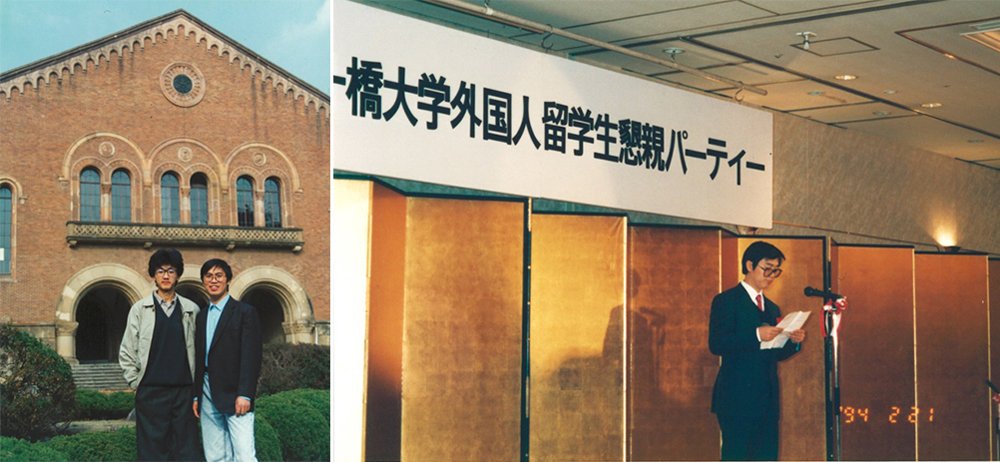
With a friend in front of the Kanematsu Auditorium at Hitotsubashi University, where I was studying abroad (November 1992) = left photo. Giving a speech as a representative of international students at a social gathering for international students (February 1994) = right photo.
Hatayama: It's very meaningful that students from Japan, China, Taiwan, and other countries participate in discussions in Professor Lee's classes. Also, the GC group places a great deal of emphasis on foreign language proficiency, right?
Lee: Language education in the GC group thoroughly studies the languages chosen at the time of application (English, Chinese, Japanese) from the first year. "English track," "Chinese track," and "Japanese track." From the second year onward, students study specialized subjects Major in their own foreign language (first and second foreign languages).
Of course, not everyone can take specialized courses offered in a foreign language from their second year onwards; there are prerequisites to guarantee educational outcomes. We have established objective criteria using scores from external tests such as TOEIC®, HSK, and the Japanese Language Proficiency Test. For example, the starting line for taking specialized courses in English is a TOEIC® score of approximately 650, which is about 150 points higher than the university-wide average score. Students cannot take the next step in their studies unless they clear this requirement. While some students may take longer, they all eventually clear the requirement and graduate.
Recently, there has been an increase in graduates pursuing master's degrees at prestigious universities abroad, with some even attending Harvard.
Hatayama: I often feel that many students at Obirin University have their academic spirit ignited and grow significantly. By the way, Professor Li is trilingual, fluent in Japanese, Chinese, and English. Are there many students who aim to become trilingual like you, rather than just bilingual?
Lee: In addition to the "English Track," "Chinese Track," and "Japanese Track" I mentioned earlier for first-year students, in their second year, students can also choose the "Trilingual Track," where they intensively study a second foreign language. For example, students studying English tend to choose not only Chinese as their second foreign language, but also Korean, Vietnamese, or Spanish, which are not recognized as foreign languages. The idea of "one language only" when it comes to acquiring a foreign language is no longer relevant. Students are actively studying a second foreign language.
Hatayama: I understand that once your foreign language level reaches a certain point, you can take courses offered in English or Chinese. In those courses, do exchange students from overseas and Japanese students study together?
Li: The basic concept is "everyone studies together." However, we divide the classes into two groups based on level. Studying together with exchange students is also a major attraction. Recently, a Chinese graduate student studying Japanese-Chinese simultaneous interpretation and translation came to Obirin University and is taking classes with undergraduate students who are native Japanese speakers, and I think it's a great source of inspiration for both sides.
We want to further expand our programs in Korean and Chinese, and open our doors even more to people from other countries.
Hatayama: I understand that one of the things Professor Lee wants to do now that he's become the head of the faculty is to create a new "Korean Language" course in the trilingual track.
Lee: That's right. According to our executive committee's survey, we found that more than half of the students in the GC (Global Course) program want to study Korean as their second foreign language. We've found similar trends at other universities, and I think this is related to the spread of Korean culture. So, we're going to create a new Korean language course in the trilingual track, and offer specialized subjects in Korean as well. We hope this will further enhance our current educational program.
Furthermore, we would like to develop the Global Curriculum (GC) program to serve as an educational option for the children of the approximately 800,000 overseas Chinese currently residing in Japan. We want to enhance the Chinese language skills and cultural knowledge of these children who use Chinese at home but whose educational language is Japanese. To that end, we hope to further strengthen our Chinese language track.
The number of foreigners living in Japan, even those not from China, is increasing significantly. For example, a child born and living in Japan to Nepalese parents can speak Japanese. We believe it would be appealing if we, as an educational institution, could create and provide opportunities for them to study English, Chinese, Korean, and other languages in addition to Japanese.
Hatayama: I think that's a very Obirin-like perspective. It would be great if we could actively expand the GC (Global Course) Japanese language program not only to students, but also to children of families who have come from overseas due to unforeseen circumstances. That connects to what Professor Yasuzo Shimizu, the founder of Obirin Gakuen, poured his heart and soul into. At Chongzhen Gakuen, the predecessor of Obirin Gakuen, which Professor Shimizu opened in Beijing in 1921, children of various nationalities from China, Japan, and the Korean Peninsula studied together. Speaking of which, Professor Li, you also translated Professor Shimizu's book "The Life of a Pebble" into Chinese, didn't you?
Regarding 'Korean,' I've heard that although many students study it in high school, it's hard to find a place to further their studies. It seems useful for high school students like that too. In the GC Department, students use the language skills learned in their first year to split into three Major, acquiring specialized knowledge relevant to the global society.
Li: The new curriculum includes three Major: 'Public Relations Major,' 'Language Inquiry Major,' and 'Cultural Co-Creation Major.' The academic field of public relations is not very familiar in Japan, but it is already a popular field in regions such as China, Taiwan, and the United States. Students learn interpersonal communication, strategic communication within a global environment by organizations and companies, and media literacy that serves as the core of communication through media, nurturing personnel responsible for public relations and external relations for companies and local governments.
Focusing on "sharing" rather than "persuasion": Taking on international conferences and considering the future of Asia.
Hatayama: I have high expectations for the future development of the academic group. Also, what kind of research have you been doing recently, Professor?
Lee: This is about "historical reconciliation." Next year (2025) marks the 80th anniversary of the end of World War II, and the three major powers in East Asia—Japan, China, and South Korea—are repeatedly experiencing friction and conflict over what is known as the "negative history." A major challenge is how to achieve reconciliation between countries and between peoples. We must approach this with a spirit of tolerance so that hearts can connect, and this will test each other's communication skills.
Therefore, with the support of private organizations such as the Atsumi International Exchange Foundation's Sekiguchi Global Research Group, we hold an annual roundtable conference, "The Possibility of Dialogue Between National Historians in Japan, China, and Korea," where experts who study national history in each country gather to understand each other's research. It started in 2016 and will be held for the ninth time in 2024. The philosophy is not to "persuade the other side," but to "share" each other's research findings. I think this has made the dialogue smoother.
Hatayama: At the level of private exchanges, it's common to "get to know each other by sharing drinks," but the path to historical reconciliation is difficult. I respect your attitude in tackling such topics head-on, and I have hope that your efforts will bear fruit someday. Also, I understand that you are dedicated to international conferences.
Lee: Every two years, the Sekiguchi Global Research Group hosts the "Asian Future Conference." This conference brings together people who have studied in Japan or who are interested in Japan to discuss the future of Asia. What sets it apart from other academic societies is that it covers "any field is fine." However, it is considered important to explain things in a way that is understandable to people outside of one's field, so I think it is a place where trilingual abilities are truly put to the test. Around 500 people participate each time, and a proceedings of papers is published, in which I am involved as an academic committee member in the selection process.
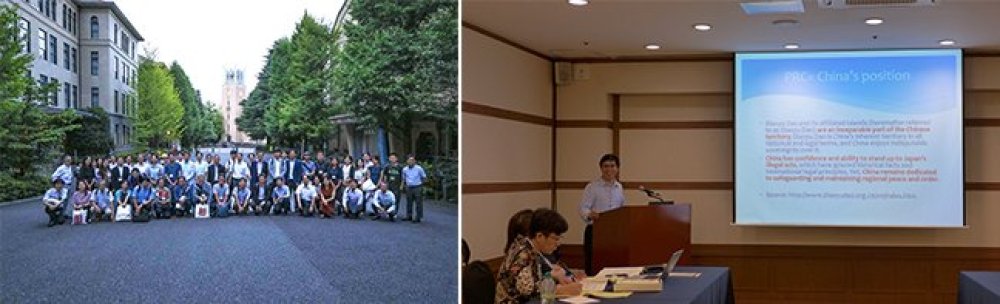
The eighth roundtable conference, "The Possibility of Dialogue Between National Historians in Japan, China, and Korea," bringing together researchers from three countries, was held in August 2023, with presentations and discussions on the theme of "How have 20th-century wars, colonial rule, and reconciliation been discussed?" (Photo left). Professor Lee, who presented his research at the 4th "Asian Future Conference" held in Seoul, South Korea in August 2018 and received the Best Presentation Prize (Photo right).
Hatayama: Thank you. As I listen to you, I am increasingly convinced that Professor Lee's philosophy is rooted in the spirit of the school. I have high expectations for Professor Lee, who embodies the "foundation" of Obirin.
J. F. Oberlin University College of Global Communication Student Council Head
Enmin Li
He was born in Shanxi Province, China. In 1992, he came to Japan as a government-sponsored international student for a joint Japan-China doctoral program to train human resources. He earned his Ph.D. in History from Nankai University in 1996 and his Ph.D. in Sociology from Hitotsubashi University in 1999. In 2003, he was appointed Associate Professor at the School of International Studies, J. F. Oberlin University. From 2010~2020, he concurrently served as a director of the Atsumi International Exchange Foundation, and from 2012~2013, he was a Visiting Scholar at Stanford University. J. F. Oberlin University Served as Director of the International Institute, College of Global Communication Division Dean, and Assistant Student Division Head (in charge of academic divisions), among other positions. Has held his current position since April 2024. His major works include 'Sino-Japanese Private Economic Diplomacy 1945~1972' (Beijing: People's Publishing House), 'China, Japan, and Taiwan in Transition' (Ochanomizu Shobo, recipient of the Masayoshi Ohira Memorial Prize), and 'The Political Process of the Japan-China Peace and Friendship Treaty Negotiations' (Ochanomizu Shobo). His co-authored works include 'History and Reconciliation' (University of Tokyo Press), 'Historical Perceptions of Conflict and Coexistence' (University of Tokyo Press), and 'Japanese Government's Cross-Strait Policy' (Taipei: Center for Research in Humanities and Social Sciences, Academia Sinica). He has also translated many English, Chinese, and Japanese works such as Warlord Studies, Western Wisdom at Its Source: Huxley's Evolution and Ethics, Chaoyangmen Wai no Nihong, and Pebble