[Collection of Schools of Thought] 28. Tatsuo Kaneshita
Faculty and President Dialogue
"Complete strangers" Through the story Re-examining oneself and society
College of Performing and Visual Arts
Tatsuo Kaneshita Professor
Main content
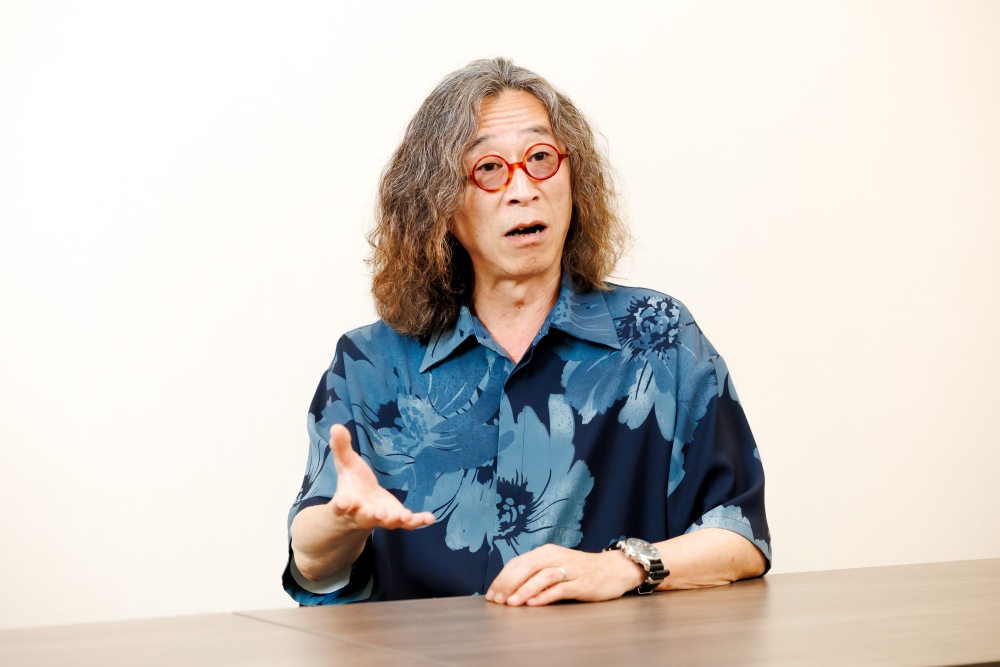
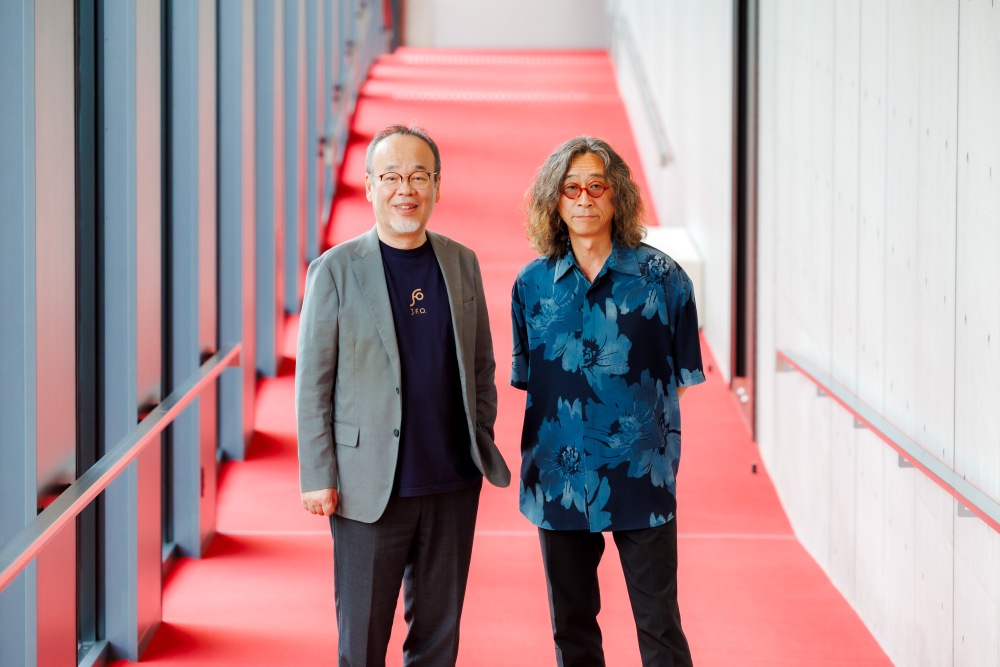
Professor Tatsuo Kaneshita has been presenting socially conscious theatrical works since the era when the 'small theater boom' was in full swing. He delves into what drew him to the freedom of theater and the feelings he put into the stage he created together with College of Performing and Visual Arts students (Interviewer: President J. F. Oberlin University Hiroaki Hatayama).
In an era of increasing uniformity Enchanted by theater
Hatayama: I was born in 1962, so I suppose I'm around the same age as Mr. Kaneshita. I heard that Mr. Kaneshita encountered theater at a high school in Hokkaido. What kind of youth did you have?
Kaneshita: I was born in 1964, but because I was born early in the year, I'm in the same academic year as those born in 1963. So the president is one year my "senior." I've heard that the "80s" are trending among young people these days, and that era seems to be an object of longing in many ways. The students I interact with at the university now are in their late teens to early twenties, and I was right in the middle of the 80s. But the 80s I actually experienced felt like they were getting less and less interesting compared to the eras before them, and everything seemed to be becoming more uniform. The economy was certainly good, but I felt a sense of confinement, as if the whole world was heading in a "predetermined" direction.
During my high school years in the 80s, I was persuaded by an upperclassman to join the drama club. Until then, I had absolutely no interest in theater, but it was my first experience creating a production by writing scripts and directing with upperclassmen and underclassmen. Up until then, everything I did was usually taught by teachers, so this experience was incredibly fresh and enjoyable.
Hatayama: It was a time when things were being put in place and the overall level of society was rising, but people felt a sense of resentment towards that larger system. I had a similar experience; it was around the time that anti-establishment punk rock came to Japan, and I listened to it a lot. For you, Professor, theater was a world where you could feel freedom, wasn't it?
Kaneshita: Up until then, the plays I had encountered in elementary and junior high school had a somewhat moralistic feel to them, and many of the works dealt with themes like "cherish your friends." When I first encountered so-called "underground" theater in high school, it was completely different from the image I had of theater, and I was surprised to realize, "It's okay to do and say things like this!" At that time, playwright Tsuka Kohei was still very active. Tsuka's plays often had a venomous tone, expressing things that you wouldn't normally say in everyday life. I felt a sense of freedom in that.
Hatayama: After graduating from high school, you moved to Tokyo and studied theater at a vocational school. You founded the theater group "THE GAZIRA" in 1987.
Kaneshita: After graduating from school, I aspired to be an actor, so I spent a year at the training school of the "Seinenza Theatre Company," which includes the late Toshiyuki Nishida and Junko Takahata. After that, I formed a theatre company with some classmates, but I quit after a year or two, and then I founded "Gajira" to work full-time as a playwright and director.
Hatayama: What were your thoughts when you created it?
Kaneshita: Back then, there weren't as many talent agencies as there are now, and if young people wanted to do theater, it was common to form their own theater company. Of course, theater companies have their good points, but because the relationships are so close, all sorts of troubles unrelated to the play can arise outside of the creative process. At the time, I just wanted to do theater. So, Gajira adopted the format of a "project group," gathering creative members for each production, proclaiming, "We're not a theater company. We're a group that comes together to do theater." It was an unusual approach at the time.
Hatayama: So you really loved acting and wanted to focus on it. But you also needed management, right? How did you raise money and run your shows?
Kaneshita: Back then, especially with younger groups, most of the time we relied on a "hands-on" style of production. Corporate patronage wasn't common back then, and there was hardly any government funding. The performers all chipped in to sell the tickets they had to meet their quotas, and somehow we managed to keep putting on shows. From the late 1990s onwards, when government and local subsidies became available, it became really difficult without a professional producer. Until then, we had managed to get by on our own, and I did most of the production-related administrative work.
Hatayama: You received the Minister of Education Award for New Artists in 1992, which was quite early in your career, wasn't it? You've gone on to win various awards as a director since then.
Kaneshita: Compared to my peers, I was one of the earlier ones to debut. I won the Newcomer Award in my late twenties.
By playing the role of someone completely different from yourself, you can also see your current self.
Hatayama: You have created many works, but what kind of issues did you have in mind that you incorporated into your works?
Kaneshita: Especially in the late 80s, the economy was still good, and the world seemed to be in a celebratory mood. I had doubts about that trend, wondering, "Is this really happiness?" "Aren't there a lot more problems going on that we can't see?" Rather than doing entertainment-type plays that would get the audience excited, I wanted to tackle things that are invisible or unknown in everyday life. So I started using real-life incidents and wars as themes.
Hatayama: As money increases, and we acquire houses, cars, refrigerators, and a material society develops, there's a doubt about whether we ourselves are happy or free. I wanted to create works that explored these themes.
Kaneshita: That's right. When we started "Gajira," it was a time commonly referred to as the "small theater boom." It's unthinkable now, but back then, women's magazines would publish articles like "100 of the Hottest Theater Companies." I couldn't quite get into that trend either.
Hatayama: At J. F. Oberlin University College of Performing and Visual Arts, we hold a performance called OPAL (*1) every year, and the teacher produces plays under the name 'KANESHITA OPAL.' What impressed me when I saw it was the December 2024 performance 'Or Friends Gathering' (*2). It was based on the 'serial corporate bombing incidents' that happened 50 years ago, and I was amazed, thinking, 'The students really go this far!' To fully become 'directly involved,' students themselves had to internalize the awareness of the issues held by real people. What was the teacher's intention in enabling the students to accomplish so much in such a short time?
*1 J. F. Oberlin University Performing Arts Lessons (commonly known as OPAL) J. F. Oberlin University College of Performing and Visual Arts Theater & Dance Major produces as part of the classes, and the achievements of arts education are widely shared with the general public, including the local community. Students serve as cast and staff under the guidance of leading directors and choreographers.
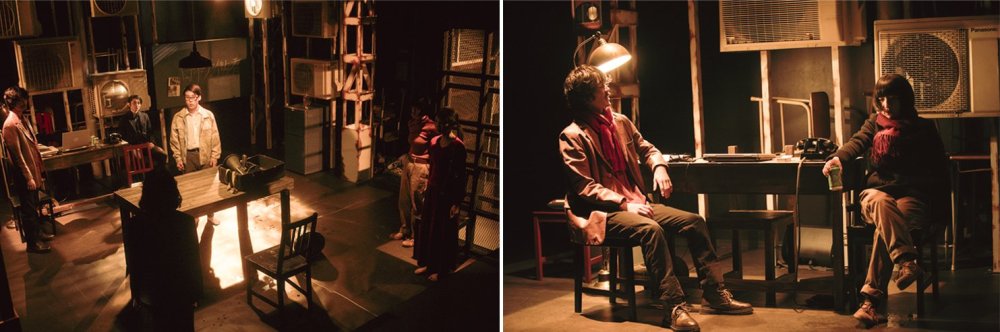
*2 KANESHITA OPAL/2024 'Or Keeping Friends' At the 31st OPAL, a total of 10 performances were held in December 2024. Based on the 'serial corporate bombing incidents' by the East Asian Anti-Japanese Armed Front in the 1970s, the work was extensively revamped by 'THE GAZIRA,' which premiered in 2004. Professor Kaneshita handled the composition, script, and direction, and seven students selected through an internal audition performed.
The students gave a passionate performance in "Or Gathering of Friends" (Photo by Rikuto Yokota).
Kaneshita: Around the early 2000s, the so-called "3-meter radius" problem began to be discussed in the theater world as well. It was said that young people were only depicting the world within their own 3-meter radius, and so on. This trend continues even now, and when I talk to students I interact with at university, it seems that they are only focused on the relationships within the range that they can see, and are troubled only by how to be themselves within that world. So, when creating theater, I think it's important to portray "people who are completely different from your usual self," rather than "how to express your usual self." In "Or Gathering Friends," we depicted terrorists from the 60s and 70s, and from the perspective of the daily lives of today's students, they are "complete strangers." By "acting" as these others who live in a world completely different from our own, using our own bodies, I think we can re-examine not only ourselves, but also today's society and the world.
Hatayama: "A complete other."
Kaneshita: In daily life, we tend to want to connect with "close others" with whom we can talk and get along, but by getting to know people who are completely different from ourselves, we should be able to put ourselves in relative terms. In preparation for the performance last December, we started building up basic knowledge from the summer holidays, starting with "What exactly is communism?" When we talked about "what universities and student movements were like back then," the students were interested, regardless of whether they considered it good or bad in itself.
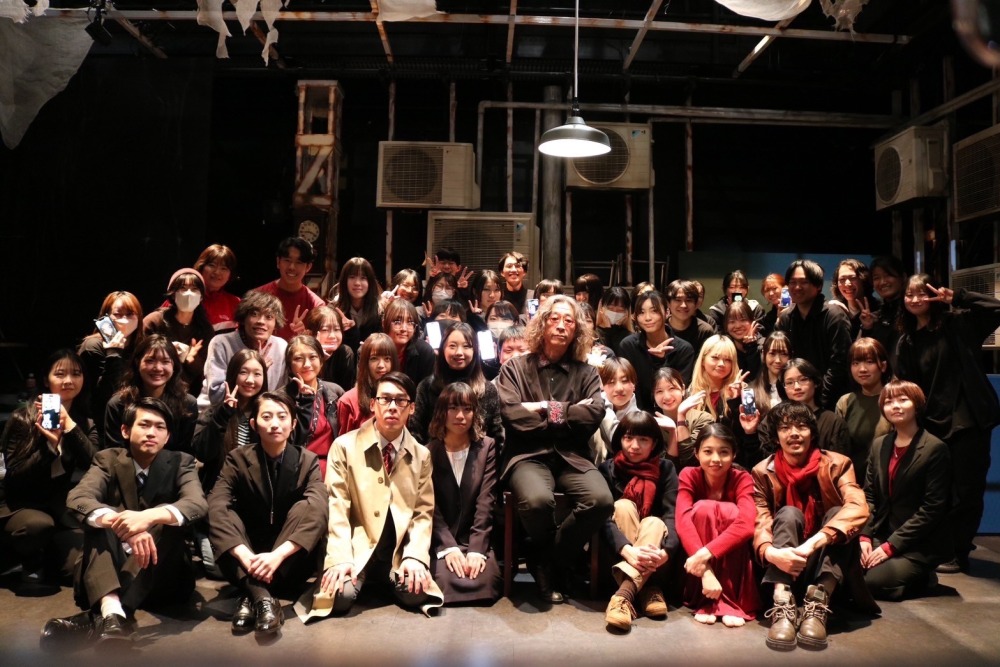
Along with the College of Performing and Visual Arts students involved in the performance.
The communication skills honed through theater are It will be useful even after graduation.
Hatayama: In today's society, "compliance" is constantly being emphasized. While I understand that these rules are meant to protect someone, I think they also contribute to the "social constraints" that you mentioned earlier. Given this context, what do you think the role of theater is in this era?
Kaneshita: There's no longer a "small theater boom" like there was when we were young, and there are hardly any theater companies left that young people aspire to. Fewer and fewer people are still steadily working in theater. It's an era where big companies are the only ones that make money. In this situation, I think it would be great if there were more theater venues where the distance between the audience and performers is closer, and where people can "witness" people performing right in front of them.
Hatayama: Finally, what is the meaning of studying theater at university?
Kaneshita: In the process of creating a work, you'll clash with people, going back and forth with different ideas, and sometimes even getting into arguments. I think that experience of exchanging opinions in that way will be a great asset, even if you don't end up going into the theater industry after graduation.
Theater makes it possible to meet many people. I myself have met many different people and had many experiences through theater. What is important in theater is not finding the answer, but the "thinking" that seeks the answer. It changes the way you see the world and at the same time prompts your own change. Sharing worries and thinking together. I believe that this is the foundation and "power" of theater.
J. F. Oberlin University College of Performing and Visual Arts Professor
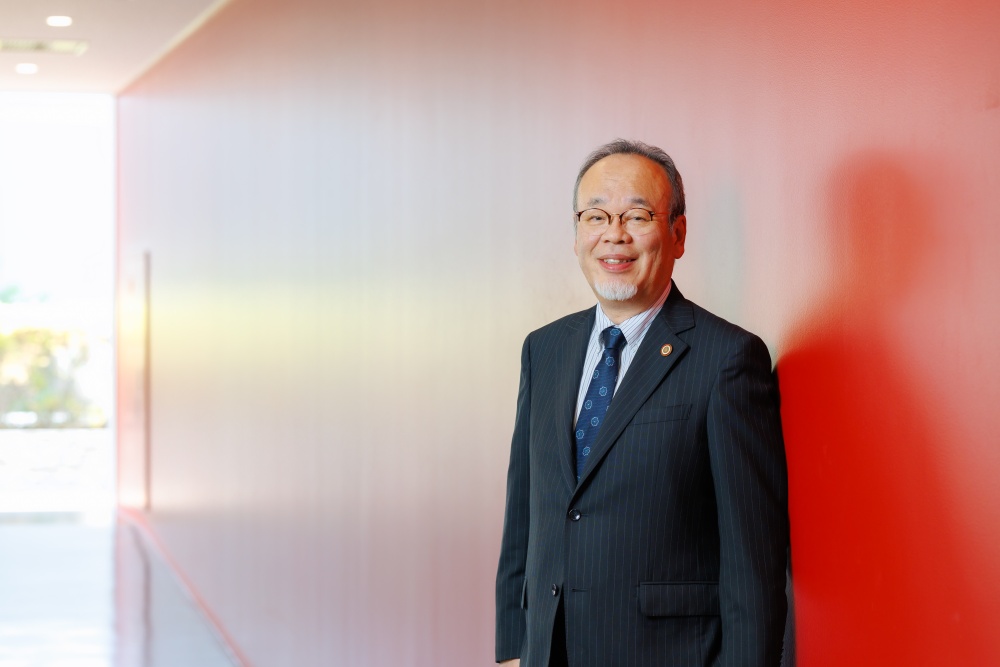
Tatsuo Kaneshita
In March 1984, he graduated from the Theater Department of the Arts Specialized Course at Nippon Kogakuin College. In 1987, he established the theater planning group THE GAZIRA. From April 2000 ~ March 2010, he served as a part-time lecturer in the Actor and Voice Acting Department of the Faculty of Arts at Nihon Kogakuin College. From April 2002 to March 2010, he served as a part-time lecturer in the Theater Major at Toho Gakuin School of Music. From April 2007 to March 2008, he was a visiting associate professor at Major Theater J. F. Oberlin University Comprehensive Culture School. From April 2008 to March 2014, he was a lecturer at J. F. Oberlin University Comprehensive Culture School. April 2014 ~ March 2021: Associate Professor at the University College of Performing and Visual Arts. From April 2021, served as College of Performing and Visual Arts Area Dean, and in April 2022, became a professor. October 1987: Winner of the Gers Circuit Grand Prix. February 1989: Grand Prize at the Parthenon Tama Small Theater Festival. February 1992: Newcomer Award (Theater Division) at the 42nd Minister of Education Award for Arts Encouragement. February 1997: Outstanding Director Award at the 4th Yomiuri Theater Awards. December 1997: Individual Award at the 32nd Kinokuniya Theater Awards. February 1998: Best Director Award at the 5th Yomiuri Theater Awards. May 1999: 37th Galaxy Award of the Month. July 2009: Special Citizen Honor Award from Shikaoi Town, Hokkaido