[Collection of Schools of Thought] 22. Yuka Fujita Mr. -Alumni and Student Interviews
Faculty and President Dialogue
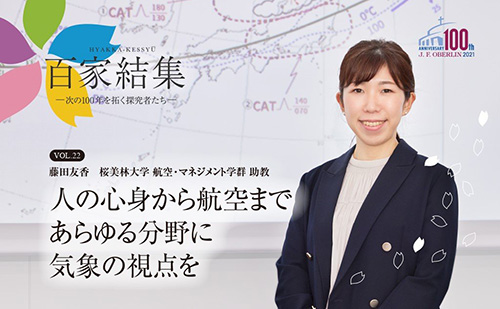
From the human mind and body to aviation Bringing a meteorological perspective to every field
College of Aviation
Yuka Fujita Assistant Instructor
Main content
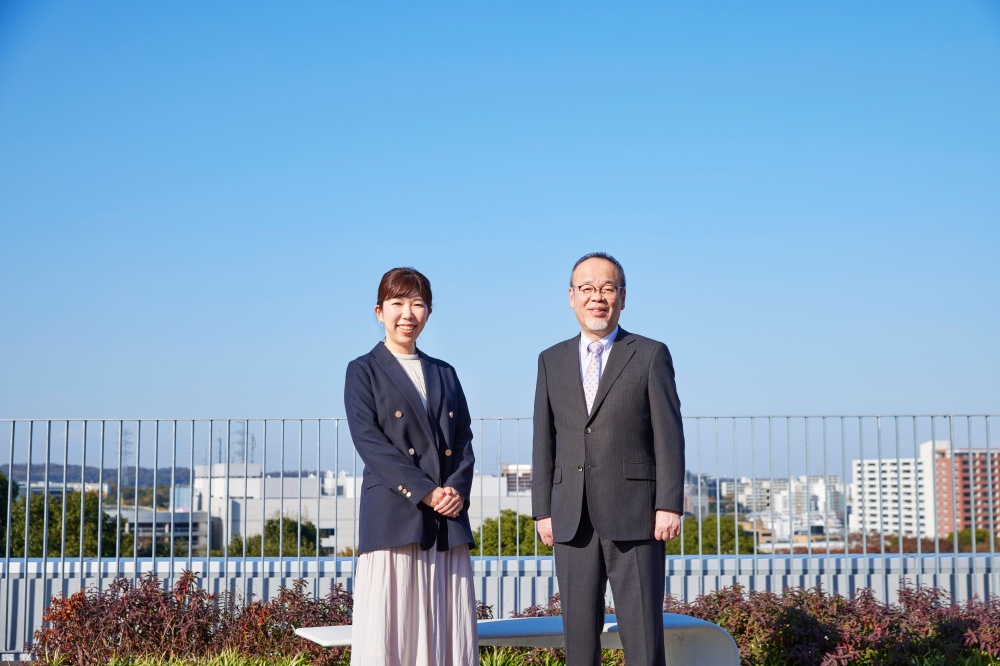
Weather, which interacts with our daily lives in many ways. Assistant Professor Yuka Fujita, who holds a meteorological qualification and has worked at broadcasters and airlines, is one of those who was captivated by its depth. We asked about the importance of meteorology, which is something that inevitably involves any field you pursue, and about the research you are currently working on (Interviewer: President J. F. Oberlin University Hiroaki Hatayama).
Focusing on how physical and mental conditions change with the weather.
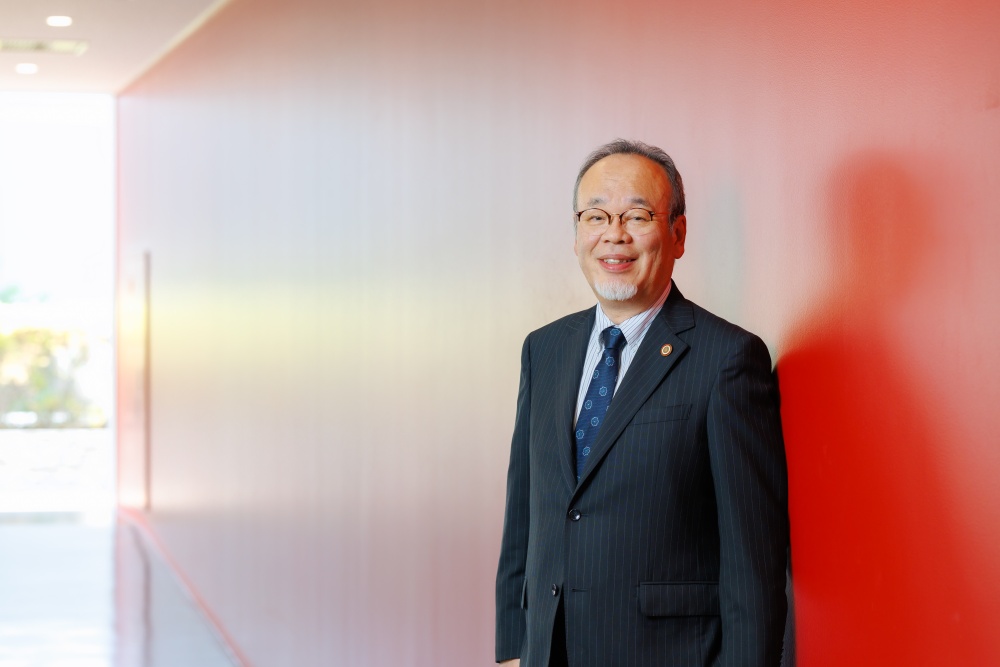
Hatayama: Professor Fujita, who teaches 'aviation meteorology' at the Faculty of Aviation and Management (now College of Aviation), is a member of the Japan Meteorological Society and the Japan Society for Aeronautical and Space Sciences. Were you originally interested in the field of meteorology?
Fujita: I've always been very interested in the weather. That's because a friend of mine, who I used to cycle to school with, would get grumpy whenever it started to rain (laughs). So every morning I would look at the weather forecast and think, "Looks like she's in a bad mood today, I'll have to be careful how I deal with her." Then one day in geography class we had to draw weather maps, and that's when I thought, "This is interesting."
Hatayama: We all know how the weather can make us feel down or excited, right? Anyway, a class on drawing weather maps sounds interesting.
Fujita: NHK radio has a program aimed at fishermen and farmers, and I used to listen to recordings of that program while drawing weather maps. That's when I became interested in meteorology and wanted to study it professionally. When I entered university, from my first year, I sat in the front row during lectures, thinking, "I have to make sure the professors remember my face." I wanted to work in a weather-related field, but I thought I couldn't get a job without a weather forecaster's license, so I thought, "I'll study a bit more, get my forecaster's license, and then look for a job," and went on to graduate school.
Hatayama: I've interviewed many professors before, but it's rare to meet someone who decided on their career path so clearly before going to graduate school. What was your experience like in graduate school?
Fujita: At the time, I was working part-time at a drugstore, and because I was dealing with health and beauty-related products, I became interested in those fields. That's when I learned about a research field called "biometeorology," which studies the connection between weather and the human body, and I created a "skin irritation forecast" under the guidance of a mentor who was knowledgeable in that field. In winter, skin gets dry, right? I made predictions by linking that to the weather.
Delivering value-added weather forecasts to the worlds of aviation and meteorology.
Hatayama: After completing your master's degree, you joined a weather forecasting company. What kind of work did you do there?
Fujita: I utilized my weather forecaster qualifications and worked in the weather forecasting department. I wrote scripts for commercial radio and television stations, which were then read by weathercasters. I also worked on issuing "frost warnings" and other information for specific regions. For example, for Yamagata Prefecture, I would issue forecasts such as "Be vigilant tomorrow morning" to prevent damage to crops, assigning different levels of warning. I also worked on snowfall forecasts for Odate-Noshiro Airport (Akita Prefecture). The company itself was located in Tokyo, but we issued forecasts for the entire country. It wasn't just agriculture and transportation infrastructure. In "construction weather," we issued pinpoint forecasts to prevent heatstroke among construction workers or accidents caused by strong winds. The Japan Meteorological Agency provides regular weather forecasts for free, so private weather companies add value to that and offer it for a fee.
Hatayama: So you explain the connection between the daily lives of different people and the weather. I understand that in addition to writing the manuscript, Professor Fujita himself also appeared on an NHK program.
Fujita: I worked as a weathercaster at NHK Tottori Broadcasting Station for four years. I passed the audition and was seconded from the weather forecasting company where I was working. I had visited Tottori on a trip before, and I'm actually a big fan of Shigeru Mizuki, the cartoonist who is from Tottori (laughs). I also wanted to visit the Sea of Japan side of the country at least once. Since I'm from Tokyo, I felt it would be a little strange to comment on the snow without knowing the hardships that the people on the Sea of Japan side face.
Hatayama: I've had a similar experience. I used to be an English teacher at a high school, and the textbooks were full of descriptions of life in English-speaking countries. I myself had never lived in such an environment, so I was teaching students as if I knew everything. That's why I quit teaching and went abroad to study. In that sense, I had a feeling of "guilt" about speaking based only on information.
Fujita: I understand.
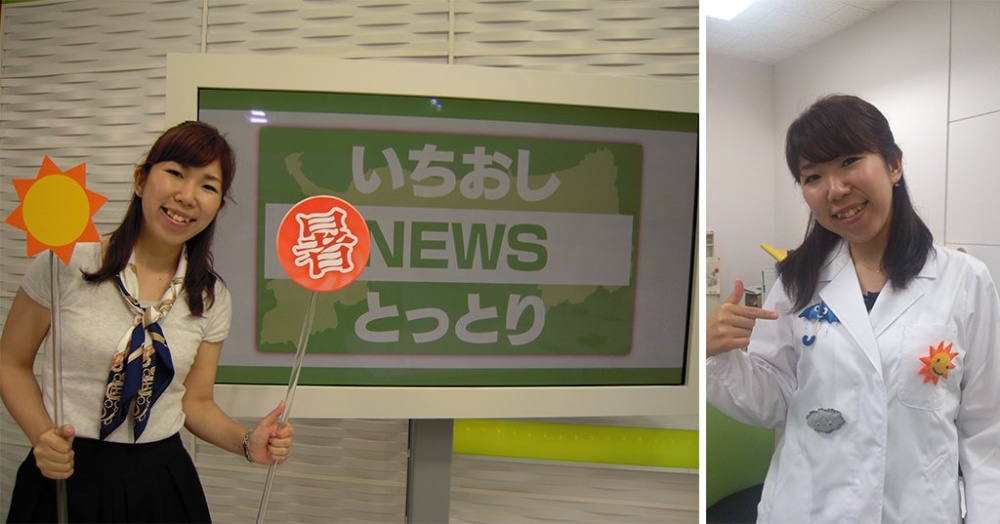
In the studio of the program she was in charge of (left photo). In the segment where she explains weather-related knowledge, she is wearing a white lab coat (right photo).
Hatayama: So you went to Tottori, but is it a place with particularly severe weather?
Fujita: It's quite intense. The famous Tottori Sand Dunes get very windy in winter, and it turns into something like a sandstorm. It snows a lot, though not as much as in Hokuriku, Tohoku, or Hokkaido, and it rains a lot too. Even a little rain can easily cause landslides.
Hatayama: After achieving your goal of "learning about the climate on the Sea of Japan side," you then changed jobs to an airline company, is that right? What led to that?
Fujita: Even when a weathercaster warns that something is dangerous, the final decision rests with the viewers and listeners. While I found the work itself rewarding, I was also drawn to the idea of a job where I could make my own decisions rather than leaving the final judgment to others. That's why I decided to switch careers and become a "dispatcher" (flight operations manager) at an airline.
Dispatchers analyze information related to the operation of aircraft to their destination, determine the safest and most efficient flight path and altitude, and create flight plans. They collect and analyze operational information such as air currents and cloud conditions along the flight route, weather information such as wind direction and speed at the destination airport, airport facility information, and passenger and cargo weight. I wanted to do a job where I could create my own flight plans and make my own judgments, so I changed jobs.
Hatayama: So that's where the connection to the current "Aviation and Management Studies" program comes in. What kind of insights did you gain at the airline company?
Fujita: I've come to realize, more than ever, just how closely meteorology and aviation are intertwined. I wasn't particularly interested in airplanes to begin with, but as I continued to study, I grew to appreciate them.
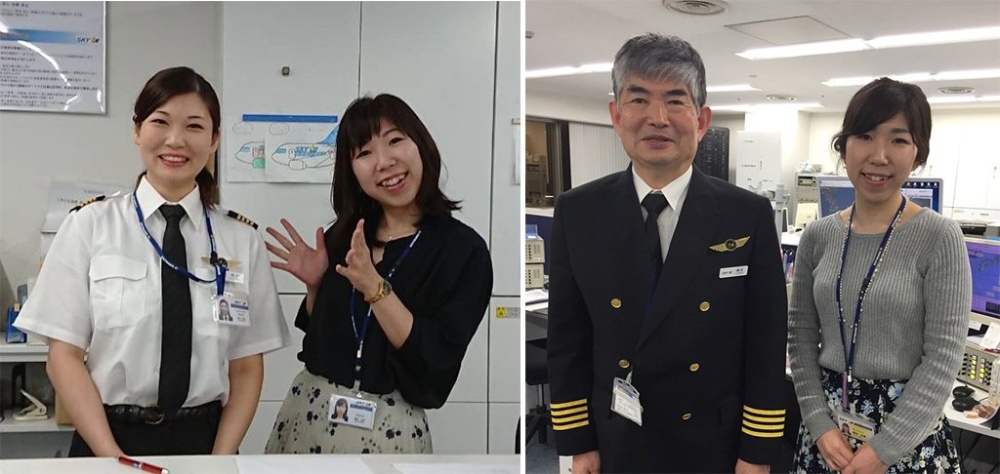
When I worked at an airline, I met Mai Suzuki, a J. F. Oberlin University graduate. It was Suzuki's first flight as captain, and he was responsible for flight management duties = photo left. Professor Tomohiro Yokota, who currently teaches at the Aviation and Management Department, also worked at the same company = photo on the right
Studying weather phenomena around the airport and exploring their mechanisms.
Hatayama: And then you started working at this university, and I hear that Professor Fujita's classes are very well-regarded by the students. What kind of things do you do to make your classes more engaging?
Fujita: Oh, no, I'm flattered. If I had to say, it might be influenced by my experience as a weathercaster. Viewers and listeners aren't necessarily experts in weather. I've always approached broadcasting with the goal of getting them interested in weather. It's the same with teaching; I try to start with something easy to understand, get them interested, and then move on to more advanced content.
Originally, few students enroll with the intention of studying meteorology; most students hope to work in the aviation industry. To these students, I tell them, "No matter what field you choose to pursue in the future, meteorology will inevitably be relevant, so it won't hurt to know about it."
Hatayama: That might inspire some students to pursue a career in meteorology. By the way, you received the "Female Researcher Encouragement Grant" in 2021. What kind of research have you been working on recently?
Fujita: I'm researching meteorological phenomena that affect operations at regional airports. Specifically, I'm studying the mechanism of "low-level wind shear" at Mt. Fuji Shizuoka Airport (Shizuoka Prefecture). Wind shear is a meteorological phenomenon where wind speed and direction change rapidly around an airport. If an aircraft encounters wind shear just before landing, it may not be able to land stably and may have to abort the landing. Some of the latest aircraft are equipped with devices that issue warnings when wind shear is encountered.
However, currently, the situation is such that "we simply won't know until the conditions are actually met." We want to unravel the mechanism of wind shear itself so that we can predict its occurrence to some extent. To that end, we are collecting observational data from days when wind turbulence prevented stable landings and conducting repeated simulations. We also want pilots and those involved in flight operations management to be able to predict, even if they lack experience, that "when these conditions align, it's probably dangerous." We hope to collect similar data from regional airports outside of Shizuoka as well, and it would be great if students could join us in helping with the observations.
Hatayama: It would be great if students could get involved too. They all love airports, after all. Finally, is there anything you'd like to say here?
Fujita: President, are you familiar with the term used to describe the strength of a tornado? It's called the "F scale," and it's a rough estimate of wind speed based on the extent of damage caused by tornadoes, downbursts, and other gusts of wind. The greater the damage, the higher the F value, indicating a high wind speed. Actually, this "F" comes from the initials of Dr. Tetsuya Fujita, who devised it. Dr. Fujita discovered and named downbursts, which can cause aviation accidents, and his research results at that time have contributed to the safe operation of aircraft today. I'm not related to Dr. Fujita, but we share the same last name, so I feel a sense of kinship and often use it as a topic of conversation.
Hatayama: Oh really? I didn't know that.
Fujita: I jumped into the field of aviation meteorology from meteorological research, and that's how I got to where I am today. I feel like I was somehow drawn here by Dr. Fujita, an authority on aviation meteorology. I also hope to create something like the "F scale" someday.
J. F. Oberlin University College of Aviation Teaching Assistant
Yuka Fujita
Graduated from the Department of Environmental Systems, Faculty of Global Environmental Science, Rissho University in March 2007. Completed the Master's Program in Environmental Systems Science, Graduate School of Global Environmental Science, Rissho University in March 2009 (Master of Science). From April 2009 to July 2016, worked in the Weather Forecasting Department of Life Business Weather Co., Ltd. (seconded as a weather caster at NHK Tottori Broadcasting Station from April 2011 to March 2015). From August 2016 to March 2020, worked in the Flight Control Section, FOC Department, Skymark Airlines Co., Ltd. Assumed current position in April 2020. Holds qualifications as a weather forecaster and flight operations manager.