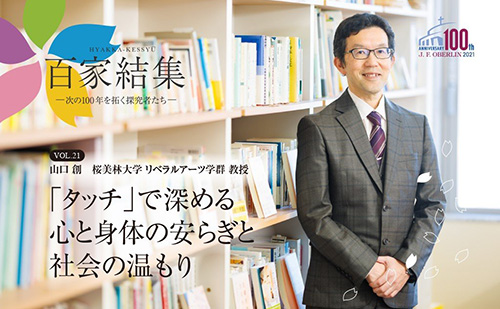
[Collection of Schools of Thought] 21. Mr. Hajime Yamaguchi-Alumni and Student Interviews
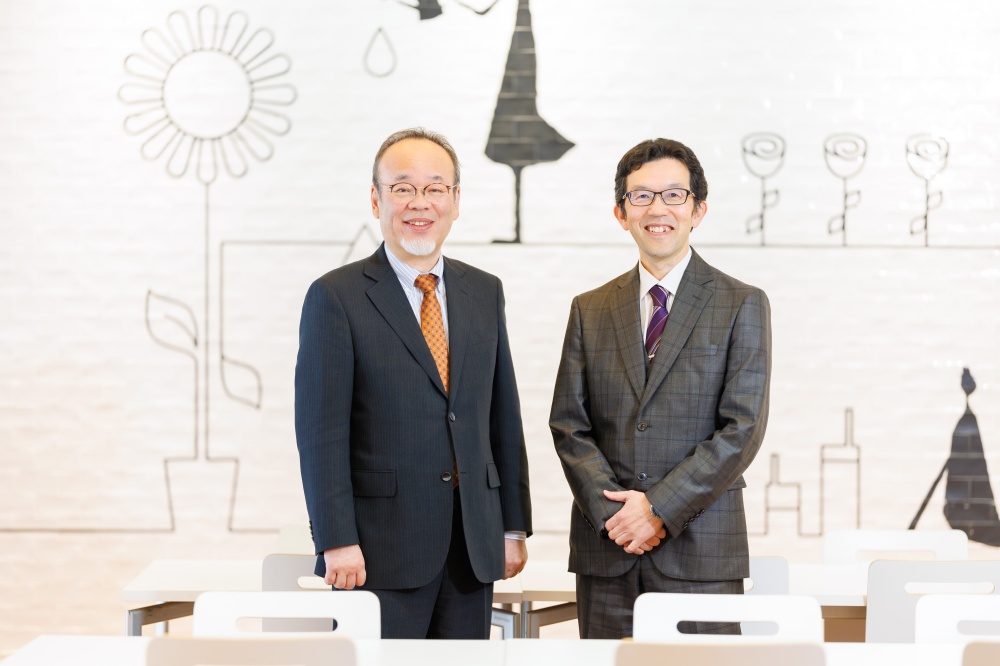
Faculty and President Dialogue
Deepen your understanding through "touch" Peace of mind and body, and the warmth of society
College of Arts and Sciences
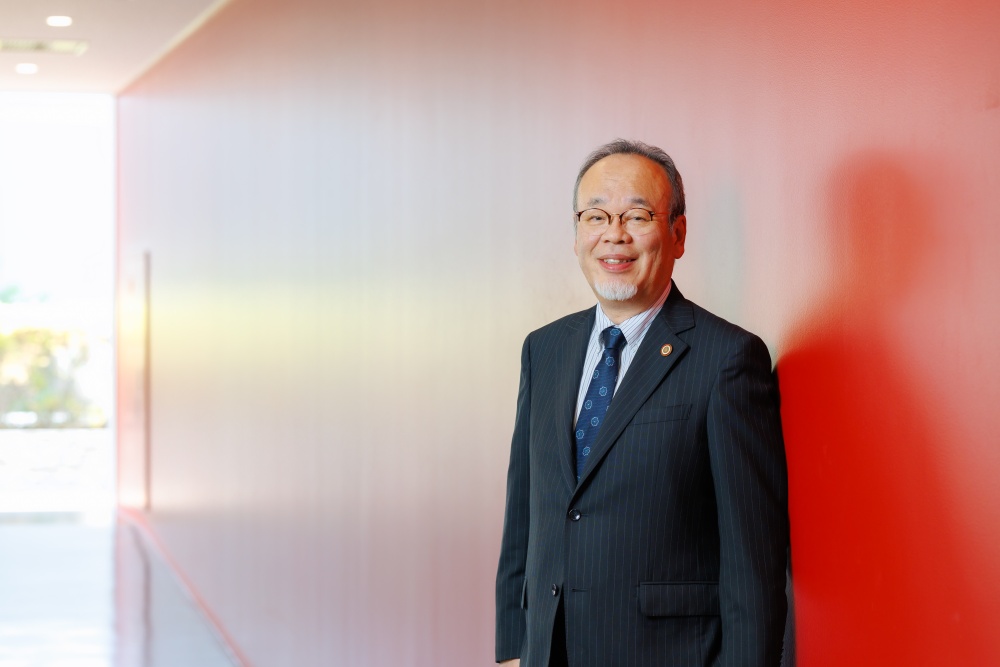
Hajime Yamaguchi Professor
Main content
Professor Hajime Yamaguchi has studied the changes in mind and body brought about by skin-to-skin 'contact.' We had them talk about the effectiveness of "self-touch" discovered during the COVID-19 pandemic and the expected effects of "touch care" in various social contexts (Interviewer: President J. F. Oberlin University Hiroaki Hatayama).
Hormones that deepen feelings of happiness and bonds are released through "touch".
Hatayama: Professor Yamaguchi, you appear in various media outlets, but I'm happy to have this opportunity to speak with you in depth. When we talk about Professor Yamaguchi, we think of your research on "touch," don't we?
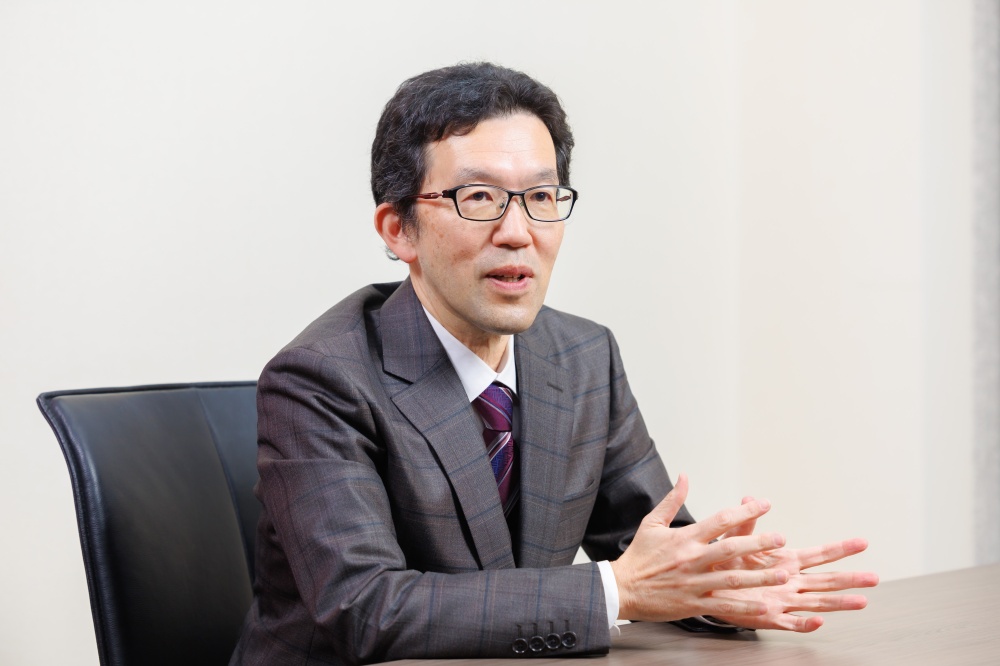
Yamaguchi: Thank you. Touching is the simplest means of healing for humans and the origin of communication with others. Touching people can alleviate pain and stabilize the mind. Research has shown that signals of pleasure from sensory receptors reach the brain, promoting the secretion of oxytocin, a hormone that is thought to deepen feelings of happiness and bonds with others, and helping to alleviate pain and stress.
Hatayama: First, I'd like to know how your interests converged into those fields.
Yamaguchi: During my student days, I studied at the Faculty of Human Sciences at Waseda University. It was the faculty that opened when I applied for it, and it's like the current 'liberal arts' program. Until then, academic disciplines were 'octopus pot type,' with many researchers conducting research only within their respective specialized Area, such as psychology and education. But after all, humans are both physical beings and social beings, so it is necessary to understand the human heart from such multifaceted perspectives.
So I majored in psychology, but my research was a little different from traditional psychology; it approached the mind and human relationships from the perspective of the body. This is called "body psychology," a field of study advocated by Professor Yutaka Haruki (1933-2019, Professor Emeritus of Waseda University), from whom I studied. Professor Haruki himself was involved in Eastern approaches to harmonizing mind and body, such as Tai Chi, Zen meditation, and yoga, and as I practiced these with him, I wanted to delve deeper into the subject, so I went on to graduate school. After completing my doctoral program, I worked as an assistant for three years, and then as a full-time lecturer at Seitoku University for nine years.
Hatayama: What kind of work did you do when you were an instructor?
Yamaguchi: I used to teach child psychology to students aiming to become kindergarten teachers or childcare workers. While working on their graduation theses, I collected data from nurseries and kindergartens, and I discovered that children who had more interaction with their parents tended to be calmer and have gentler personalities, among other positive results (*1). This became a turning point for me, and I began researching the "impact of parent-child interaction."
Hatayama: So that's how you arrived at the theme of "touch."
*1 Source: Hajime Yamaguchi (2004) 'A Child's Brain Is Found in the Skin' (Kobunsha)
From "personal space" to "touch": Deepening research with new ideas
Yamaguchi: When I was in my doctoral program, I was researching "personal space," which is the distance between people. After that, I wanted to research something new. I realized that "if you eliminate the distance, it becomes 'touch.' That's a far more interesting topic." Animals build relationships by touching each other, like grooming. Humans are, of course, a type of animal, so I think "touching" is a very important animal instinct. However, there was little research on touch, even on a global scale. I thought, "Why isn't anyone doing this important topic? Well, I'll give it a try," and that's how I started.
Hatayama: In cultural anthropology, there is research on the "distance" between people during communication. Some cultures speak at close range, while others speak at a slight distance. Some cultures hug when they meet, while others do not. Are these things also related?
Yamaguchi: There is a connection. Japanese people are considered a "very infrequent" people compared to the rest of the world. However, if you look closely, there is actually a lot of contact between parents and children. But then, once children reach adolescence, that contact suddenly stops. In contrast, Western countries tend to continue having physical contact even into adulthood. I think Japan is unique in that respect.
Hatayama: You've been talking about the effects of touch, but could you tell us what the relationship is between stress and skin in the first place?
Yamaguchi: Speaking of skin problems, while genetics and aging are causes of dry skin, stress is also involved. When you're under a lot of stress, the skin's barrier function breaks down and the amount of moisture in the stratum corneum decreases. Touch is very effective in alleviating such stress. However, with the COVID-19 pandemic making it difficult to have physical contact with others, we changed direction and wondered, "What if we touched ourselves?" After doing some research, we found that touching your own body also releases oxytocin, which helps relieve stress, and the importance of "self-touch" became clear.
Hatayama: Where and how should I touch them?
Yamaguchi: Take about five minutes to touch your head, face, arms, chest, and stomach with your hands. The key is to move your hands slowly and stop and press. When touching your face, cup your hands around it and press down, focusing on the sensation. When touching your arms, stroke them slowly, moving your palms at a rate of about five centimeters per second. Doing this will maximize the secretion of oxytocin, which helps suppress the stress hormone cortisol. Incidentally, oxytocin is also secreted by smelling aromatherapy. In particular, the scents of lavender and clary sage oil have been proven to stimulate the secretion of a lot of oxytocin (*2).
Hatayama: When you scientifically prove such effects, what methods do you use?
Yamaguchi: Oxytocin and cortisol are measured by collecting them from saliva, but stress and relaxation levels can be investigated by examining the activity of the autonomic nervous system or by measuring body temperature with a thermographic camera.
*2 Source: Ogata, K., Ataka, K., Suzuki, H., Yagi, T., Okawa, A., Fukumoto, T., ... & Asakawa, A. (2020). Lavender oil reduces depressive mood in healthy individuals and enhances the activity of single oxytocin neurons of the hypothalamus isolated from mice: a preliminary study. Evidence-Based Complementary and Alternative Medicine, 2020.
A thermographic camera used in the study. Body temperature decreases under stress and increases in a relaxed state.
Spreading touch therapy to create a people-friendly society
Hatayama: Many young people who were unable to attend high school due to the COVID-19 pandemic have enrolled at our university. What approach do you take when dealing with such students?
Yamaguchi: When commuting to school was restricted, many students struggled with not being able to make friends or became depressed due to online classes, but that is gradually being resolved now. However, I think that a general trend among young people these days is that they have had fewer experiences of interacting with people from a young age and have fewer opportunities to get to know others through physical contact, so they tend to be more sensitive and avoid deep relationships. As they increasingly interact on social media where text information is the main form of communication, they seem to have difficulty meeting people in person, making eye contact, and maintaining appropriate personal space.
Therefore, in my seminar classes, we start with an activity where everyone interacts physically. At first, the students might feel a little hesitant, but as they literally touch each other's skin, they quickly become closer and before you know it, they're all good friends.
Hatayama: Are there any new themes you'd like to tackle in the future?
Yamaguchi: In welfare Area, abuse of the elderly and disabled is now a problem. We have just started an initiative where we learn 'touch care' from the staff at the facility and have users perform it on us. As a result, not only the person being touched, but also those who touch it—that is, those who care for it—release a lot of oxytocin. This increases trust in the other person, creating the possibility of building close relationships. There are many other Area where "touch care" can intervene, such as for issues of child abuse or developmental disabilities. If we increase contact from childhood, oxytocin levels rise, and ultimately, I think we can create a warm society that is gentle on people and free from conflict.
Hatayama: I really hope we can have a society like that. If we could hold hands during meetings, maybe things would go a little more smoothly (laughs).
Yamaguchi: By all means, go ahead and suggest it and give it a try (laughs). The origin of my research is actually my experiences in Izu, Shizuoka Prefecture, where I was born and raised. It's a place with abundant nature, and I think the things I experienced there using all five senses are still relevant to me today. The idea I mentioned earlier that "humans are a type of animal" also stems from that. No matter how advanced technology becomes, I want to emphasize that primitive senses like touch and smell are important for humans.
Hatayama: Wow, that was interesting. I'm going to try "touch care" right away.
J. F. Oberlin University College of Arts and Sciences Professor
Hajime Yamaguchi
In 1991, he graduated from the Department of Basic Human Sciences, School of Human Sciences, Waseda University. In 1993, he completed the master's program in Health Sciences at the Graduate School of Human Sciences at the same university. In 1996, he completed the doctoral program in Health Sciences at the Graduate School of Human Sciences, Osaka University, earning a PhD in Human Sciences. April 1996 ~ March 1999: Assistant at the Center for Comprehensive Human Studies, same university. April 1999 ~ March 2008: Full-time lecturer in the Department of Child Studies, Faculty of Humanities, Seitoku University; April 2008 ~ March 2014: Associate professor in the Department of Psychology and Education at J. F. Oberlin University. Has held his current position since April 2014. His publications include 'The Brain of Children Is in the Skin' (Kobunsha), 'The Healing Power of the Hands' (Soshisha), and 'The Unconscious Healing Power of the Body' (Sakurasha), among many others