[Collection of Schools of Thought] 20. Toshihiko Tabuchi Mr. -Alumni and Student Interviews
Faculty and President Dialogue
What questions does it pose to society? Our goal is to create videos that benefit all parties involved.
College of Performing and Visual Arts
Toshihiko Tabuchi Professor
Main content
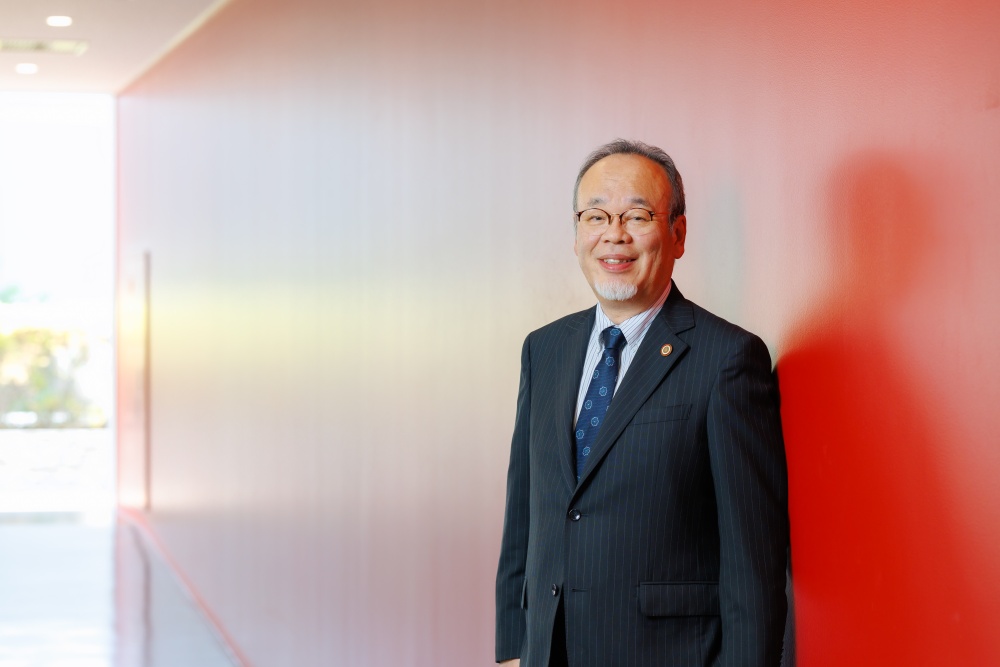
Professor Toshihiko Tabuchi has documented remote regions and social issues around the world. He shared his thoughts on the essence of video production that he wants to convey in educational settings, and the skills he hopes students will cultivate through expressive activities (Interviewer: President J. F. Oberlin University Hiroaki Hatayama).
Finding a new path in documentaries, they reflect the "differences" of the world.
Hatayama: Professor Tabuchi worked at TV Tokyo for a long time. When you were deciding where to work, did you focus on media-related fields from the beginning?
Tabuchi: No, as a law student, I initially thought about becoming a lawyer and joined a criminal law seminar. While studying juvenile law there, I decided to research the influence of television dramas on juvenile crime. Coincidentally, there was a senior in my seminar who worked for a major commercial television station in Tokyo, and he told me a lot about the world of television, and I thought, "That sounds interesting!" So I decided to join the company.
Hatayama: That's an interesting reason for wanting to work there. I understand you were involved in the production of documentary programs at TV Tokyo.
Tabuchi: Initially, I was in charge of music programs and the like. This was during the time when idols were popular in the 80s. After gaining experience and becoming a director, in my fourth or fifth year at the company, I was assigned to produce a program introducing Tibet. I was deeply impressed by the various experiences I had there, and for the first time, I became interested in documentaries. After that, I was ordered to be seconded to a subsidiary production company. While transfers are common now, it was unusual at the time to be seconded to an affiliated company at such a young age, and I assumed I had been demoted. When I thought about "what path I should forge for myself from now on," I remembered my experience in Tibet. Looking around the company, I realized that no one else was working on documentary programs. "If no one else is doing it, I'll give it a try." That's what I decided.
Hatayama: The atmosphere has changed completely since you started working on music programs.
Tabuchi: When I went to remote areas and met people from ethnic minorities, I was constantly amazed. I had an experience that was like "unlearning," where my preconceived notions were shattered. For example, when I asked the locals, "Are you happy now?", they didn't understand the meaning of the question itself. They said, "No one has ever asked us if we're happy before." I felt the pleasure of encountering a world completely different from the one I had lived in, and I worked to depict "how it was different."
Hatayama: I hear you've visited many different places around the world.
Tabuchi: I think I've been to over 100 countries. They were all remote places, and when I went on a trip, I would visit several countries in one go. There weren't any field documentarians like me in the company, so I looked for senior colleagues at other stations and asked them for advice. I also devoured old books and specialized books on folklore, and whenever I found a place where cameras hadn't been, I'd think, "I'm going to go there." That's how I got around to it.
I went trekking with the staff in the Himalayas, where I was on assignment.
In Ladakh, India, with women in traditional clothing
Connecting to the next generation: Asking questions of society through video.
Hatayama: From what I'm hearing, you sound like a cultural anthropologist. But you also had a period where you were involved in drama production, right?
Tabuchi: People often say, "Drama and documentary are completely different, aren't they?" but that's not entirely true. For example, if you try to depict poverty in a documentary, you can only depict the facts, so it ends up being a dark story. However, if you depict it in a drama, you can not only depict the dark parts, but also supplement it by depicting something brighter through fiction. For me, I think they are the same, just depicted in different ways. When looking at things, we only see one side, but it is important to imagine the other side that is always there. I think that is something I realized because I have worked on both documentaries and dramas.
Hatayama: What roles did you play at each of those sites?
Tabuchi: In documentaries, I did both directing and producing. I came up with the ideas myself and negotiated the budget. In dramas, I focused solely on producing. With documentaries, there are fewer staff members, so I can just go and shoot as the director. In contrast, dramas are large-scale productions involving many staff members, so I rely on the director's expertise while I handle the producing myself. That's the approach I've taken.
Scripts for dramas I produced
In addition to documentary footage released on DVD, he has authored numerous books. A new book about the television industry is scheduled to be published by Poplar Publishing in early January 2024.
Hatayama: What led you to move from a television station to a university?
Tabuchi: Recently, I feel that the culture of nurturing young people in the TV industry has been fading. I've ended up being loudly shouted about monetization. After working as a part-time lecturer at several universities for about ten years, including J. F. Oberlin University, I have come to feel that the mindset of "expressing through video and conveying it to people" can be passed on to the next generation. That sense of mission was born.
Hatayama: I share that sentiment. Our student days were truly free; we studied what we loved and did what we loved. Now, with many universities across the country struggling to recruit students, we're so focused on the competition to survive that I feel we're not adequately conveying to students that "university is supposed to be such a free place." I think it's important to discuss the essence of university once again and then put that into practice.
Tabuchi: There's a phrase in the management philosophy of Omi merchants, 'Mipo Yoshi,' right? "Good for sellers, good for buyers, good for society." It feels like that one aspect of 'good in society' has faded. The world of visual media has always been about creating good works, moving others, making a living for ourselves, and beyond that, the desire to "enrich society through broadcasting culture." This is exactly what J. F. Oberlin University advocates for 'learning and serving people.' Using video to benefit society and appeal to society. Actually, the most important thing has recently been neglected. I believe this applies not only to video but also to the trends of society as a whole. What I always tell my students is to think about why they study video. It's great to move someone, and if you can make money from it, you're happy again. But I want you to think even more about "what kind of impact can it have on society." I believe that is the key point.
Fostering expressions and self-esteem that cannot be quantified.
Hatayama: Nowadays, society worships numbers and is overly fixated on data-driven thinking, so the "creative and creative elements" in the humanities and social sciences tend to be sidelined. College of Performing and Visual Arts students at our university receive specialized education to become "expressers" who shape their sensibilities. To "communicate" something is to devote your heart to figuring out how to present it most effectively to your audience. Theater, dance, music, and visual arts are fields that cannot be confined to data philosophy and are expected to regain attention in the future.
Tabuchi: That's right. In my seminar, as part of their job search, students get to experience on-the-job training in various industries. They might work as desk staff at an entertainment agency or receive training in video production at an editing studio. They also get to experience distributing lunch boxes to actors and staff on drama sets. It may seem like a simple job at first glance, but by distributing lunch boxes, they learn what roles each person plays, how many people there are, and how the set works. Students change a lot after gaining on-the-job experience. They gain confidence and always find something that makes them think, "Maybe I'm suited to this field or job."
For individual research projects in the seminar, students are asked to create videos instead of writing papers. For example, some students choose "the differences between Japanese and Korean dramas," while others compare the opening sequences of variety shows by channel and time slot; all of them offer interesting perspectives. When we solicit ideas, good suggestions keep coming one after another.
Hatayama: What research would you, Professor Tabuchi, like to pursue in the future?
Tabuchi: What I'm currently working on is creating a video recreating the "hidden Christian baptism ceremony" that was performed on Narushima Island in the Goto Islands of Nagasaki Prefecture. The Goto Islands were a place with a large population of "hidden Christians." There is a project to recreate the baptism ceremony called "O-suzuke/also known as Tsunokaki" that remains in this area for the first time in 51 years, and we recorded it on video in August 2023. I would like to continue my research and archive videos related to "hidden Christians" in the future.
Hatayama: I'm from Kagoshima, and the western part of Kyushu is really interesting, isn't it? It has a unique culture that's a blend of Western and Eastern influences. Finally, could you tell us what you think about university education?
Tabuchi: I believe it's too late to start media literacy education after you've entered the workforce. I want students to enjoy their moratorium period while simultaneously acquiring the general knowledge and skills necessary for working life. And in video education, communication is essential. By creating something together with peers, students can discover themselves. I want students to use this as an opportunity to enhance non-cognitive abilities such as self-esteem, which cannot be measured by numbers or data, and to reflect on themselves.
J. F. Oberlin University College of Performing and Visual Arts Professor
Toshihiko Tabuchi
Born in Hyogo Prefecture in 1964. After graduating from Keio University's Faculty of Law, he joined TV Tokyo. He has worked on documentaries visiting remote areas around the world, and has visited more than 100 countries. At the same time, he is also actively involved in the production of socially conscious documentaries, tackling themes such as the "United Red Army," "elderly first-time offenders," and "stalker perpetrators." He has also produced numerous dramas. His awards include the 52nd (2014) Galaxy Award for "Searching for the Exit of the Labyrinth" (Part I: Peering into the Depths of a Stalker's Mind, Part II: Stalker: 70 Days of the Latest Treatment), the 54th (2016) Galaxy Award for "Disability Plus Alpha: Between Autism Spectrum Disorder and Juvenile Delinquency," and the Grand Prix in the Single Drama Category at the International Drama Festival in Tokyo Drama Awards 2017 and the MIPCOM 2017 MIPCOM BUYERS’ AWARD for Japanese Drama Grand Prix for the drama "Prison Break." His published works include "The Art of Victory for the Underdog: The Secret of TV Tokyo's Reverse Thinking That Turns Unfavorable Conditions into Strengths," "Developmental Disorders and Juvenile Delinquency," "Stalker Perpetrator: Please Run Away from Me," and "The Shape of Happiness Learned from Remote Places." His released video works include "The Complete Collection of Remote Places of the World, Volumes 1 and 2," "The Golden City of Bamiyan: The Giant Buddha Seen by Xuanzang," and "The Boy of the Wind: The Eternal Legend of Yutaka Ozaki," among others.
Text: Naoki Kaga, Photos: Takuma Imamura
Interview date: This took place in September 2023.