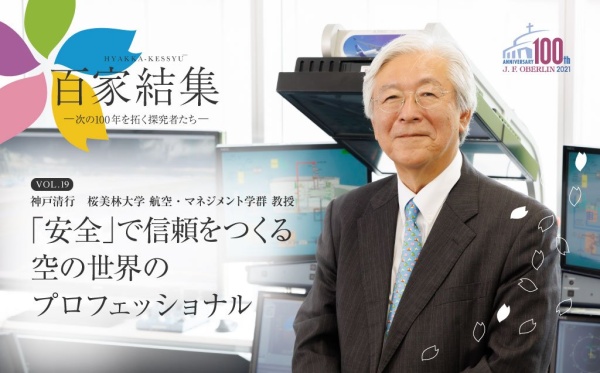
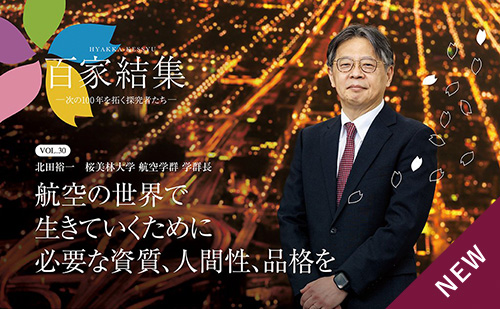
[Hundred Schools of Thought] 19. Kiyoyuki Kanbe Mr. -Alumni and Student Interviews
Faculty and President Dialogue
Building trust through "safety" Professionals in the world of aviation
College of Aviation
Kiyoyuki Kanbe Professor
Main content
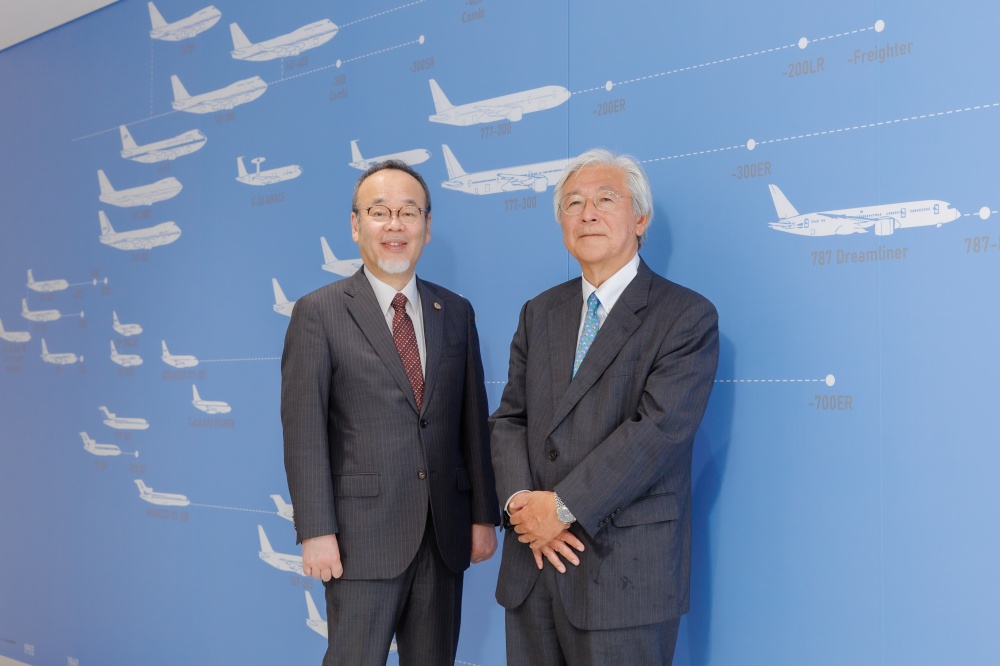
An aircraft that brings together the pinnacle of technology. Professor Kiyoyuki Kanbe has long faced the challenges of manufacturing and the high standards required for operation. In recent years, graduates who left under Professor Kobe have begun to make their presence felt in the aviation industry. We asked about the education that Oberlin values in the background (Interviewer: President J. F. Oberlin University Hiroaki Hatayama).
Obirin University students attracting attention in the aviation industry
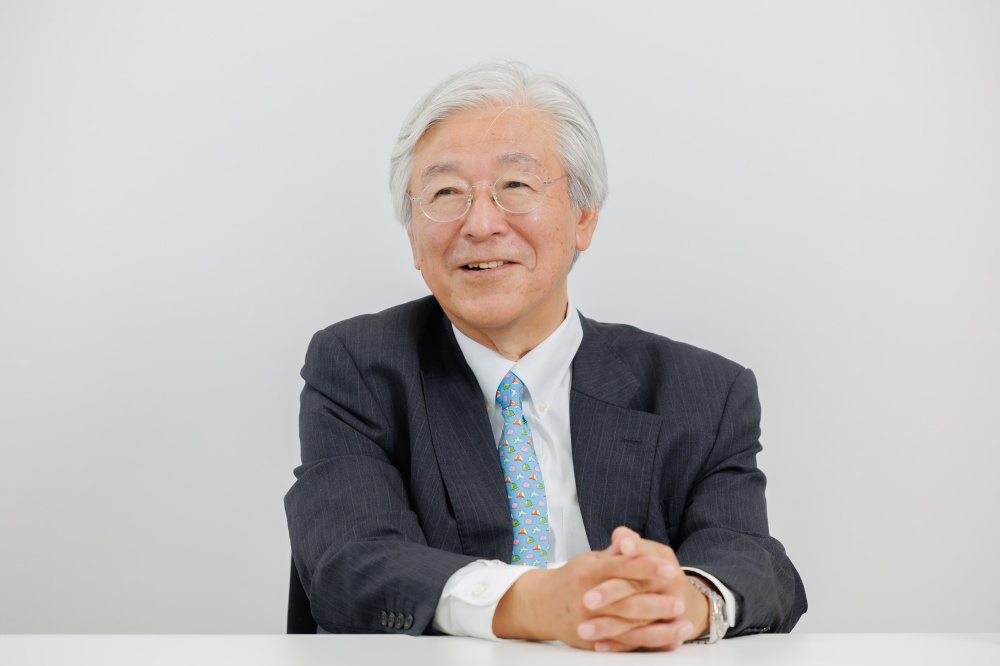
Hatayama: Mr. Kobe, who worked for many years at Japan Airlines, was a professional in the maintenance department. It's been six and a half years since you came to J. F. Oberlin University.
Kobe: When I first joined, I taught in the 'Aviation Management Department' at 'College of Business Management'. From 2020, I moved to the newly established 'Aviation and Management Department.' We have established programs to train various specialists who will carry the skies of the world.
Hatayama: Currently, College of Business Management 's Aviation Management program offers two courses: 'Airline Business,' which aims for a wide range of jobs in the aviation industry, and 'Airline Hospitality,' which aims for cabin attendants and ground staff. And at the Aviation Management School (now College of Aviation), to which the professor belongs, there are four courses: "Flight Operations," "Air Traffic Control," "Maintenance Management," and "Airport Management." How do you feel about your new academic campus?
Kobe: The Aviation and Management program attracts excellent students, and not only have students from the Flight Operations course, which has produced many airline pilots, been highly regarded by major airlines during their job search, but students from the other three courses that were newly established when the Aviation and Management program was founded are also receiving high praise from major airlines. It seems that our education is becoming widely recognized in the aviation industry and in society at large. When I asked my former colleagues at Japan Airlines about the reputation of Obirin University students, they said, "Obirin students have good personalities," and "There are some who will likely take on important positions in the future." In addition, recruiters said that "there is something different about them compared to students from other universities."
Hatayama: What kind of place is that?
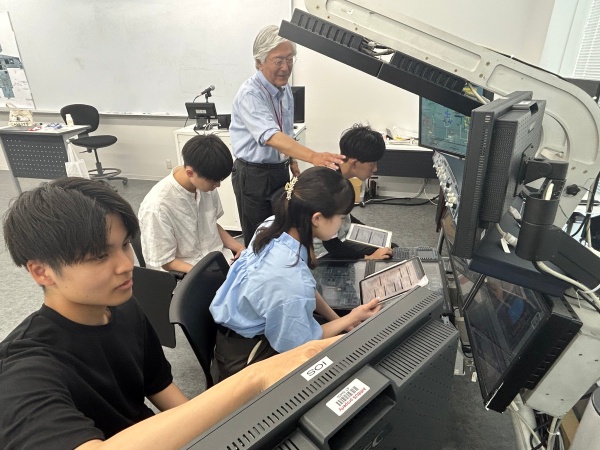
Kobe: First, there are many students who can use practical English. And another thing, and this is the most important, is that they have a strong sense of safety. So I was very pleased when they said they felt safe. In my seminar, we are conducting research on "aircraft reliability management" using the Airbus A320APT aircraft programmer trainer. "Reliability management" is fundamental to the operations of airlines, and it is about providing safety based on trust.
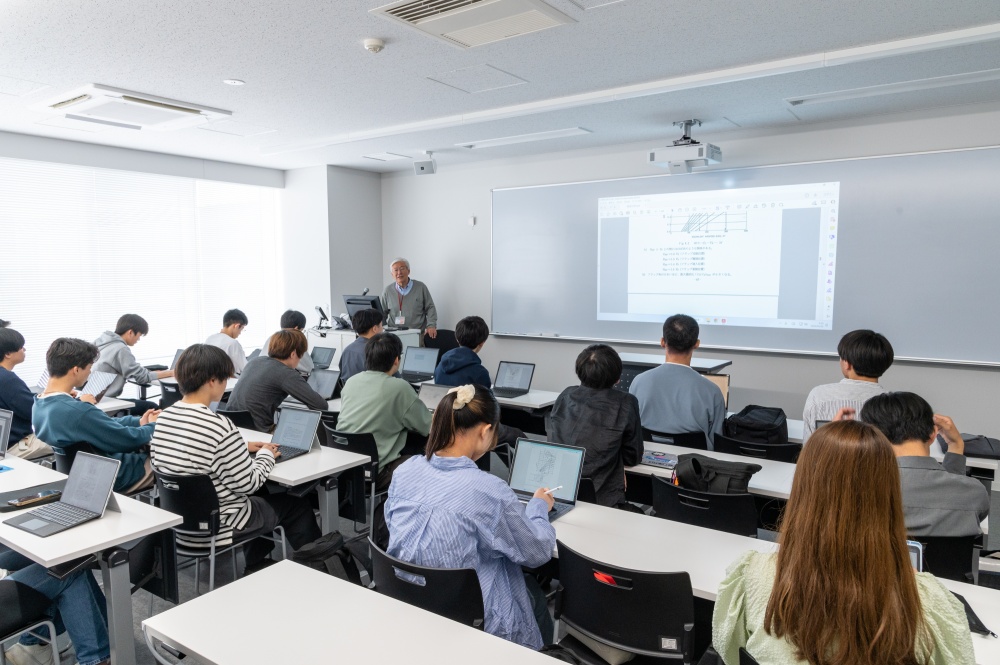
In the Aviation and Management program, this awareness is cultivated through training, practical exercises, and lectures. While the curriculum for all courses is based on aviation law, the fundamental premise of this law is "safety." In this way, students naturally acquire the concept of "reliability management."
Typically, airlines provide safety training to their employees over several years after hiring, but it could be said that this is already being practiced in the Aviation and Management program. During the job search process, this learning is accurately reflected in each student's application forms and interview responses, which seems to give companies a sense of reassurance.
Why is aircraft manufacturing so difficult?
Hatayama: That's very reassuring. By the way, Professor Kobe, I understand you majored in mechanical engineering during your student days. How did you end up joining Japan Airlines?
Kobe: My university professor was a thermodynamics expert, and my senior was conducting basic research at the National Aerospace Laboratory (NAL, now JAXA's Aeronautical Technology Directorate) to create a combustor for the jet engine to be installed on the experimental aircraft "Asuka." I was assigned there to help with the research. This was around the time the government began to seriously commit to the development of domestically produced jet engines.
I also had a senior colleague at Japan Airlines who told me to "study the latest jet engines," so I ended up working in their engine division. It was like an "internship" as we would call it today. After graduation, I was hired by them permanently.
Hatayama: I see. After losing the Pacific War, Japanese aircraft manufacturing was stagnant for a long time, wasn't it?
Kobe: One of the reasons is that we couldn't get the know-how from the United States regarding metal materials that can withstand high temperatures and pressures, which are especially important for jet engines. The U.S. doesn't grant licenses so that Japanese jet engines can't be sold in the U.S. After all, there's no point in making engines that can't be sold.
Hatayama: Was the YS-11 any good? It was the first passenger aircraft developed by Japan after World War II, right?
Kobe: The YS-11 had Japanese "Type Certificate*1" and "Airworthiness Certificate*2," but orders from U.S. airlines were limited for various reasons.
*1 "Type certification": A certification issued for each type of aircraft, certifying that its design and manufacture meet the specified safety standards.
*2 "Airworthiness Certificate": A certificate that certifies that an aircraft's strength, structure, and performance meet the technical standards for safety and environmental protection, after inspection. It's like a "vehicle registration certificate" for a car.
Hatayama: In Japan, after that, there was the HondaJet, a small business jet developed by Honda Motor Co., Ltd., and the Mitsubishi SpaceJet, which Mitsubishi Aircraft Corporation worked on developing but ultimately canceled.
Kobe: What sets the HondaJet apart from Mitsubishi Aircraft is that it was designed in the United States. Its headquarters are also in the United States, and it obtained its US type certification first. While there are restrictions on obtaining US type certification after obtaining Japanese type certification, type certification obtained in the US is recognized worldwide. That's where the difference between a successful and unsuccessful aircraft lies.
Hatayama: So, if you were to fly the HondaJet in Japan, would that mean importing it?
Kobe: That's right, it's an import. We've talked about "type certification" and "airworthiness certification," but there are also many certifications and licenses required for production. The aviation authorities in the US and Europe are not happy to approve these either. There are tens of thousands of aircraft equipment and parts, and each one of them has its own certification and license.
Aiming to become an essential airline engineer for the airline industry, I will strive for great growth.
Hatayama: I understand that you were seconded to Boeing in the United States while you were working for Japan Airlines. Were you involved in jet engine development there?
Kobe: No, no, the jet engines used in Boeing aircraft are mainly developed and manufactured by three companies (Pratt & Whitney, GE, and Rolls-Royce). This is a bit complicated, but at the time, Japan Airlines was one of the launch customers for the Boeing 777, which Boeing was developing. A launch customer is a customer that places an order large enough to convince Boeing to proceed with manufacturing and development, and acts as the backing for launching the new aircraft manufacturing plan.
Boeing could no longer manufacture aircraft on its own, and began incorporating input from aircraft parts manufacturers and airlines in various countries from the manufacturing stage onward. I participated in the design of the interface between the jet engines and the airframe. At that time, numerous new technologies were being adopted in the airframe and jet engines, and new technologies that improved aircraft reliability, such as fault information systems, were being introduced one after another.
Hatayama: When you think about the history of airplanes, it's really interesting how politics, economics, and technological innovations are all involved. I could listen to you talk all day long (laughs). I envy the students. Also, when we were setting up the Aviation and Management department, I learned about the depth of the work of "maintenance," which is Professor Kobe's specialty.
Kobe: The Aviation Act, a law governing all aspects of aviation, contains two important regulations related to air transport businesses. One is the "Operational Regulations." Pilots and cabin crew are directly involved in these regulations. The other is the "Maintenance Regulations." These regulations define how airlines maintain aircraft to ensure that the aircraft, as their business tool, maintains its original performance and quality—in other words, to manage reliability. Maintenance technicians are directly involved in these "Maintenance Regulations." There are many required qualifications, including the "First-Class Aircraft Maintenance Technician" license stipulated in the Aviation Act, as well as in-house certifications, and each technician must continuously maintain their skills. Only after both the "Operational Regulations" and "Maintenance Regulations" are in place can an airline be authorized to operate. Maintenance is a very important foundation.
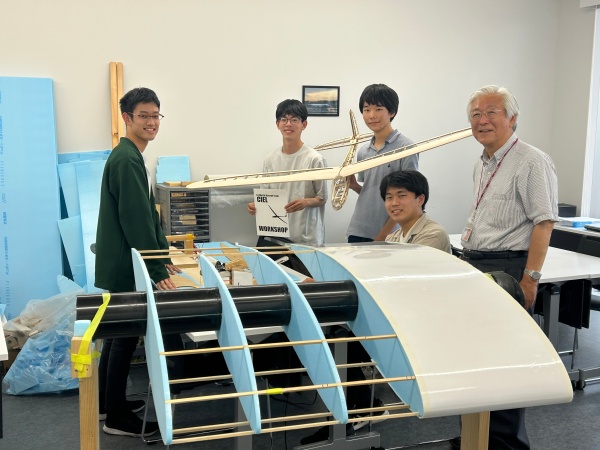
The club "Ciel" aims to participate in the "Birdman Contest" held at Lake Biwa.
He also serves as an advisor to both "Simfinity," a club that uses Airbus's A320 aircraft training equipment (APT) to learn about its structure and safe operation.
Hatayama: This relates to the "reliability management" of aircraft that you have been consistently emphasizing.
Kobe: As the students cultivate advanced expertise through classes, training, and overseas internships, they all grow into completely different people, both physically and mentally. Their physical growth is probably due to eating a lot of meat overseas (laughs), but it's their way of being as "people" that grows. They come to deeply understand how important "trust management" is.
In 2023, we renovated Tama Academy Hills, further enhancing our educational facilities. As the only academic group in Japan specializing in aeronautics, we hope that students will strive to become specialists in the aviation industry.
J. F. Oberlin University College of Aviation Professor
Kiyoyuki Kanbe
In 1975, he entered the School of Science and Engineering at Waseda University. While enrolled, he conducted basic research on turbine engine combustors at the Aerospace Technology Research Institute. In 1979, he graduated from the Department of Mechanical Engineering, School of Science and Engineering, Waseda University. That same year, he joined Japan Airlines and was assigned to the maintenance department. Seconded to Boeing in the United States for two years, engaged in the development project of the "B777." After returning to Japan, I gained extensive experience in the maintenance departments of airlines, including maintenance, planning and finance, production management, technical management, and quality assurance. In 2016, he left the company. Since 2019, he has been a member of the Japan Aeronautical Engineers Association Aircraft Mechanic and Manufacturing Engineer Training Liaison Council. J. F. Oberlin University joined College of Business Management in 2016 as a part-time lecturer in the Department of Aviation Management. In 2019, he became a professor in the student group. Since April 2020, he has been in his current position at the newly established Aviation and Management Department. First-Class Aircraft Maintenance Engineer, Aviation Radio Operator