[Collection of Schools of Thought] 13. Tomoko Ikeda Mr. -Alumni and Student Interviews
Faculty and President Dialogue
Japanese and English, language and non-language. I saw it as I went back and forth. Possibilities of Communication
College of Global Communication Student Leader
Tomoko Ikeda Professor
Main content
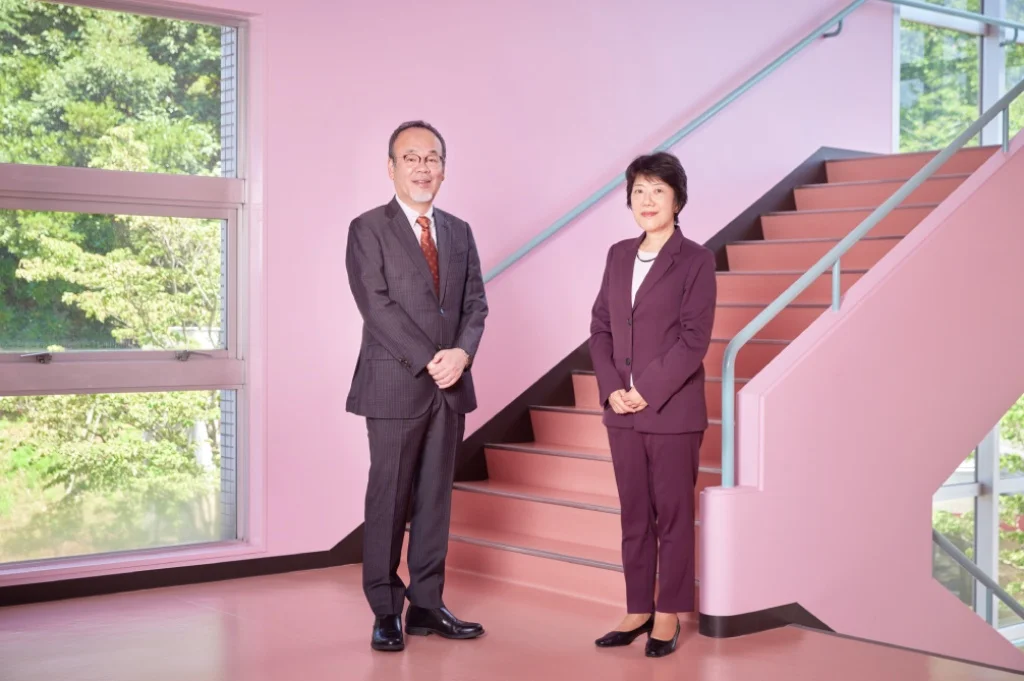
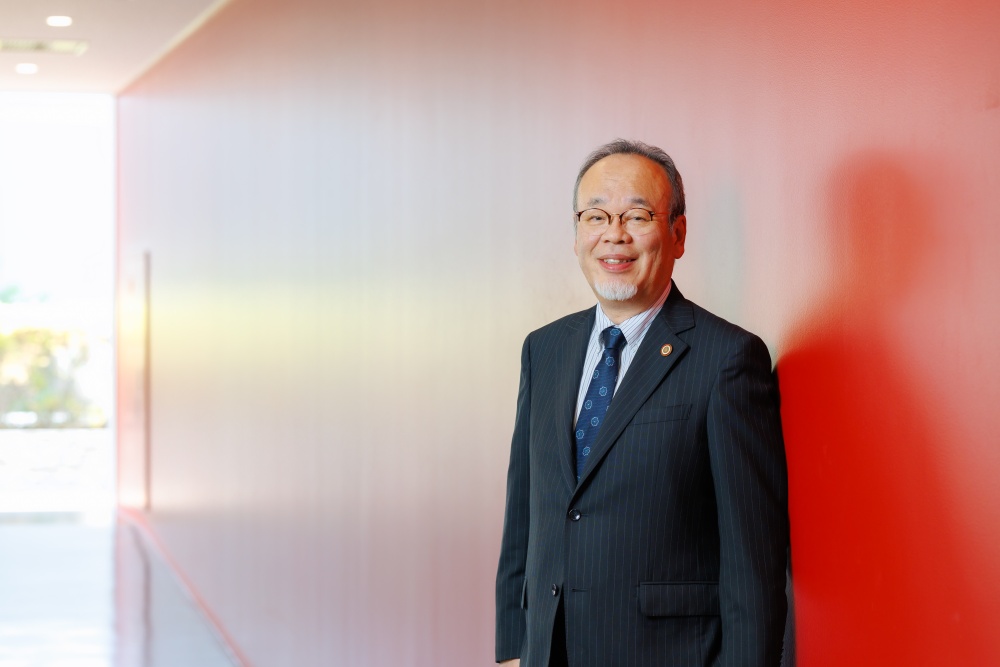
Professor Tomoko Ikeda, who has been interested in bridging the gap between Japanese and English since his student days, began his career in the field of Japanese education. In graduate school, he devoted himself to researching communication and ended up being exposed to different cultures while studying abroad. As the head of the College of Global Communication, we set the goal of truly realizing "multicultural coexistence" (Interviewer: J. F. Oberlin University Hiroaki Hatayama President).
During my student years, I developed an interest in American culture, society, and counterculture.
Hatayama: Professor Ikeda, you serve as the head of the Global Communication (GC) program. The GC program will be starting a new curriculum from the 2023 academic year. What are some of its key features?
Ikeda: There are three large pillars. First, a thorough language enhancement program. You will study intensively in one of the English, Chinese, or Japanese language tracks. Next, students choose one of three Major ("Public Relations Major," "Language Inquiry Major," and "Cultural Co-creation Major") to acquire knowledge and skills useful in a global society. The goal is to develop foreign language skills while also developing the ability to think about what to do with them. The final pillar is international exchange and cross-cultural experiences that can be experienced both on campus and at the study abroad destination. In principle, everyone studies abroad for one semester, and we provide learning opportunities to help students envision their future in society, such as obtaining qualifications and leading to career development.
Hatayama: I feel like I can gain a global perspective and make great strides. Professor Ikeda, you yourself graduated from the Department of English and American Studies at Tokyo University of Foreign Studies, but what made you interested in English?
Ikeda: I think it's similar to young people today, but the trigger was music. I thought, "I want to understand English lyrics," and that sparked my interest in the culture that emerged from it. In the early 1970s, the first Western music that awakened me to it was Carly Simon's "You're So Vain." Later I thought, "Oh, that strange voice singing in the background, that's Mick Jagger!" (laughs). ...It seems like we could go on and on if we talk to Professor Hatayama, who loves music.
When I was a student, I was interested in moving "between Japanese and English," so I participated in a translation seminar at university. However, I spent most of my time on mountaineering club activities. From rugged mountain hikes like "bushwhacking" through the thickets of Oku-Tone to more popular destinations like the Northern Alps. Mountaineering is a movement started by young people in Germany who advocated a return to nature in response to a modernizing society, and I myself have been drawn to so-called "counterculture" since junior and senior high school. I also researched student movements of the 1960s.
Hatayama: I'm roughly the same age as you, so I understand completely. When we were in high school and college, Japan was in a period of stable growth after a period of rapid economic growth. When you're going through good times, students tend to gravitate towards punk music or empathize with tragedies. Conversely, during difficult times, cheerful discourse becomes popular. After graduating, you worked for a company before becoming a Japanese language teacher, is that right?
"This is it!" said the Japanese language teacher trainee.
Ikeda: When I was a student, I wanted to become a subtitle translator, so I attended translation school and spent my days taking notes while watching foreign films at the cinema. But I thought I needed to gain experience working in an organization, so I got a job... However, I found working for a company very painful, so I quit after six months.
Then, one day while working part-time, I was browsing women's magazines at a bookstore. In the information section at the back, I found an advertisement for a Japanese Language Education Society recruiting trainees for Japanese language teachers. At that moment, I thought, "This is my calling." As I mentioned earlier, I really enjoyed moving back and forth between Japanese and English, and I also enjoyed communicating with people. I thought that this job might allow me to travel abroad. The following year, I got a job at a Japanese language school, where I worked on administrative tasks such as visa applications for international students while undergoing training.
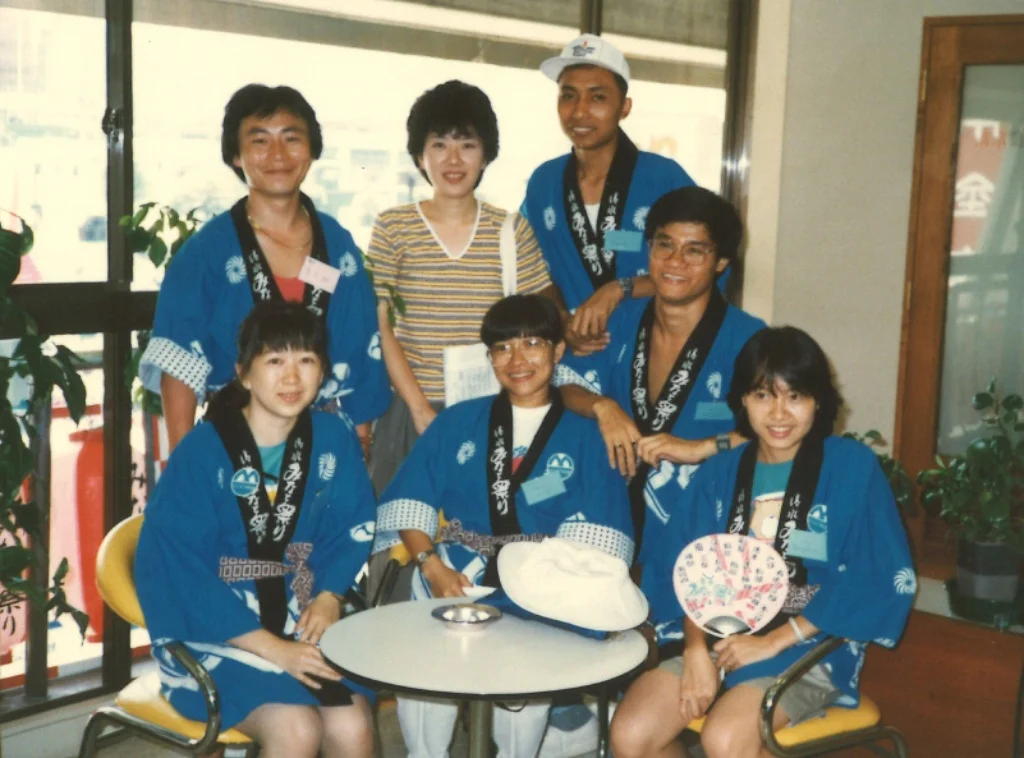
My early days as a novice Japanese language teacher, the starting point of my professional career. Participating in the Shimizu Port Festival (1985) with students (from Thailand and South Korea) I taught at a Japanese language school in Shibuya.
Hatayama: How long did you work at the Japanese language school?
Ikeda: I worked as an administrative staff member and full-time lecturer for four years. After that, I wanted to experience graduate school studies and studying abroad, so I applied to be one of the first participants in a project by the North American University Educational Exchange Committee (at the time). It was a program where I would be sent to the United States or Canada to study at graduate school while teaching Japanese at that university, and a scholarship was guaranteed.
Hatayama: That was around the time when Japanese was experiencing a huge boom in American universities. There were lots of Japanese classes, and not enough instructors.
Ikeda: It was perfect timing. It was 1988. Before the participants were sent to various parts of North America, there was a few months of training in Georgia, which was my first time in America, and being suddenly in the South, known as the "Deep South," had a huge impact on me. I wasn't used to the unique English with its long vowel sounds at first, and I was impressed by the sight of people dressed up and gathering at church on Sundays, as it is a region with many devout Christians. In the end, I was chosen for Texas from the list of partner universities. At the time, "Texas" only brought to mind images of cowboys and deserts, so I was not particularly keen on going, but looking back now, it was a really good thing because it was a culturally diverse place.
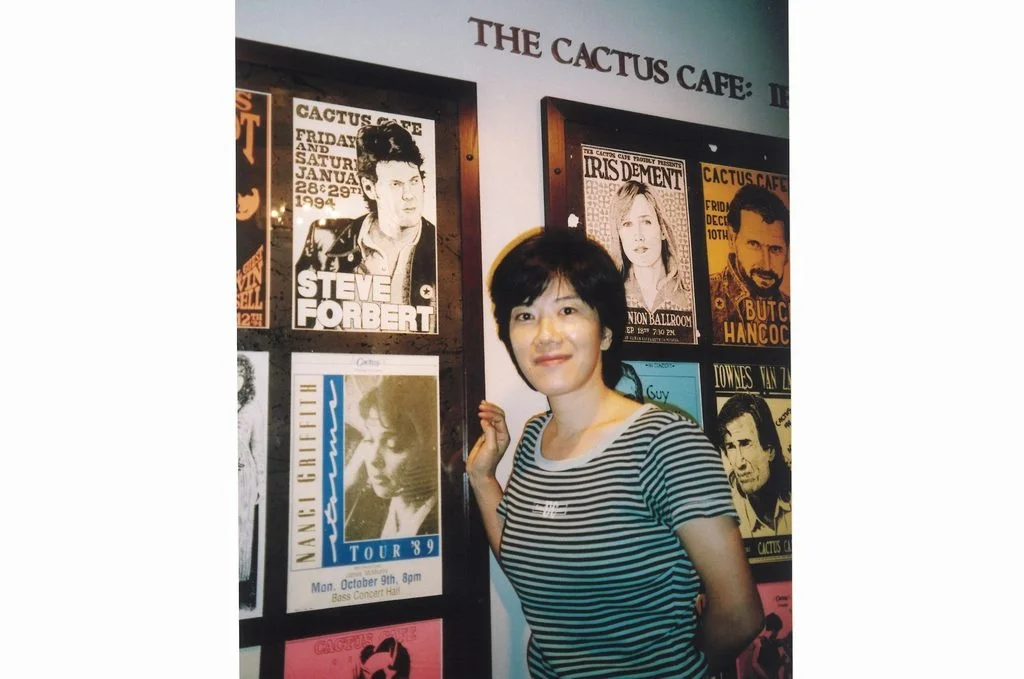
At the Cactus Cafe, a hallowed hall for singer-songwriters located in the student union building at the University of Texas at Austin (2006). It's one of the most memorable places on campus, where I spent a lot of time between classes and writing papers.
Hatayama: Even so, it must have been very difficult to teach while studying yourself.
Ikeda: In my master's program, I chose the field of "Speech Communication," and I started learning rhetoric from Plato, Aristotle, Cicero, and others. I had already been in the world of Japanese language education for four years, so I enjoyed teaching. I was surprised at how different the students' attitude towards classes was compared to when I was teaching in Japan. Students in Texas are very demanding of their teachers.
After returning to Japan, in 1991 I took on the role of providing pre-graduate education to government-sponsored international students who were about to enter undergraduate programs at the Japanese Language School affiliated with my alma mater, Tokyo University of Foreign Studies. Students came from a wide variety of countries, including Asia, Europe, Africa, Central and South America, and Oceania. I continued in this role for about eight years, but then I resigned to pursue a doctoral degree and returned to Texas. This time, I went to the University of Texas at Austin.
Hatayama: What kind of research did you do in your doctoral program?
Ikeda: During my master's studies, I mainly researched "nonverbal communication," so I developed from there and conducted interaction analysis using "conversation analysis" and micro-ethnography approaches, drawing from the lineage of "ethnomethodology," a current trend in contemporary sociology. Ethnomethodology is a discipline that focuses on the daily actions and common-sense activities of people living their lives and aims to clarify their "self-evident nature."
My doctoral dissertation studied how native and non-native Japanese speakers communicate using non-linguistic resources. Instead of viewing language and non-linguistic communication as two completely different poles, I adopted a multimodal approach, analyzing them as a single entity. Using this method, I examined from various angles how non-native Japanese speakers participate in interactions. It wasn't about generalizing about the communication styles of Japanese people or people from other cultures, but rather about observing and unraveling what was happening in the moment. It was quite interdisciplinary.
Encountering the practice of autonomous learning and thoughts on multicultural coexistence
Hatayama: That's really interesting. After earning my doctorate, I returned to Japan and went to J. F. Oberlin University. Currently, what focus do you place on your research?
Ikeda: I am most interested in language education, international group training, and citizenship. Regarding Japanese pedagogy, the encounter with autonomous learning and learner autonomy practiced by J. F. Oberlin University was significant. Learners have decision-making power and control their learning, and Obirin is the leading expert in practical Japanese language programs. Based on this philosophy, each learner plans independently, analyzes, and proceeds in consultation with the teacher, practicing the lessons. From a teacher's perspective, the preparation is tough because it requires an enormous number of drawers, but I feel that encountering this initiative is a valuable asset. We want to deepen this philosophy even further.
Hatayama: This trend isn't limited to language learning; it's becoming a trend in learning as a whole. It's shifting from lecture-style classes to active learning. This system is more costly and time-consuming than traditional whole-class instruction, so I think the challenge is to see how far we can implement it. Now, with ICT technology, it's becoming possible to a certain extent. Finally, as the head of the GC group, how do you want to grow the GC group going forward?
Ikeda: As we revamp our curriculum, in addition to the three pillars I mentioned at the beginning, we want to truly realize "multicultural coexistence," which has become a key word of our time. We want our GC students to see both "global"—outside of Japan, or the world—and "local"—within Japan, or where they are—and become people who work for a better society together with people from diverse backgrounds who make up the same society. We want to help them do that.
Hatayama: This perfectly aligns with the trajectory of your research, Professor. First, there's the "Language Track," and you're also an expert in "Communication." We are very fortunate to have such a wonderful person as the head of the faculty. We want to share this vision with the students and other faculty members and grow as a faculty.
J. F. Oberlin University College of Global Communication Student Council Head
Tomoko Ikeda
Graduated from the Department of English and American Studies, Faculty of Foreign Studies, Tokyo University of Foreign Studies, and completed a master's program in Speech Communication at Southwest Texas State University, USA. The University of Texas at Austin, Ph.D. in Communication Studies (Language & Culture), PhD. After serving as a full-time lecturer at Aoyama School of Japanese, part-time lecturer at the Faculty of Foreign Languages at Southwest Texas State University in the United States, and full-time lecturer and associate professor at the Center for International Students Japanese Education at Tokyo University of Foreign Studies, he has been at J. F. Oberlin University (Institute for Basic Education) since September 2007. In 2016, with the establishment of the school of study, it moved to College of Global Communication. Current position since April 2021