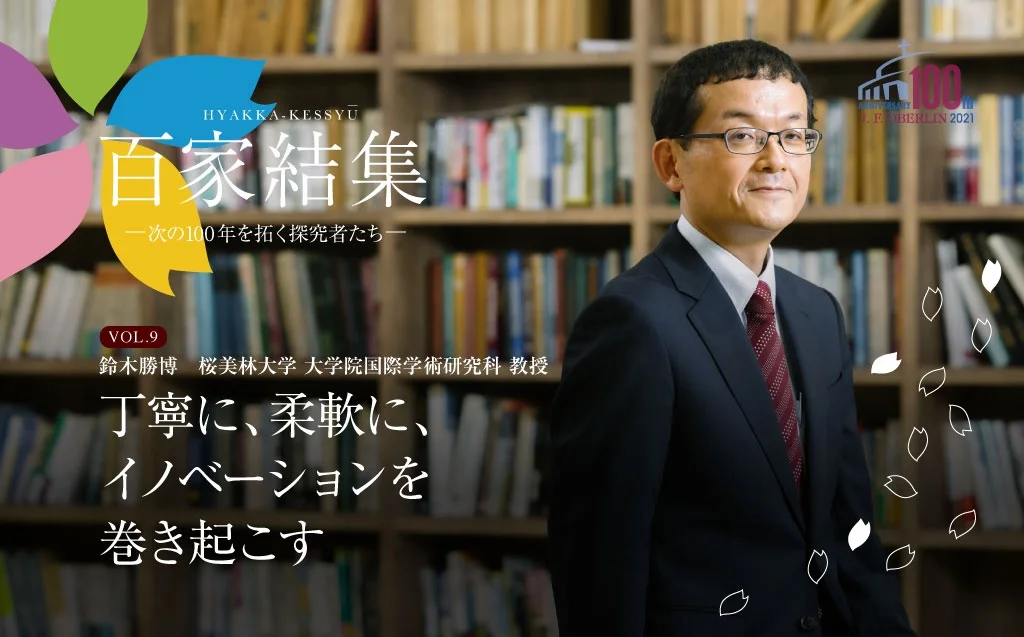
[Collection of Schools of Thought] 09. Katsuhiro Suzuki Mr. -Alumni and Student Interviews
Faculty and President Dialogue
Carefully and flexibly, Innovation to cause
Graduate School International Graduate School of Advance
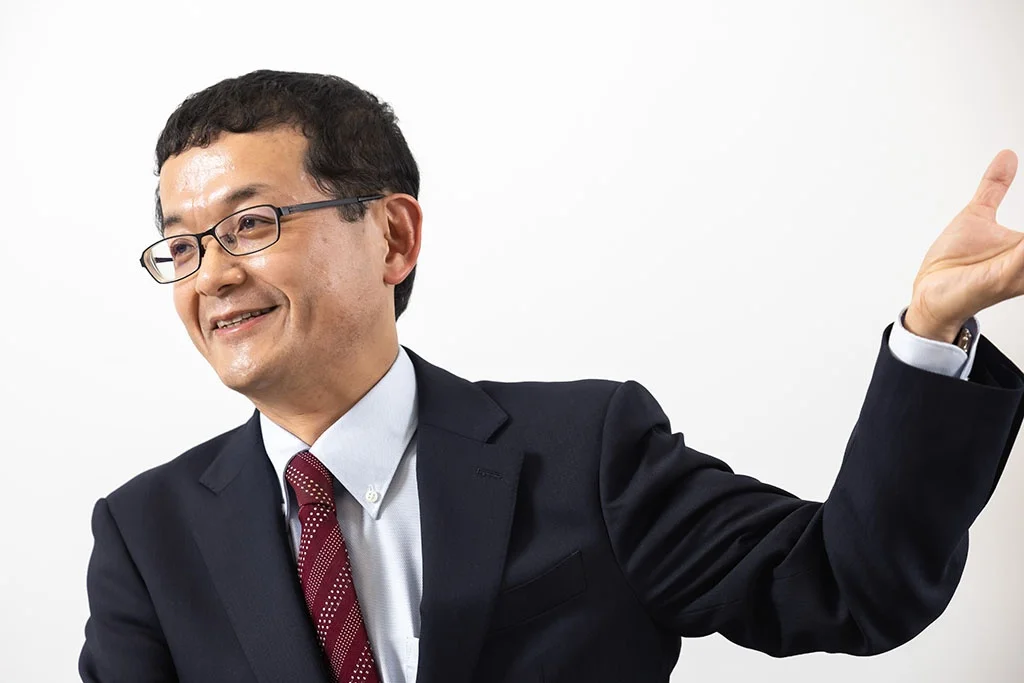
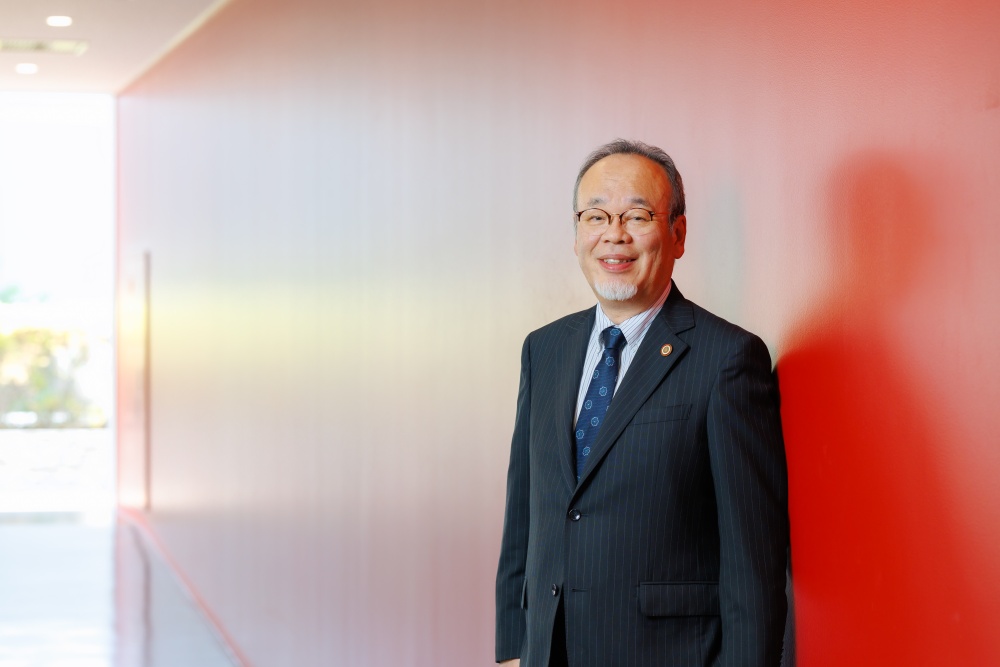
Katsuhiro Suzuki Professor
Main content
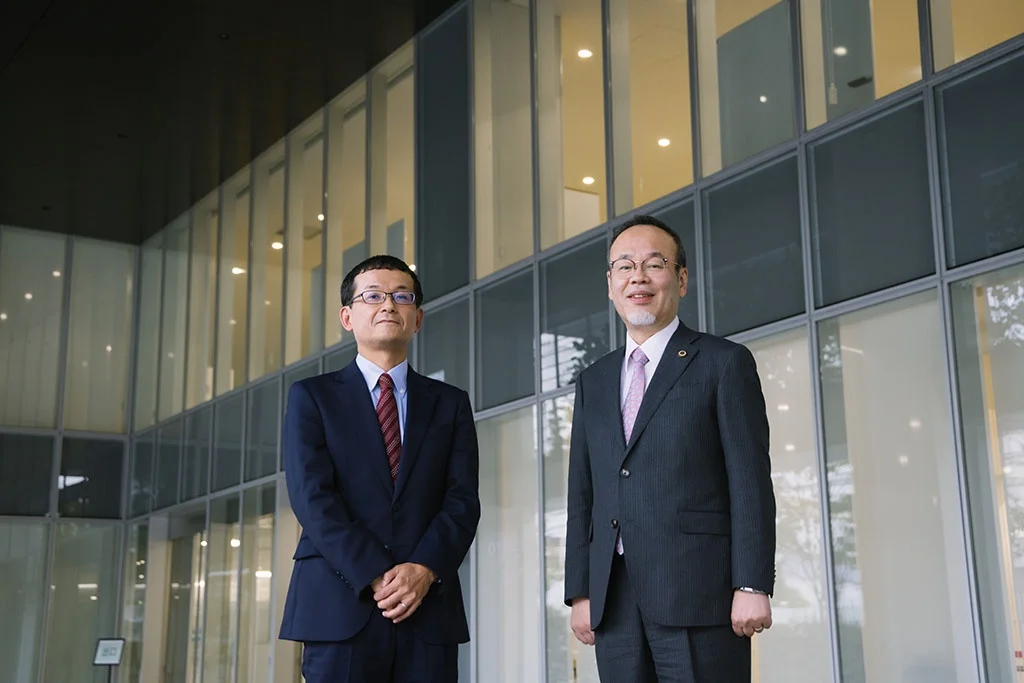
Professor Katsuhiro Suzuki, who studied physics and has worked at affiliated companies of audit firms, focuses on the theme of "innovation." Although this field evokes glamorous breakthroughs, it is said to be achieved by carefully analyzing customer emotions and solving small challenges (Interviewer: President J. F. Oberlin University Hiroaki Hatayama).
Aiming for innovation that I couldn't achieve during my time as a company employee.
Hatayama: Among J. F. Oberlin University with professors with unique backgrounds, Professor Suzuki has a unique profile. After studying physics at two graduate schools, Kyoto University and the University of Tokyo, he worked as a playing manager at a private think tank, an executive officer at a small and medium-sized enterprise, and research and education activities at other universities before coming to Obirin.
Suzuki: At Kyoto University Graduate School, I was in the experimental field, but I wanted to deepen my knowledge of theoretical physics, so after obtaining my master's degree, I re-enrolled in the master's program at the University of Tokyo Graduate School. I studied fluids and complex systems, and after obtaining my doctorate, I moved to an affiliate of a major private auditing firm, where I was fortunate enough to have the opportunity to work on analysis using physics methods. At the time, the keyword "econophysics" was also popular, and I was very interested in applying the methods I had researched to social sciences. However, in reality, I was so busy with daily work that I didn't have the time to develop a unique and "innovative" service.
Hatayama: So your experience studying physics connects to the "innovation education" you're currently working on. What exactly is the concept of "innovation"?
Suzuki: Originally, it meant "new combination," but the Chinese word "創新" (chūangxin), which is also used in the name of the Shinjuku campus building, might be a more fitting description. The development of groundbreaking new products, the introduction of new production methods, and the challenge of new sales methods are all fundamental to economic development. It's easy to say in words, but when I was working for a company, it was difficult to translate that into results. On the other hand, I would come across news of small and medium-sized enterprises that were developing highly unique products and making remarkable progress. I wondered, "How on earth are they doing it?" That's when I became interested in "innovation management."
Afterwards, while working as a part-time lecturer at another university, I continued my days conducting individual consultations with small and medium-sized enterprises, conducting research and education through industry-academia collaboration. J. F. Oberlin University joined in 2017, and now I work with students on 'innovation education.'
We understand our customers' needs and are completely dedicated to supporting them.
Hatayama: Could you tell me more about this "innovation education"?
Suzuki: Developing groundbreaking new products and fundamentally reforming organizations inevitably involves difficulties and pain. How do we cultivate individuals who can proactively contribute to such activities, or who can support (creators and projects)? I believe that education should instill in them the mindset and ability to take action. What we have been working on at our university is "problem-solving innovation." It is not innovation based on radical technology that will fundamentally change our lives. It is simple, but first we thoroughly think about, observe, and talk to our customers. Then we understand the situation and context in which our customers find themselves, and while comprehensively considering their "thoughts" and "emotions," we conduct hypothesis testing toward realizing innovation.
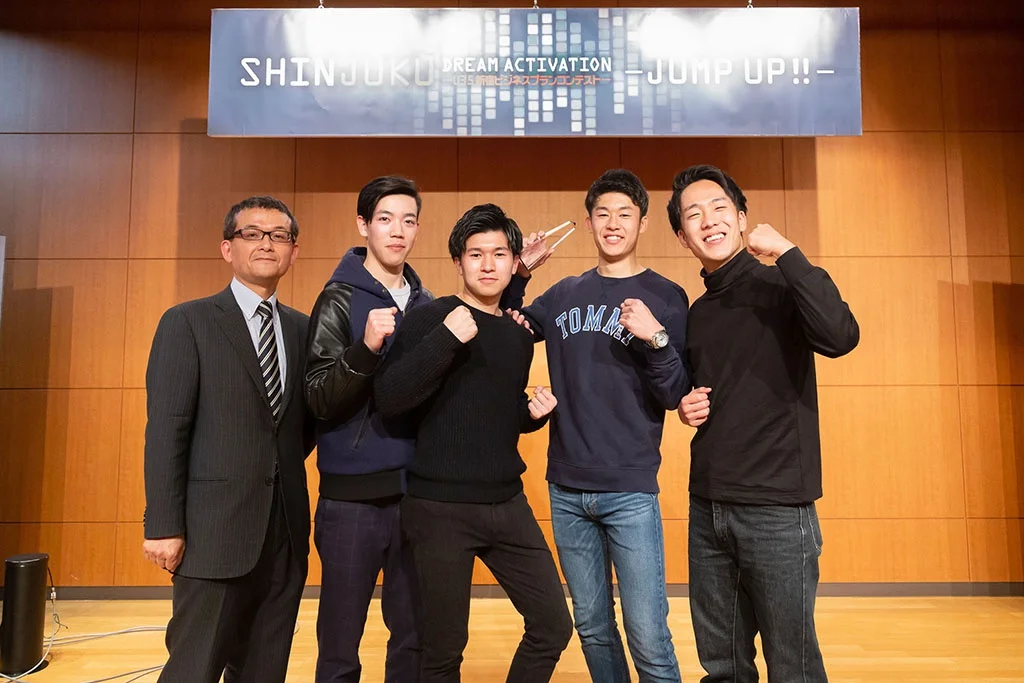
Hatayama: This is a concept of "design thinking," meaning you carefully observe the user, define the problem, and come up with ideas for solutions. A symbolic example of "raising needs" is that four students from the College of Business Management taught by Professor Suzuki won the Excellence Award at the 2019 "U35 Shinjuku Business Plan Contest."
Suzuki: The students presented on "Operating a website to share ideas for remaking caregiving clothing." They proposed an idea to solve the clothing-related problems faced by people with disabilities and their guardians, and to enrich their lives. They actually conducted numerous interviews with staff, students, and guardians of special needs schools, building trust that allowed them to elicit requests. There is still a long way to go before the business becomes a reality, but they received high praise for confirming that there is a real potential need. This is the result of sincerely engaging with customers and conducting thorough research before creating a "good-looking business model."
In another example, a student who had the experience of their own grandmother suddenly collapsing and being left unattended for three days without anyone noticing conceived a monitoring business for "elderly people living alone who appear healthy," and became a finalist in the same contest in 2020. At the heart of this was the student's strong desire to "never let something like this happen again." I feel that this attitude of thoroughly empathizing with the customer's feelings is what makes Obirin University unique.
With the students who won the Excellence Award at the 2019 "U35 Shinjuku Business Plan Contest." The contest, co-sponsored by Shinjuku Ward and the Tokyo Chamber of Commerce and Industry, is open to residents and students of Shinjuku Ward under the age of 35, and recognizes outstanding business plans while also providing support for their commercialization.
Shift your perspective and develop the flexibility to overcome adversity.
Hatayama: Professor Suzuki has also chosen "effectuation" as a theme. What exactly does that entail?
Suzuki: An Indian management scholar studied 27 successful entrepreneurs and analyzed their thought processes and behavioral strategies. Five practical principles are proposed, one of which is called the "Lemonade Principle." For example, suppose you try to source lemons to sell, but only get low-quality ones. When you're wondering "What do I do now?", you shift your thinking and decide to "Let's sell them as lemonade." When a problem arises, you try to use it to your advantage and turn it into a business opportunity. During the COVID-19 pandemic, there were companies that successfully transformed their business models or changed their products to create hits. I think those are typical examples. And actually, I think this is something that students at Obirin University are good at.
Hatayama: That may be true. Obirin students are not too rigid and are not afraid. Business schools make you do case studies thoroughly, don't they? What you learn there is that "if there are 100 examples, there will be 100 results." You get simulated experience of how to deal with those situations. If you have rigid thinking, you won't be able to adapt to the situation and you will fail. It's important to always start from zero, first look at the situation, and then respond flexibly.
Suzuki: That's right. We're hoping to cultivate that flexibility together with the proactive students of Obirin University.
J. F. Oberlin University Graduate School International Graduate School of Advance Professor
Katsuhiro Suzuki
In 1990, he graduated from the Faculty of Science at Kyoto University. In 1992, he completed the master's program in Physics II, Graduate School of Science, Graduate School of Science, University of Tokyo. In 1994, he completed the master's program in physics at the Graduate School of Science, University of Tokyo. In 1997, he completed the doctoral program at the same university. He has been active for about 10 years as a playing manager at a private think tank and as an executive officer at a small and medium-sized enterprise. Through practical work, he developed an interest in "innovation creation and its management," engaging in research, education, and venture support at public institutions such as the Organization for Small and Medium Enterprise Development, as well as universities like Waseda University and Tokyo Institute of Technology. In 2017, he became Associate Professor at J. F. Oberlin University College of Business Management, in 2019, Associate Professor at the Graduate School of Business Administration, Osaka University, and since April 2021, he has held his current position