[Collection of Schools of Thought] 08. Mr. Reiko Kobayashi-Alumni and Student Interviews
Faculty and President Dialogue
Fostering talent across disciplines The heart of opera and the culture of musicians
College of Performing and Visual Arts
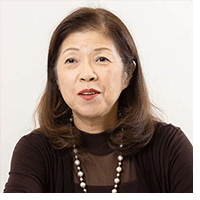
Reiko Kobayashi Professor
Main content
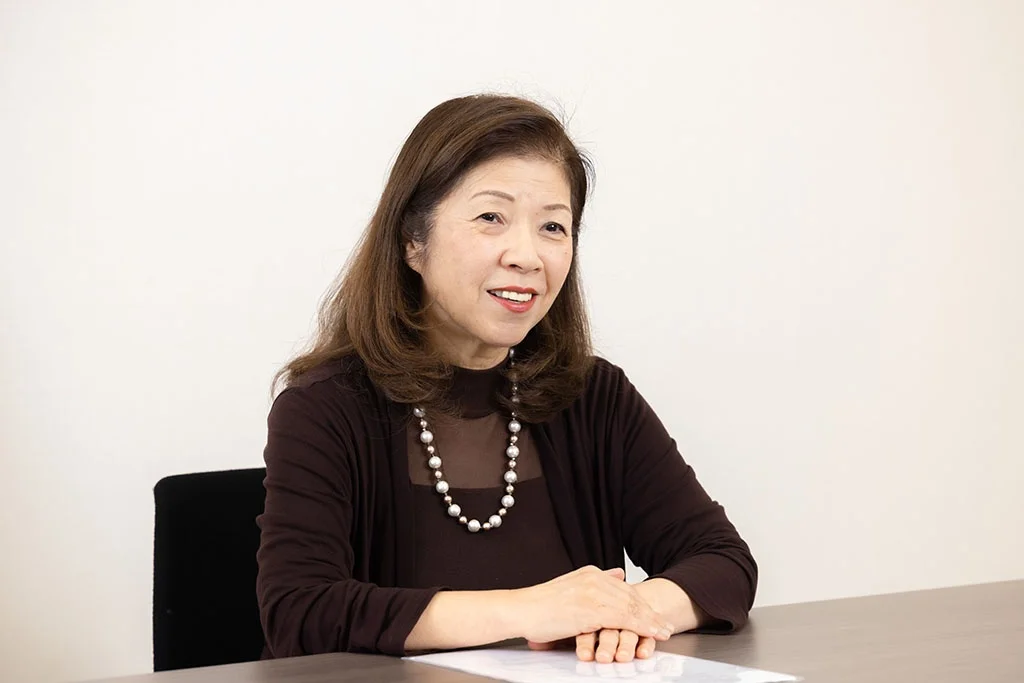
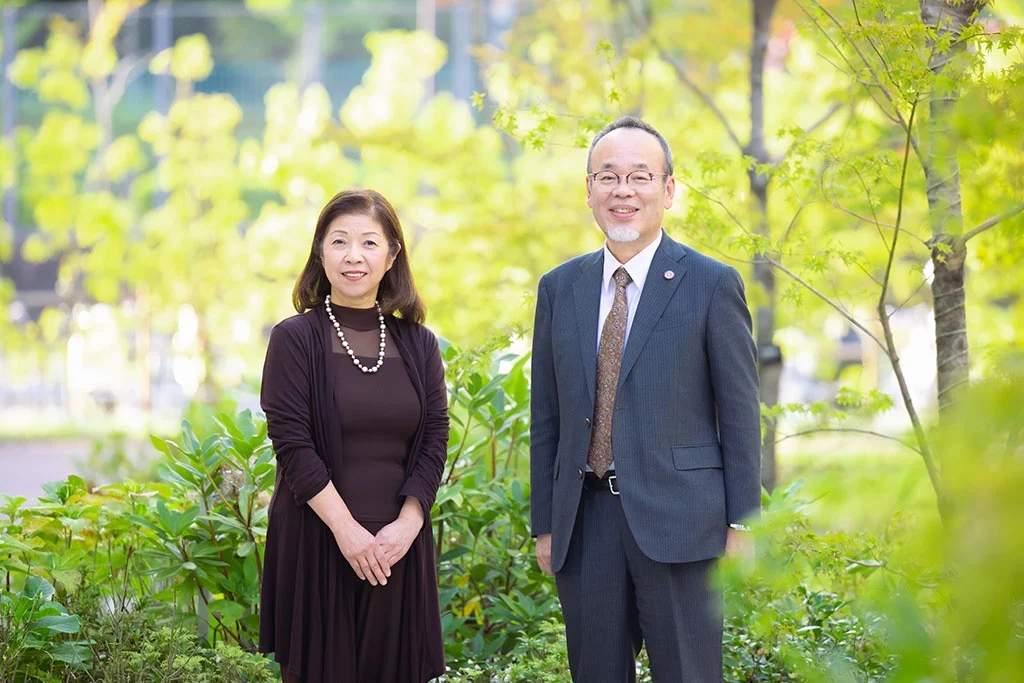
Professor Reiko Kobayashi, who has performed the opera 'Madama Butterfly' in theaters across Europe for many years. Guided by my mentor, I seized the opportunity in Italy and blossomed into a large flower. The spirit of opera I want to convey to students, and the 'cultural knowledge' of music that can only be gained at Obirin— (Interviewer: President J. F. Oberlin University Hiroaki Hatayama).
Seeking something that "cannot be stolen" by anyone, I enrolled in a music university.
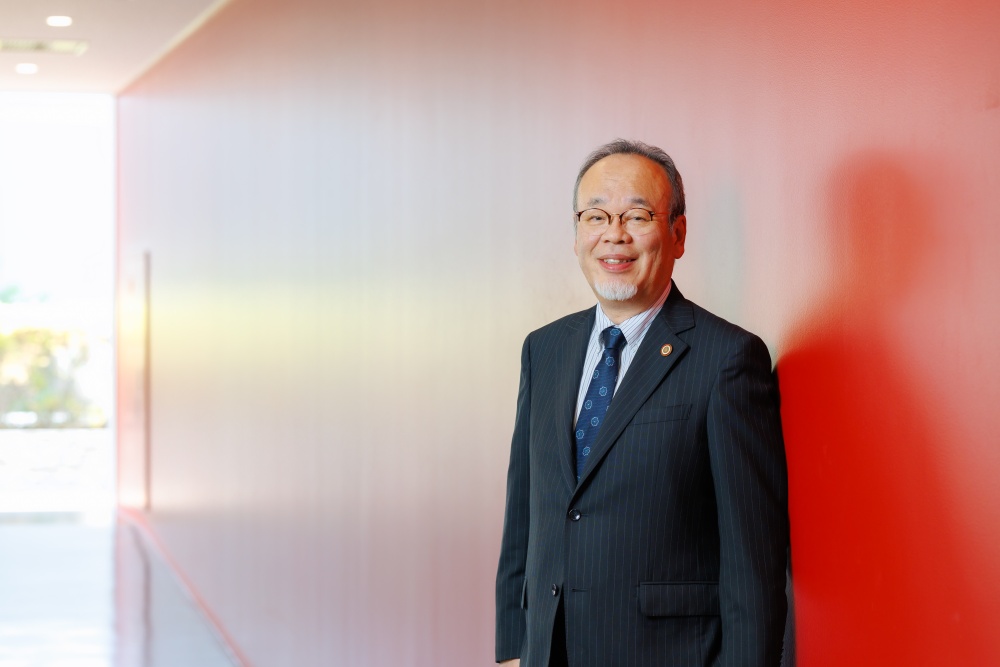
Hatayama: Ms. Kobayashi, as a vocalist, you have performed "Madame Butterfly" nearly 70 times in various European countries. What led you to go to those places?
Kobayashi: To begin with, I wasn't from a wealthy family; I grew up in a very ordinary family in Shinshu. Back then, it was rare for women to even attend a four-year university. When I told my family I wanted to go to music college, they all opposed it. But then, I was encouraged by the words of my piano teacher, whom I was studying with for the entrance exams at the time: "Wear something that a thief can't steal."
Hatayama: "Something that can't be stolen by a thief"?
Kobayashi: My teacher told me this: "Expensive bags and jewelry are gone if they're stolen by a thief. But education, once you acquire it, can never be stolen by others. Go to university and do what you want to do." My parents sent me off on the condition that I become a music teacher at a school. And at the Nagoya University of Arts, where I enrolled, I met another mentor (Mr. Motoharu Nakajima) who would change the course of my life. He encouraged me, saying, "Your singing voice is soft, round, and deep. You have the voice to sing Italian opera, so go for it."
Then, at the age of 24, I went to study abroad and attended a music conservatory in Italy, spending my days participating in competitions. One day, after sharing first place in a competition, a tenor student from the same conservatory recommended me to an agent, saying, "They're looking for a young, pretty girl with the vocal talent to sing 'Madama Butterfly.' Reiko, why don't you go and check it out?"
Hatayama: "Madama Butterfly." It's an opera composed by Puccini. Set in Nagasaki, it depicts the marriage of the beautiful geisha "Cio-Cio-san" to a US Navy officer, and its tragic ending. The aria "Un bel dì vedremo" (One Fine Day) is famous.
Kobayashi: It seems they were looking for a Japanese person who could wear a kimono, kneel with their hands together, and say "Welcome." I passed the audition and began touring relatively large theaters throughout Europe. This was right after I finished at the conservatory. You might think that everything went smoothly, but that wasn't actually the case. In fact, I failed the final exam at the conservatory once. And that was because one examiner gave me a low score, simply because I was Japanese. Looking back now, it was a terrible act of harassment, but thanks to my graduation being delayed by a year, I was able to pass the audition for "Madame Butterfly." You never know what life will bring.
With the teachings of my mentor in my heart, I will convey the true essence of opera at Obirin University.
Hatayama: What is the most memorable performance in your career?
Kobayashi: It was four months after my first child was born when I performed in "Madama Butterfly." It was in the autumn of 1986 at the Basel Opera House in Switzerland. I had a local babysitter look after my child at the hotel where we were staying for about a week, and whenever I found a break in rehearsals, I would rush back to the hotel to breastfeed. The performance ended without incident, and when I went out onto the stage for the curtain call, exhausted, about 2,500 audience members all rose to their feet at once to welcome me. I thought, "I can't believe this is happening!"
Hatayama: After about 25 years living in Europe, I returned to Japan in 2005 and was assigned to J. F. Oberlin University. Based on my experience in Italy, what I have incorporated into my education at Obirin is something I have incorporated.
Kobayashi: Japanese people are just too reserved! Opera in Italy is much more open and something that absolutely has to be conveyed. There's no such thing as "the beauty of stillness." I instruct my students to discard their previous concepts and to directly express their desire to "communicate."
Hatayama: One of your students, Miwako Okamura, who was mentored by you, won first place at the Riccardo Zandonai International Vocal Competition held in Italy in July 2021.
Kobayashi: Okamura-san has grown tremendously during her four years at Obirin University. I have always tried to pass on my experiences to my students by recalling my mentors in Nagoya, such as "This is the kind of guidance they gave me in situations like this" and "This is what they said to encourage me."
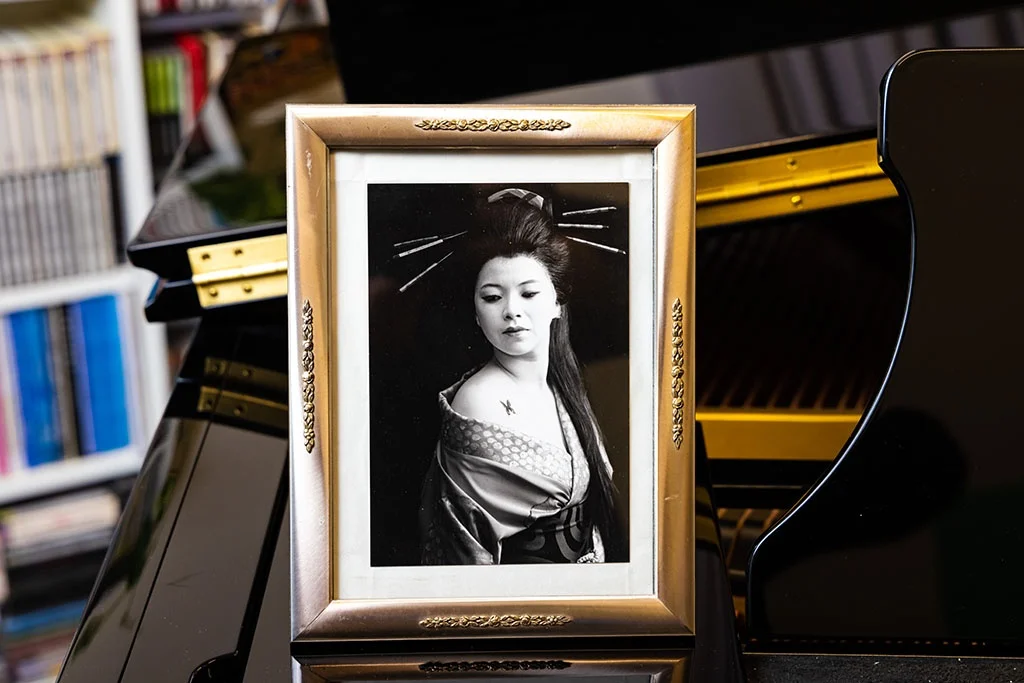
A photo taken in 1986 when she performed "Madama Butterfly" at the Basel Opera House in Switzerland.
Cross-disciplinary learning expands on the new campus.
Hatayama: In spring 2020, College of Performing and Visual Arts began their studies at the newly opened Tokyo Hinatayama Campus.
Kobayashi: The greatest appeal of Music Major is that you can learn music from a broad perspective across different fields. At existing music universities, if you specialize in vocal music, you can only study vocal music as your main major. At Obirin, students in their first and second years can study two main fields: vocal music, piano, musicals, jazz, popular, and composition. To develop the "culture" of a musician, studying only classical music is inflexible. You try to explore various fields broadly and decide, "This is what I want to do." Obirin can do that. You can also get a teaching license. Once the hall currently under construction is completed, opportunities for performances will continue to expand.
Hatayama: The 'Tokyo Hinatayama Campus' is adjacent to the large new town Machida Yamazaki housing complex, and buses run continuously from Machida Station. It would be great to open a Events where local people can easily get familiar with music. College of Performing and Visual Arts also offers "Music Major," "Theater & Dance Major," and "Visual Arts Major." Like in Europe, you can have a little wine around the hall, savor some snacks, listen to an ensemble, or watch a play. I hope that someday I can do something like that.
Kobayashi: I want to increase the opportunities for students to perform as much as possible. For example, operas by the vocal seminar, concerts by the piano and instrumental seminars, and musicals. I want to try everything that can be done on stage.
J. F. Oberlin University College of Performing and Visual Arts Professor
Reiko Kobayashi
After graduating from the Vocal Department of Nagoya University of the Arts, he completed the vocal studies at the Milan Verdi National Conservatory. He won 4th prize at the Novara International Vocal Competition, 1st place in the vocal category at the Costantino Fiocchi International Music Competition, 1st prize at the Enna International Vocal Competition, and 1st place at the Puccini International Vocal Competition. From 1981, he was based in Milan, Italy for 25 years, where he was active. In 1983, she made her European debut singing the title role in the opera 'Madama Butterfly' at the Filz Theater in Germany. Madama Butterfly was performed a total of 67 times in the Netherlands, Belgium, Switzerland, France, and Italy. She also appeared 10 times in Europe as Mimi in 'La Bohème.' Since 2005, he has been teaching at J. F. Oberlin University, and is currently a professor of College of Performing and Visual Arts Music Major