[Hundred Schools of Thought] 05. Atsushi Ogaki Mr. -Alumni and Student Interviews
Faculty and President Dialogue
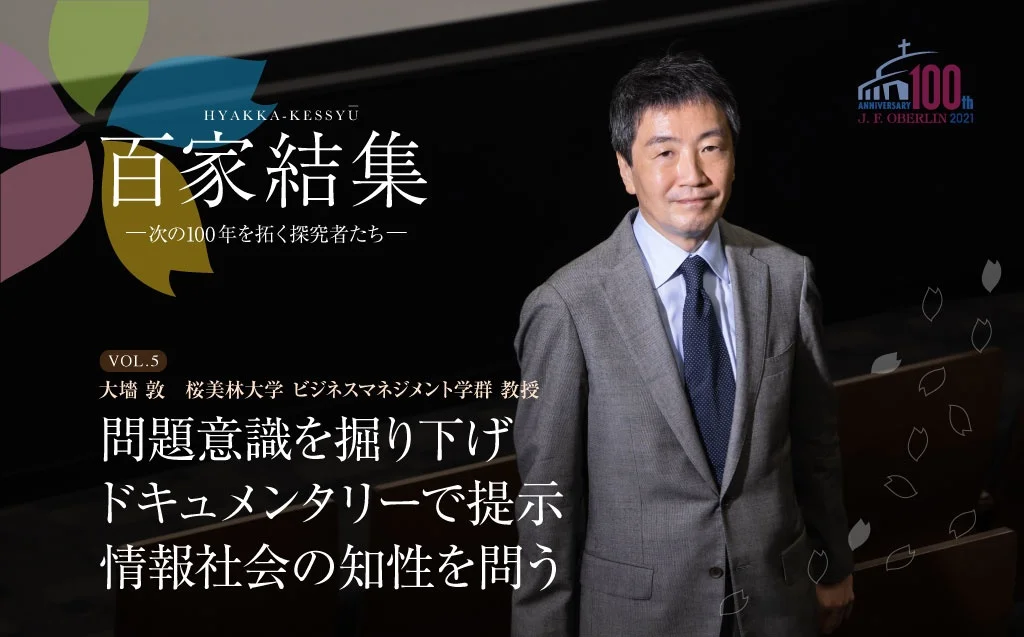
Delving deeper into the problem Presented in the documentary Questioning intelligence in the information society
College of Business Management
Atsushi Ogaki Professor
Main content
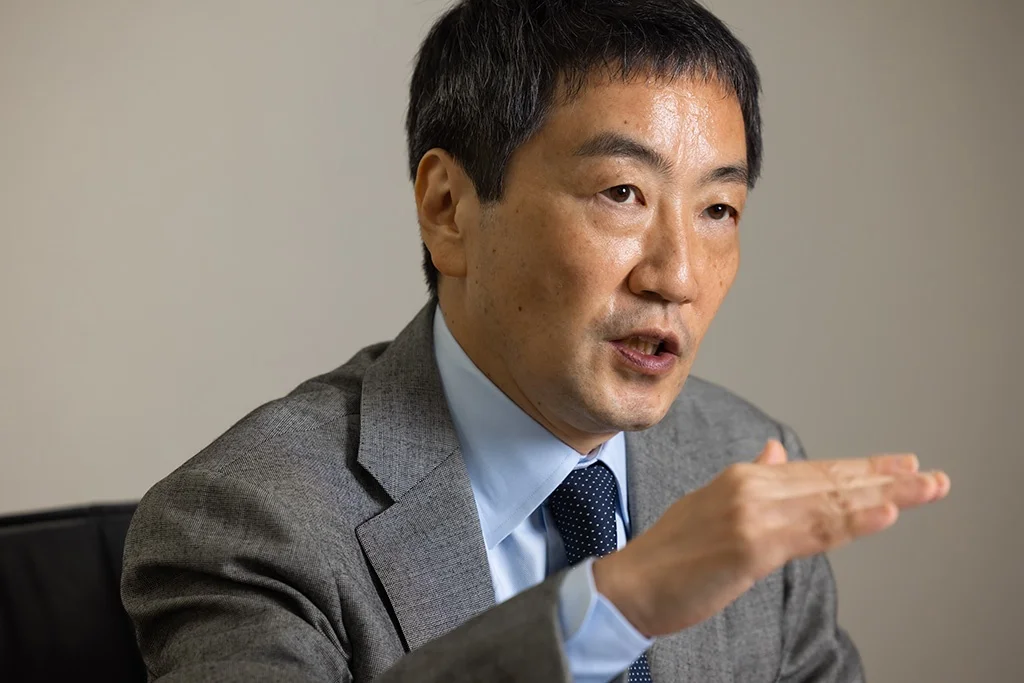
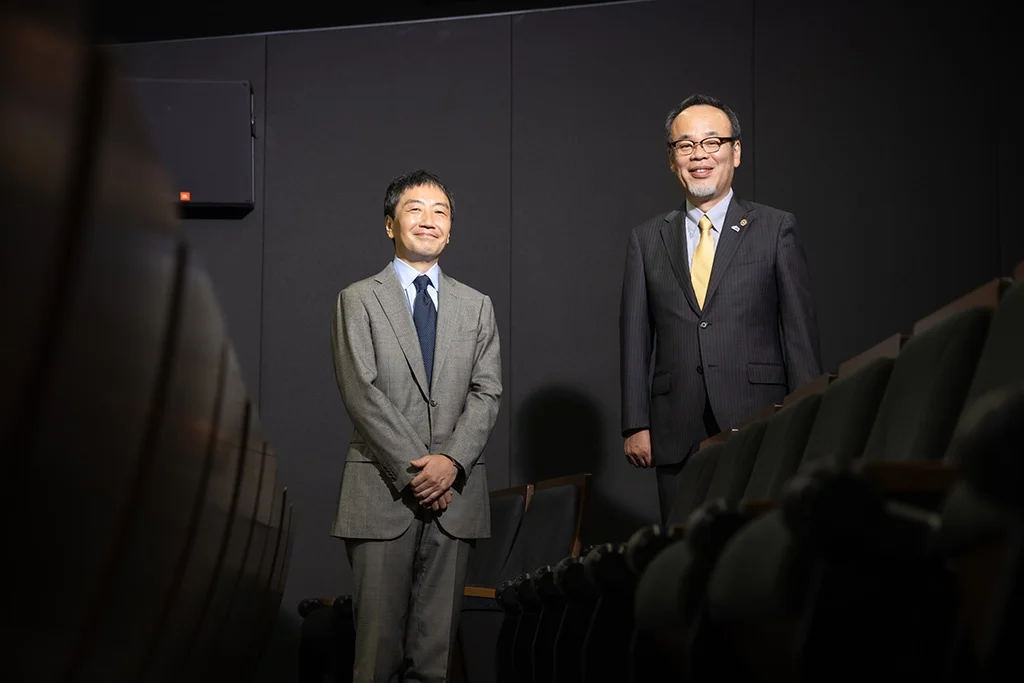
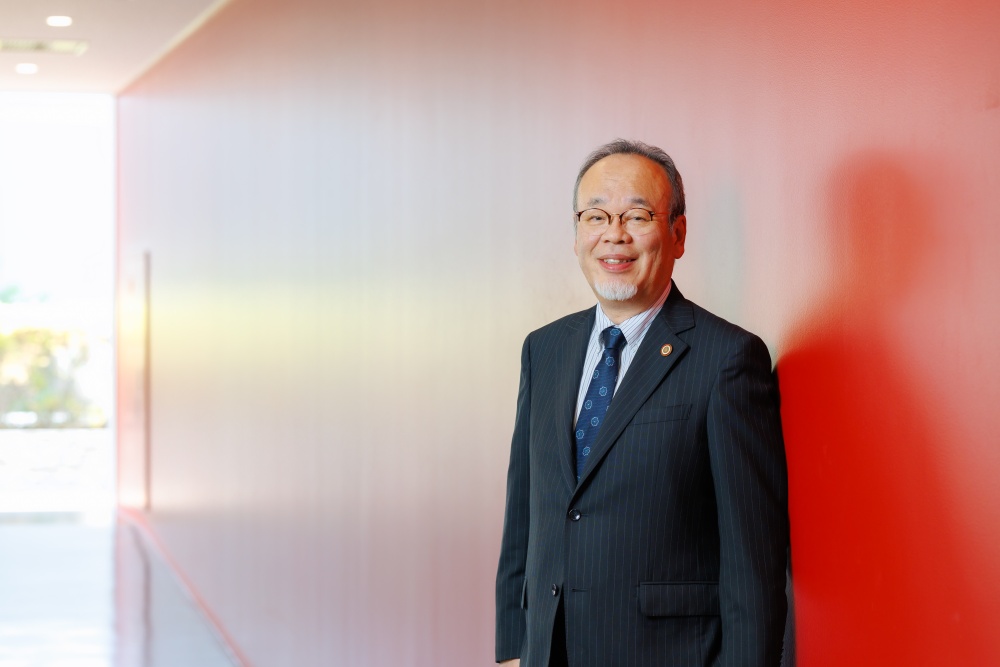
Professor Atsushi Oogaki, who has produced numerous programs for NHK. After retirement, I have raised issues through the production and research of documentary films that tackle taboo topics. We send a message encouraging students to select information from the diversified media and elevate it into their own ideas (Interviewer: President J. F. Oberlin University Hiroaki Hatayama).
Drawn to documentaries, I joined NHK. The internet changed viewer demand.
Hatayama: You spent a long time in the broadcasting industry, but what was the reason you decided to pursue a career in the media world?
Ogaki: My father worked for a trading company, and my family and I lived in New York and Jakarta, so I experienced the joy of being exposed to different cultures. Furthermore, I loved documentaries when I was a student, and I aimed to work for a television station because I thought I could do something different from others.
In 1986, I joined NHK and was assigned to the Kushiro Broadcasting Station in Hokkaido. It was a city I had no prior connection to, and everything I saw and heard was new to me. I did a lot of reporting on the fishing industry, and I even boarded a fishing boat with fishermen and accompanied them on a pollock fishing trip to the Sea of Okhotsk. It was truly an experience that most people wouldn't get to have. After working in Kushiro for four years, I spent my days working in Tokyo and Osaka as a director, desk editor, and producer.
The greatest strength of television programs is their ability to break down even the most difficult topics and explain them in an easy-to-understand way. By presenting the information to viewers through video, audio, on-screen text, and even the guests' commentary, they can make them think, "Ah, I see."
Hatayama: Professor Ogaki, who was at the heart of the mass media, how have you viewed the rapidly changing environment surrounding the media?
Ogaki: Satellite broadcasting began in the late 1980s, and broadcasting technologies such as ENG (Electronic News Gathering) and satellite relays evolved. What was particularly impressive was the live broadcast in 1986 when the Marcos regime in the Philippines, which was called a developmental dictatorship, was overthrown by the People Power Revolution. Also, in 1989, we entered an era where we could simultaneously witness world-shaking events such as the Tiananmen Square incident in China and the fall of the Berlin Wall. After that, I worked as the director of the NHK Special "New Electronic Nation" (1995-96), depicting the changes surrounding media. Then, in the 2000s, with the spread of the internet, the release of the iPhone, and the dramatic evolution of communication environments, video streaming gained a degree of freedom that surpassed television.
What I've particularly noticed in recent years is the shift in demand for media. The traditional demands—delivering accurate information nationwide, setting agendas to protect democratic societies, and informing public opinion—have been replaced by a growing need for individuals to be able to freely select and access all kinds of information. This has given me much to consider as to how the broadcasting industry should confront this change.
Unyielding to invisible pressure, we present a lively discussion.
Hatayama: By the way, Professor Ogaki, you've been working on several interesting projects. Since 2018, you've been an advisor for the production of documentary footage for the "Le Pont International Music Festival Ako-Himeji," and in 2019, you researched how broadcasters covered the "Ceremony of the Emperor's Enthronement."
Ogaki: I wanted to investigate whether Japanese broadcasters were fulfilling their role as media outlets, specifically "serving the public's right to know (agenda setting function, public opinion awareness function)." More specifically, I was concerned about whether they were setting agenda items on issues related to the symbolic emperor system and the future of the imperial family, and raising public awareness of these issues. So, on October 22nd, the day of the "Ceremony of the Enthronement of the Emperor," I recorded and analyzed news and information programs broadcast by six terrestrial broadcasters using a 24-hour simultaneous recording device. However, the broadcast content was almost identical, and I concluded that it was difficult to say that diverse perspectives were ensured.
Hatayama: That's very interesting. Another thing is that Professor Ogaki's independently produced cultural documentary film, "Shunga and the Japanese," has received high praise. The English version was screened at the AAS (Association for Asian Studies) general meeting, and it was also used in lectures at the Japanese Studies Department of the University of Chicago in the United States. What was the background to the production of the film?
Ogaki: In 2015, the first ever exhibition of erotic prints in Japan was held at the Eisei Bunko (Bunkyo-ku, Tokyo). However, no broadcast media covered it. So I went to the site and said, "I'll film it myself." When I looked into it, I found it to be a very deep world, and I became completely engrossed in it, making an 87-minute film about it. It was screened in over 30 theaters nationwide and fortunately received high praise. This is a very difficult topic to deal with socially. Despite the various issues that have been raised, there is an invisible pressure at work to avoid touching on it. I think we should discuss this more in order to uncover what we should be concerned about.
This video has age restrictions and can only be viewed on YouTube.
Digesting information and transforming it into one's own ideas—that is the intelligence of a university student.
Hatayama: What role will universities play in the future? And are there any topics you would like to tackle?
Ogaki: Universities are "accumulations of knowledge." I think we need to find a methodology for how to give back that knowledge to society. It might be effective to target people and appeal to them by saying, "A professor at Obirin University has written this paper, please read it." I would also like to be of some help if I can.
Furthermore, I want students to possess the "intelligence" necessary to thrive in today's world. For our generation, reading highbrow books such as Marx, and for my generation, reading contemporary thought like postmodernism, was considered a sign of intelligence. However, in today's world, where we can instantly access all kinds of information from around the globe via smartphones, I believe that intelligence lies in having the know-how to discern the reliability of that information, select what is reliable, and transform it into one's own ideas.
My own "theme of life" is to record, organize, summarize, and present worldly phenomena through video and audio, and present them to society. At J. F. F. Oberlin University, we are documenting the ongoing disaster prevention Events at the Yamazaki housing complex near campus. I want to combine university research activities with my own skills into a 'combined technique,' and give back to students and society.
J. F. Oberlin University College of Business Management Professor
Atsushi Ogaki
He graduated from the Faculty of Economics at Hitotsubashi University in 1986 and joined NHK. He mainly produced documentaries, educational programs, welfare programs, and history programs. Some of the major programs he worked on include "Historical Secrets Historia," "Extracurricular Lessons: Welcome, Senior," "Three Years Since the Great Hanshin Earthquake: How Did People Begin to Move On?", "Double Exposure: Records of Surviving Hiroshima and Nagasaki," "Brakeless: The JR Fukuchiyama Line Derailment," and NHK Specials such as "New Electronic Nation," "The Road of Civilization," "The New Silk Road," and "Egyptian Excavations." He retired in March 2019 and has been in his current position since April of the same year.
Text: Naoki Kaga, Photos: Takuma Imamura
Interview date: This took place in September 2020.