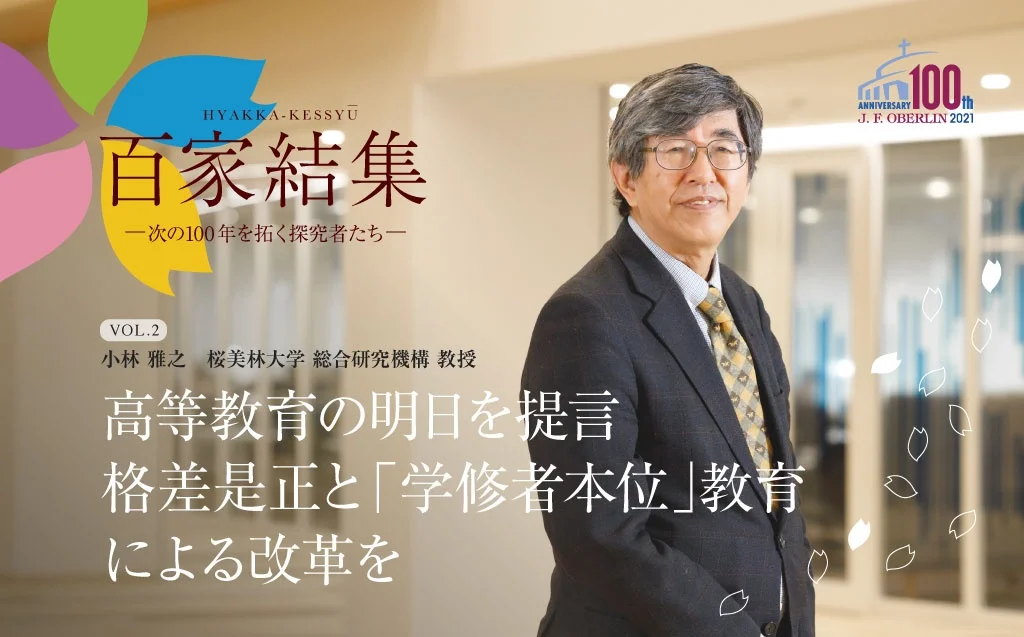
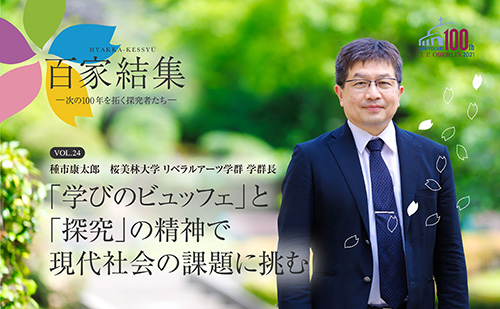
[Collection of Schools of Thought] 02. Masayuki Kobayashi Mr. -Alumni and Student Interviews
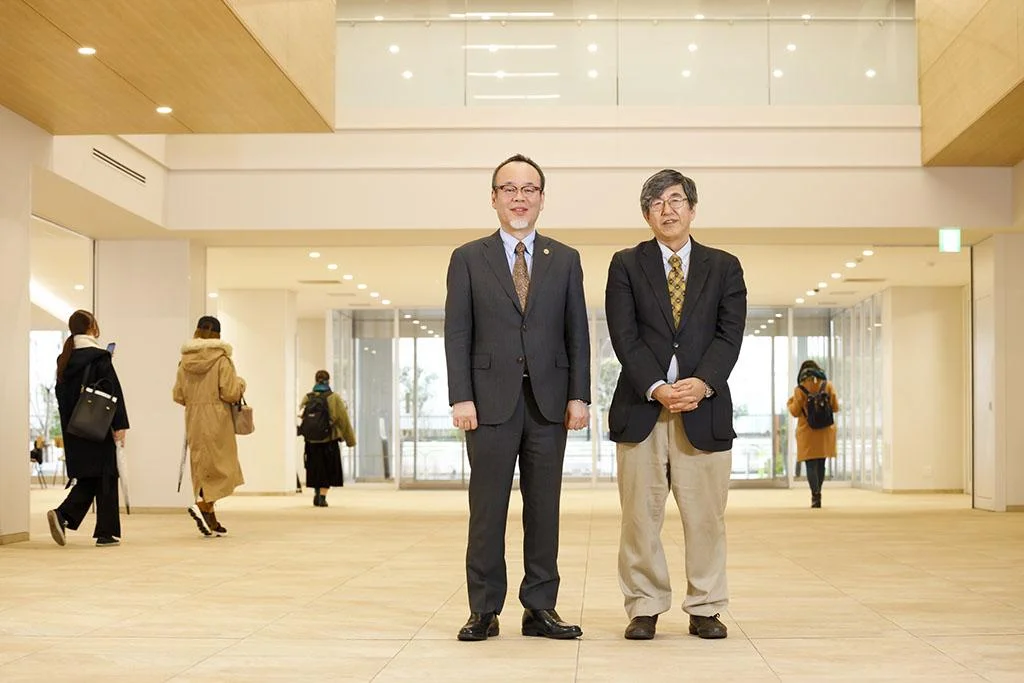
Faculty and President Dialogue
Proposals for the future of higher education Addressing inequality and student-centered education Reforms by
Comprehensive Research Organization
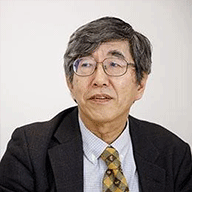
Masayuki Kobayashi Professor
Main content
With the declining birthrate and what is called the 'era of everyone entering university,' the ideal of higher education is being questioned once again. Professor Masayuki Kobayashi speaks about the true value of liberal arts, the shift toward student-centered 'learner-centered' education, and the correction of educational disparities. We raise the challenges faced by Japanese universities (Interviewer: President J. F. Oberlin University Hiroaki Hatayama).
Japanese universities are currently facing a wavering of trust in education.
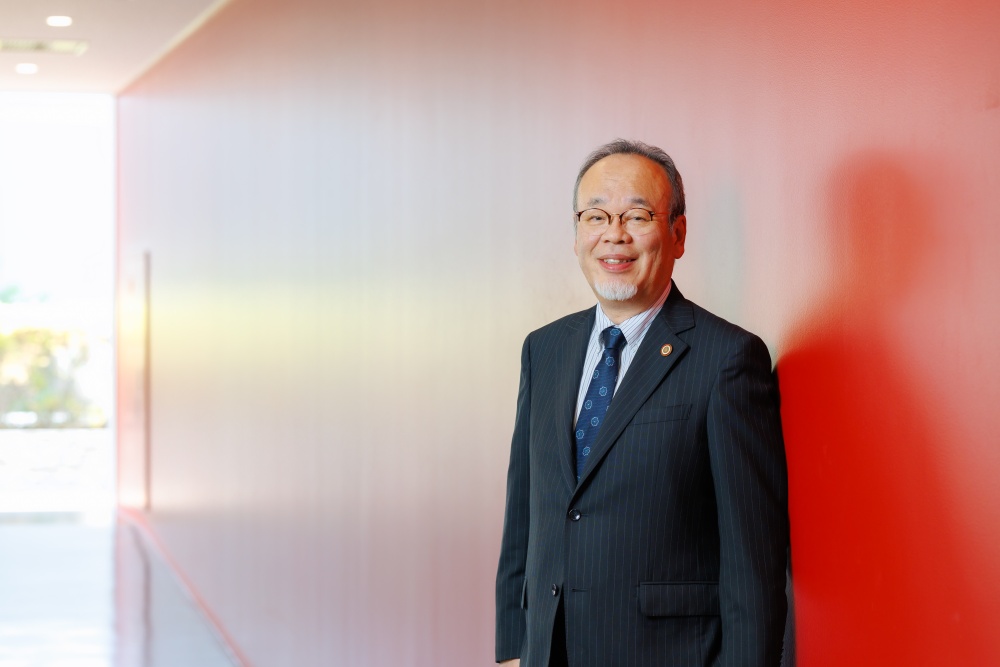
Hatayama: Professor Kobayashi, the key theme of your research is "higher education policy." What issues are you currently interested in?
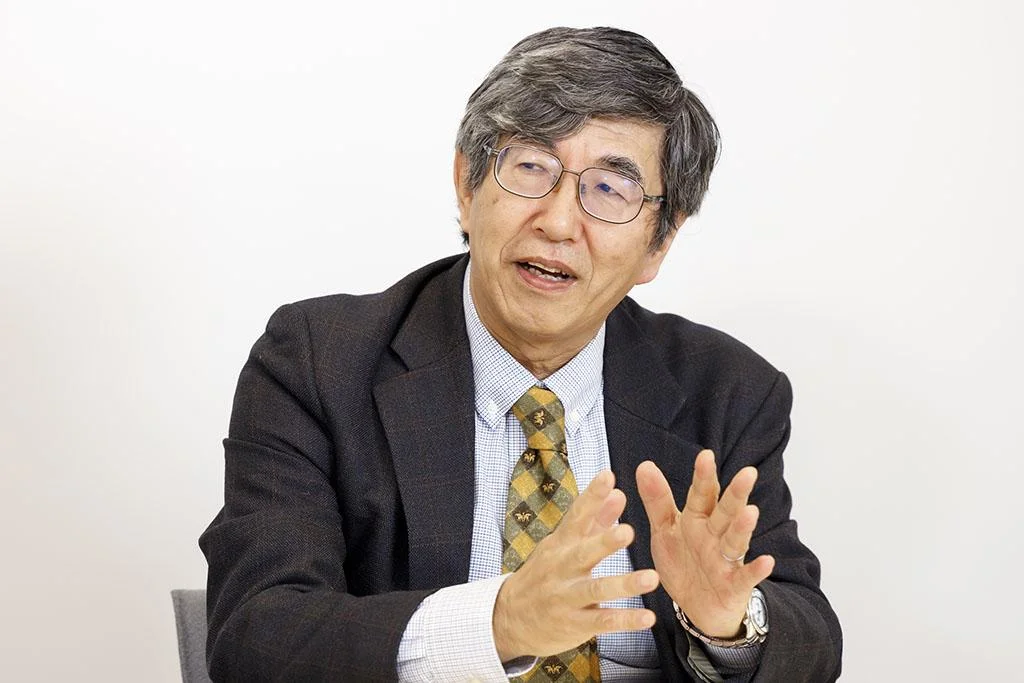
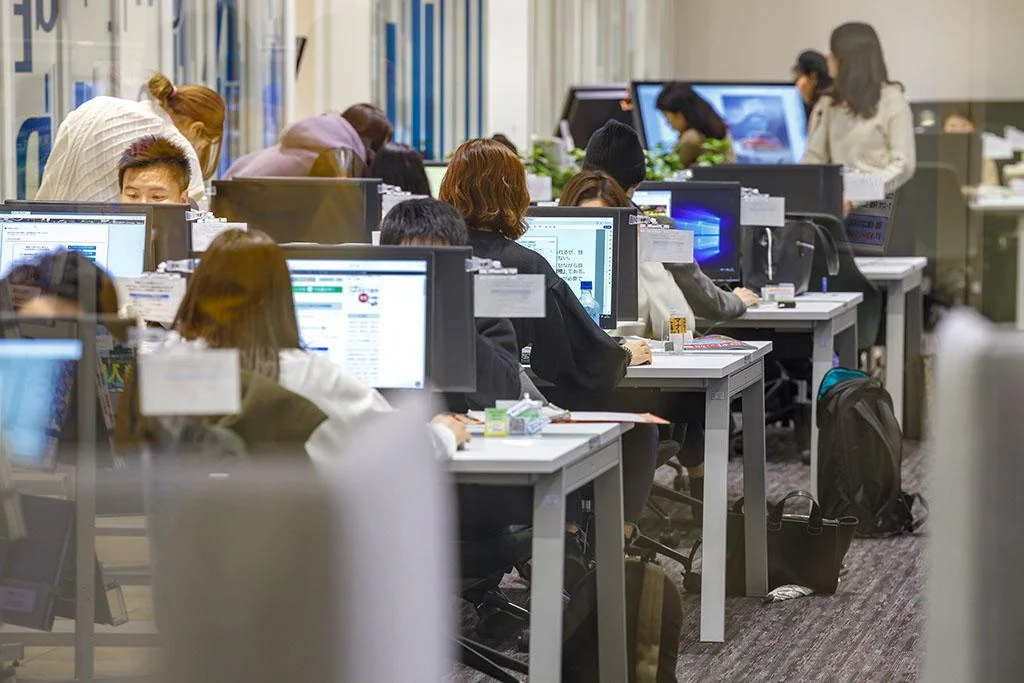
Kobayashi: What concerns me is that "society's trust in universities is declining." The number of universities is increasing, some are failing to meet their enrollment quotas, and some are even said to be on the verge of bankruptcy. Society is looking at universities with a very critical eye, yet the universities themselves are taking things easy. Some faculty members still cling to the old image that "students should study on their own. They should learn by watching their teachers." In contrast, some students study proactively, while others are "waiting for instructions." Furthermore, the number of working adults and international students will increase in the future, and I question whether universities are adequately able to cope with the diversification of students.
On the other hand, national policies are also insufficient. I have served on committees for the Ministry of Education, Culture, Sports, Science and Technology and the National University Association, and I can say that the country's finances are poor and it cannot spend money on education. National universities are having their operating grants reduced by 1% every year. The absolute amount of subsidies for private schools has increased, but the relative proportion of these subsidies in university revenue has decreased. In this situation, the way the government creates grant themes and provides money haphazardly from time to time is quite half-hearted. I believe that a more systematic plan is needed.
Now more than ever, we need a shift towards liberal arts and a student-centered education.
Hatayama: Let's ask about how universities create their "content." J. F. Oberlin University has been installing College of Arts and Sciences since 2007. For a time, faculties and departments like 'International Liberal Arts' were popular at other universities, but recently, more and more places have started using the term 'liberal arts.' What are your thoughts on liberal arts education, Professor Kobayashi?
Kobayashi: In Europe, liberal arts education ends in secondary education. In the United States, universities are responsible for liberal arts education, and there are even colleges specializing in liberal arts. In Japan, before the war, a similar education was provided in the old-system high schools. However, due to postwar reforms, the education that was previously spread over six years in the old-system high schools (3 years) and old-system universities (3 years) was crammed into four years in the new-system universities, which is a very impossible thing to do from a curriculum standpoint. Furthermore, especially for about 30 years from the 1990s, general education has declined, and people are saying, "This is really not good." In the sciences, for example, there are growing concerns that researchers' ethics and broad perspectives will be lost. I feel that liberal arts are necessary now more than ever.
At the same time, what is needed in university education as a whole is a shift to a "learner-centered" system that clearly shows students "what they can learn and acquire" and allows them to feel the results. Curriculum must not be created according to the convenience of universities and faculty, but rather from the perspective of the students. This was clearly stated for the first time in the report "Grand Design for Higher Education Towards 2040" compiled by the Central Council for Education in 2018.
Correcting educational disparities and breaking the vicious cycle.
Hatayama: Professor Kobayashi, you continue to research educational opportunities and educational disparities among students. With the 18-year-old population decreasing and the university enrollment rate increasing, what do you think will happen to these disparities?
Kobayashi: Educational inequality is linked to social and economic inequality, creating a vicious cycle that needs to be broken somewhere. As a measure to reduce inequality, the United States is focusing on grants and scholarships. This is an international trend, but Japan is very far behind. We have only just made a little progress.
The tuition fee reduction measure that will begin in April 2020 will provide government subsidies for tuition fees for students from low-income households with an annual income of 3.8 million yen or less. However, this has created a problem: students from middle-income households who previously received tuition fee reductions do not meet the new income requirements and are therefore ineligible for the measure. In response, the Ministry of Education, Culture, Sports, Science and Technology has included approximately 5.3 billion yen in the budget proposal to ensure that students at national and public universities who were previously eligible continue to receive support. However, this budget has not been allocated to private universities. I think private universities should be more outraged by this situation. I also think that one of the reasons for the decline in trust is that "universities do not speak out."
Hatayama: I think it will become even more important for universities to communicate with society and to be accountable both inside and outside the university. Now, you came to Obirin University in 2019, what are your impressions of it?
Kobayashi: I'm looking forward to seeing how we can leverage the collaboration between the Shinjuku campus, which opened in 2019, and the existing Machida campus. Since we've gone to the trouble of creating a new campus, we should bring in new ideas as much as possible. As I mentioned earlier, we should define what skills students will acquire and create a curriculum that corresponds to that.
Hatayama: In order to make it "learner-centered," we must turn our previous concepts on their heads and think differently. I have renewed my belief that "changing the way universities are built" is the path that Obirin University should aim for.
J. F. Oberlin University Professor, National Institute for Advanced Studies
Masayuki Kobayashi
He graduated from the Faculty of Education, University of Tokyo in 1976. In 1982, he completed all coursework for his doctoral degree at the Graduate School of Education, University of Tokyo. He has held positions as an assistant professor in the Faculty of Humanities at Hiroshima Shudo University, an assistant professor in the Faculty of Liberal Arts at the Open University of Japan, and an assistant professor and then professor at the Center for University-Wide Education Research, University of Tokyo, before assuming his current position in April 2019. He has served as president of the Japan Society for Higher Education, a director of the Ashinaga Scholarship Foundation, and a temporary member of the Central Council for Education of the Ministry of Education, Culture, Sports, Science and Technology. His main research themes include "higher education theory," "educational expenses," "student support," "university evaluation," "university management," and "tuition fees." He has authored numerous books, including "Disparities in Educational Access: The Worsening Burden of Educational Expenses" (Chikuma Shobo).