Three policies
Index
Graduation Certification and Degree Awarding Policy (Diploma Policy)
College of Global Communication aims to foster individuals who can contribute to multicultural coexistence by acquiring advanced communication skills in multiple languages and specialized knowledge applicable in a global society. Specifically, in a global society, we nurture individuals who can leverage communication skills and expertise that transcend language barriers to serve as bridges between cultures, solve problems, and fulfill solid roles in collaboration.
Under the curriculum designed to achieve this objective, students who achieve a cumulative GPA of 1.50 or higher during the designated period of enrollment, acquire the required graduation credits (16 credits in "Basic Education Subjects," 40 or 48 credits in "Language Skills Subjects" (depending on the language track) and 44 or 36 credits in "Specialized Subjects" (depending on the language track), plus other electives, totaling 124 credits or more), and who meet the following requirements will be awarded a "Bachelor of Global Communication" degree, based on the university's fundamental educational philosophy, "Policy on Graduation Certification and Degree Awarding," and "Policy on Curriculum Organization and Implementation."
(1) Knowledge and skills related to communication
They possess a high level of practical communication skills in multiple languages that are applicable in a global society.
(2) Knowledge and understanding of multiculturalism and interculturalism
By learning about world languages, geography, history, social systems, economics, politics, gender, and more, students can understand global events within their context, become aware of diverse values, objectively select information without blindly accepting it, and think with a broad perspective.
(3) Knowledge and skills related to problem-solving ability and teamwork
(4) Social responsibility as a citizen
As a highly cultured and insightful international individual based on Christian principles, they can practice the principle of "learning to serve others."
Curriculum Development and Implementation Policy
[Curriculum Organization]
The curriculum consists of "Language Skills Subjects" designed to equip students with the skills necessary to succeed in higher education abroad, and "Global Studies Subjects" taught in English, Chinese, Korean, and Japanese.
The number of credits and GPA required for graduation are as follows:
The breakdown of the number of credits required for graduation is as follows:
1. English Track
If you choose the English track, the breakdown of credits required for graduation is as follows. Please note that students whose first language is English (or whose first language is second to none) cannot choose the English track.
■Basic Education Subjects: 8 credits of compulsory subjects, 8 or more credits of elective compulsory subjects, for a total of 16 or more credits.
■Major Subjects: 40 or more credits in language skills subjects, 44 or more credits in specialized subjects (32 or more credits in global studies subjects and 44 or more credits in specialized seminar subjects combined), total of 84 or more credits.
Language skills subjects (16 required credits, at least 4 credits from "Special English A" or "Special English B," plus at least 20 elective credits from the English track of language skills subjects)
*Credits earned while studying abroad may be recognized as language proficiency credits.
2. Chinese Track
If you choose the Chinese language track, the breakdown of credits required for graduation is as follows. Please note that students whose first language is Chinese (or whose first language is second to none) cannot choose the Chinese language track.
3. Japanese track
If you choose the Japanese track, the breakdown of credits required for graduation is as follows:. Students whose first language is Japanese (or is equivalent to Japanese) cannot select the Japanese track.
■Basic Education Courses: A total of at least 16 credits consisting of 8 credits from Compulsory Courses and at least 8 credits from Compulsory Elective Courses
■Major Courses: At least 40 credits from Language Skills Courses, at least 44 credits from Specialized Courses (a total of at least 44 credits from 32 Global Studies Courses and Specialized Seminar Courses), for a total of at least 84 credits
Language Skills Courses (In addition to 16 credits from Compulsory Courses, at least 24 credits from Japanese Language Skills Courses)
*Credits acquired while studying abroad may also be recognized as language skills courses.
Global Studies Courses (At least 32 credits are required. However, both of the following conditions 1 and 2 must be met:.)
[Condition 1]
At least 16 of the 32 credits must be acquired from subjects offered in Japanese. I don't care about Major.
[Condition 2]
A total of 32 credits must be acquired from selected Major subject groups, including the following compulsory subjects:. It does not matter what language the course is taught in.
< Compulsory Subjects for Each Major >
Public Relations Major: Introduction to Public Relations (4)
Language Exploration Major: Language Studies (4)
Cultural Co-Creation Major: Social Participation (4)
A total of at least 32 credits from Global Studies Courses and at least 44 credits from Specialized Seminar Courses are compulsory.
For details, see Graduation Requirements Table in Course Guide See.
Credits acquired while studying abroad may also be accepted as global studies subjects.
4. trilingual track
Students aim to graduate by studying two languages at the time of application or after enrollment. If you choose the trilingual track at the time of application, you will study Korean intensively in the first year and English or Chinese intensively in the second year. If you transfer to the trilingual track after entering school, you will learn one more language after entering school in addition to the language track you chose before entering school (English, Chinese, or Japanese). You cannot choose your first language (or an equivalent language) for either of the two languages studied in the trilingual track.
■Basic Education Courses: A total of at least 16 credits consisting of 8 credits from Compulsory Courses and at least 8 credits from Compulsory Elective Courses
■Major Courses: At least 48 credits from Language Skills Courses, at least 36 credits from Specialized Courses (a total of at least 36 credits from 32 Global Studies Courses and Specialized Seminar Courses), for a total of at least 84 credits
Language skills (Compulsory credit for two language tracks or programs. Elective courses are taken from one of two language tracks or program languages.)
Global Studies Courses (At least 32 credits are required. Any language is acceptable. A total of 32 credits must be acquired from selected Major subject groups, including the following compulsory subjects:.)
< Compulsory Subjects for Each Major >
Public Relations Major: Introduction to Public Relations (4)
Language Exploration Major: Language Studies (4)
Cultural Co-Creation Major: Social Participation (4)
*Credits acquired while studying abroad may also be recognized as language skills courses.
*Compulsory language skills courses require a total of eight subjects, four from each of the following two languages.
・Four subjects: Integrated English IA, Integrated English IB, Integrated English IIA, and Integrated English IIB
・Four subjects: Integrated Chinese IA, Integrated Chinese IB, Integrated Chinese IIA, and Integrated Chinese IIB
・4 subjects: General Japanese IA, General Japanese IB, General Japanese IIA, and General Japanese IIB
・Four subjects: Integrated Korean IA, Integrated Korean IB, Integrated Korean IIA, and Integrated Korean IIB
A total of at least 32 credits from Global Studies Courses and at least 36 credits from Specialized Seminar Courses are compulsory.
For details, see Graduation Requirements Table in Course Guide See.
1.Basic education subjects
This program aims to form the foundation for four years of university studies and to equip students with the knowledge and skills necessary to take specialized subjects from their second year onward. The foundational education subjects consist of compulsory subjects and elective compulsory subjects. Compulsory subjects include "Introduction to Christian Studies," "Logic and Communication," "Information Literacy," and "Introduction to Natural Sciences." Elective compulsory subjects include "Introduction to Global Society," "Introduction to Global Culture," "Career Design," "Field Studies," "Data Science A," and "Data Science B."
This program aims to form the foundation for four years of university studies and to equip students with the knowledge and skills necessary to take specialized subjects from their second year onward. The foundational education subjects consist of compulsory subjects and elective compulsory subjects. Compulsory subjects include "Introduction to Christian Studies," "Logic and Communication," "Information Literacy," and "Introduction to Natural Sciences." Elective compulsory subjects include "Introduction to Global Society," "Introduction to Global Culture," "Career Design," "Field Studies," "Data Science A," and "Data Science B."
2. Major Subjects
- 2-1. Language Skills Subjects
The curriculum is divided into English, Chinese, Korean, and Japanese, and students will learn a language other than their first language chosen before enrollment. The following four points are emphasized in all language skills courses:
(1) Skills
The four skills (listening, speaking, reading, and writing), digital literacy, test skills, and academic skills.
(2) Critical thinking
The ability to think (the ability to select and filter information, understand its background, formulate hypotheses, integrate information, and communicate it clearly)
(3) Learner autonomy
Review, setting learning objectives, learning plan, setting future goals, study skills
(4) Intercultural understanding
Current events, cultural background (history, religion, customs, traditions), acceptance of diversity, creation of new values
(1) Skills
The four skills (listening, speaking, reading, and writing), digital literacy, test skills, and academic skills.
(2) Critical thinking
The ability to think (the ability to select and filter information, understand its background, formulate hypotheses, integrate information, and communicate it clearly)
(3) Learner autonomy
Review, setting learning objectives, learning plan, setting future goals, study skills
(4) Intercultural understanding
Current events, cultural background (history, religion, customs, traditions), acceptance of diversity, creation of new values
- 2-2.グローバル・スタディーズ科目
We offer a wide range of specialized subjects including communication, sociology, business administration, political science, linguistics, cultural anthropology, history, culture, arts, gender, and interdisciplinary Area. You will select 32 credits from Major subjects chosen after enrollment from three Major (Public Relations, Language Inquiry, and Cultural Co-creation).
3. Specialized Seminar Courses
Based on the multilingual and multicultural skills acquired in the first and second years, this subject tackles issues related to each Major field. It consists of small-group seminar-style "Major Seminars I/II" and "Graduation Thesis & Research," which consolidates what you learn.
Based on the multilingual and multicultural skills acquired in the first and second years, this subject tackles issues related to each Major field. It consists of small-group seminar-style "Major Seminars I/II" and "Graduation Thesis & Research," which consolidates what you learn.
The number of credits and GPA required for graduation are as follows:
- Foundational education subjects, major subjects, electives, totaling 124 credits or more.
- A cumulative GPA of 1.50 or higher since enrollment.
[Learning Methods and Curriculum]
- In the first and second years, students take "Language Skills Subjects" where they thoroughly study one or two target languages from the English, Chinese, Japanese, or Trilingual Track that they selected before enrollment, aiming to become proficient in using them in practice.
- As a general rule, all students will study abroad during their third or fourth semester (students in the trilingual track will study abroad during their fifth or sixth semester, and students in the Japanese track will study abroad only if they wish to).
- Upon returning to Japan, students will use the language skills they have improved through their studies abroad to take courses offered in their target language (English, Chinese, Korean, or Japanese), thereby deepening their understanding of various issues and challenges in Japan and around the world.
- Through group work, we foster the ability to drive innovation and leadership, nurturing individuals who can play central roles within the organization. College of Global Communication actively incorporates group work, discussions, and presentations. This helps develop the ability to approach themes comprehensively from multiple Area and perspectives.
[How to evaluate learning outcomes]
- Learning outcomes indicate the extent to which students have achieved the learning objectives set for a course. These learning objectives are set for each course and are listed in the syllabus.
- The syllabus specifies the evaluation methods for each course, and instructors rigorously assess students' achievement of the course objectives.
The breakdown of the number of credits required for graduation is as follows:
1. English Track
If you choose the English track, the breakdown of credits required for graduation is as follows. Please note that students whose first language is English (or whose first language is second to none) cannot choose the English track.
■Basic Education Subjects: 8 credits of compulsory subjects, 8 or more credits of elective compulsory subjects, for a total of 16 or more credits.
■Major Subjects: 40 or more credits in language skills subjects, 44 or more credits in specialized subjects (32 or more credits in global studies subjects and 44 or more credits in specialized seminar subjects combined), total of 84 or more credits.
Language skills subjects (16 required credits, at least 4 credits from "Special English A" or "Special English B," plus at least 20 elective credits from the English track of language skills subjects)
*Credits earned while studying abroad may be recognized as language proficiency credits.
Global Studies subjects (32 credits or more required; however, both of the following conditions 1 and 2 must be met.)
[Condition 1]
At least 16 out of 32 credits must be earned in courses taught in English. Major is not a requirement.
[Condition 2]
Students must earn a total of 32 credits from their chosen Major, including the required subjects listed below. The language of instruction is not specified.
<Required subjects for each Major >
Public Relations Major: Introduction to Public Relations ④
Language Research Major: Language Research ④
Cultural Co-creation Major: Social Participation ④
Students are required to complete at least 32 credits in Global Studies subjects and at least 44 credits in specialized seminar subjects combined.
For details, please refer to the graduation requirements table in the course guide.
Credits earned while studying abroad may be recognized as Global Studies credits.
[Condition 1]
At least 16 out of 32 credits must be earned in courses taught in English. Major is not a requirement.
[Condition 2]
Students must earn a total of 32 credits from their chosen Major, including the required subjects listed below. The language of instruction is not specified.
<Required subjects for each Major >
Public Relations Major: Introduction to Public Relations ④
Language Research Major: Language Research ④
Cultural Co-creation Major: Social Participation ④
Students are required to complete at least 32 credits in Global Studies subjects and at least 44 credits in specialized seminar subjects combined.
For details, please refer to the graduation requirements table in the course guide.
Credits earned while studying abroad may be recognized as Global Studies credits.
2. Chinese Track
If you choose the Chinese language track, the breakdown of credits required for graduation is as follows. Please note that students whose first language is Chinese (or whose first language is second to none) cannot choose the Chinese language track.
■Basic Education Courses: A total of at least 16 credits consisting of 8 credits from Compulsory Courses and at least 8 credits from Compulsory Elective Courses
■Major Courses: At least 40 credits from Language Skills Courses, at least 44 credits from Specialized Courses (a total of at least 44 credits from 32 Global Studies Courses and Specialized Seminar Courses), for a total of at least 84 credits
Language Skills Courses (In addition to 24 credits from Compulsory Courses, at least 16 credits from Chinese Language Track Courses)
*Credits acquired while studying abroad may also be recognized as language skills courses.
Global Studies Courses (At least 32 credits are required. However, both of the following conditions 1 and 2 must be met:.)
[Condition 1]
At least 16 of the 32 credits must be acquired from subjects offered in Chinese. I don't care about Major.
[Condition 2]
A total of 32 credits must be acquired from selected Major subject groups, including the following compulsory subjects:. It does not matter what language the course is taught in.
< Compulsory Subjects for Each Major >
Public Relations Major: Introduction to Public Relations (4)
Language Exploration Major: Language Studies (4)
Cultural Co-Creation Major: Social Participation (4)
A total of at least 32 credits from Global Studies Courses and at least 44 credits from Specialized Seminar Courses are compulsory.
For details, see Graduation Requirements Table in Course Guide See.
Credits acquired while studying abroad may also be accepted as global studies subjects.
■Major Courses: At least 40 credits from Language Skills Courses, at least 44 credits from Specialized Courses (a total of at least 44 credits from 32 Global Studies Courses and Specialized Seminar Courses), for a total of at least 84 credits
Language Skills Courses (In addition to 24 credits from Compulsory Courses, at least 16 credits from Chinese Language Track Courses)
*Credits acquired while studying abroad may also be recognized as language skills courses.
Global Studies Courses (At least 32 credits are required. However, both of the following conditions 1 and 2 must be met:.)
[Condition 1]
At least 16 of the 32 credits must be acquired from subjects offered in Chinese. I don't care about Major.
[Condition 2]
A total of 32 credits must be acquired from selected Major subject groups, including the following compulsory subjects:. It does not matter what language the course is taught in.
< Compulsory Subjects for Each Major >
Public Relations Major: Introduction to Public Relations (4)
Language Exploration Major: Language Studies (4)
Cultural Co-Creation Major: Social Participation (4)
A total of at least 32 credits from Global Studies Courses and at least 44 credits from Specialized Seminar Courses are compulsory.
For details, see Graduation Requirements Table in Course Guide See.
Credits acquired while studying abroad may also be accepted as global studies subjects.
3. Japanese track
If you choose the Japanese track, the breakdown of credits required for graduation is as follows:. Students whose first language is Japanese (or is equivalent to Japanese) cannot select the Japanese track.
■Basic Education Courses: A total of at least 16 credits consisting of 8 credits from Compulsory Courses and at least 8 credits from Compulsory Elective Courses
■Major Courses: At least 40 credits from Language Skills Courses, at least 44 credits from Specialized Courses (a total of at least 44 credits from 32 Global Studies Courses and Specialized Seminar Courses), for a total of at least 84 credits
Language Skills Courses (In addition to 16 credits from Compulsory Courses, at least 24 credits from Japanese Language Skills Courses)
*Credits acquired while studying abroad may also be recognized as language skills courses.
Global Studies Courses (At least 32 credits are required. However, both of the following conditions 1 and 2 must be met:.)
[Condition 1]
At least 16 of the 32 credits must be acquired from subjects offered in Japanese. I don't care about Major.
[Condition 2]
A total of 32 credits must be acquired from selected Major subject groups, including the following compulsory subjects:. It does not matter what language the course is taught in.
< Compulsory Subjects for Each Major >
Public Relations Major: Introduction to Public Relations (4)
Language Exploration Major: Language Studies (4)
Cultural Co-Creation Major: Social Participation (4)
A total of at least 32 credits from Global Studies Courses and at least 44 credits from Specialized Seminar Courses are compulsory.
For details, see Graduation Requirements Table in Course Guide See.
Credits acquired while studying abroad may also be accepted as global studies subjects.
4. trilingual track
Students aim to graduate by studying two languages at the time of application or after enrollment. If you choose the trilingual track at the time of application, you will study Korean intensively in the first year and English or Chinese intensively in the second year. If you transfer to the trilingual track after entering school, you will learn one more language after entering school in addition to the language track you chose before entering school (English, Chinese, or Japanese). You cannot choose your first language (or an equivalent language) for either of the two languages studied in the trilingual track.
■Basic Education Courses: A total of at least 16 credits consisting of 8 credits from Compulsory Courses and at least 8 credits from Compulsory Elective Courses
■Major Courses: At least 48 credits from Language Skills Courses, at least 36 credits from Specialized Courses (a total of at least 36 credits from 32 Global Studies Courses and Specialized Seminar Courses), for a total of at least 84 credits
Language skills (Compulsory credit for two language tracks or programs. Elective courses are taken from one of two language tracks or program languages.)
Global Studies Courses (At least 32 credits are required. Any language is acceptable. A total of 32 credits must be acquired from selected Major subject groups, including the following compulsory subjects:.)
< Compulsory Subjects for Each Major >
Public Relations Major: Introduction to Public Relations (4)
Language Exploration Major: Language Studies (4)
Cultural Co-Creation Major: Social Participation (4)
*Credits acquired while studying abroad may also be recognized as language skills courses.
*Compulsory language skills courses require a total of eight subjects, four from each of the following two languages.
・Four subjects: Integrated English IA, Integrated English IB, Integrated English IIA, and Integrated English IIB
・Four subjects: Integrated Chinese IA, Integrated Chinese IB, Integrated Chinese IIA, and Integrated Chinese IIB
・4 subjects: General Japanese IA, General Japanese IB, General Japanese IIA, and General Japanese IIB
・Four subjects: Integrated Korean IA, Integrated Korean IB, Integrated Korean IIA, and Integrated Korean IIB
A total of at least 32 credits from Global Studies Courses and at least 36 credits from Specialized Seminar Courses are compulsory.
For details, see Graduation Requirements Table in Course Guide See.
[Major Information]
College of Global Communication offers three Major for specialized study according to each student's goals and interests. The types of Major are as follows:
- Public Relations Major
- Language Inquiry Major
- Cultural Co-Creation Major
By choosing one Major from three Major, each student is clearly aware of their Area to study, and each Major is shown a path leading to a career after graduation and a path to obtaining qualifications. Some courses span multiple Major, and other Major can also be taken as credits for majors, allowing students to gain broad insights and build learning tailored to their individual goals.
After the end of the first-year course, if you select one Major, you will be registered as a major consisting of a pre-enrollment language track, and the "Certificate of Academic Achievement Credits" will list the name of the registered major (or major and minor). If you graduate after meeting the requirements for completing the registered major (or major and minor), the name of the completed major (or major and minor) will be listed on the 'Certificate of Academic Credit Acquisition' after graduation.
- Major: Completing a major is a requirement for graduation. Choose one of the three Major from the self-study group and register for the major. (College of Global Communication Major programs or courses other than those listed cannot be registered as majors. )
- Minor: Completing a minor is not a graduation requirement, but you can register as minors from other departments outside College of Global Communication. You cannot register another Major of College of Global Communication as a miner.
- College of Global Communication Major and minor registrations are accepted after the end of the first-year academic period, so please complete the procedures within the designated period. After that, you can switch between major and minor until the last day of the regular exam period for the semester you wish to graduate from. The types of major and minor College of Global Communication are as follows.
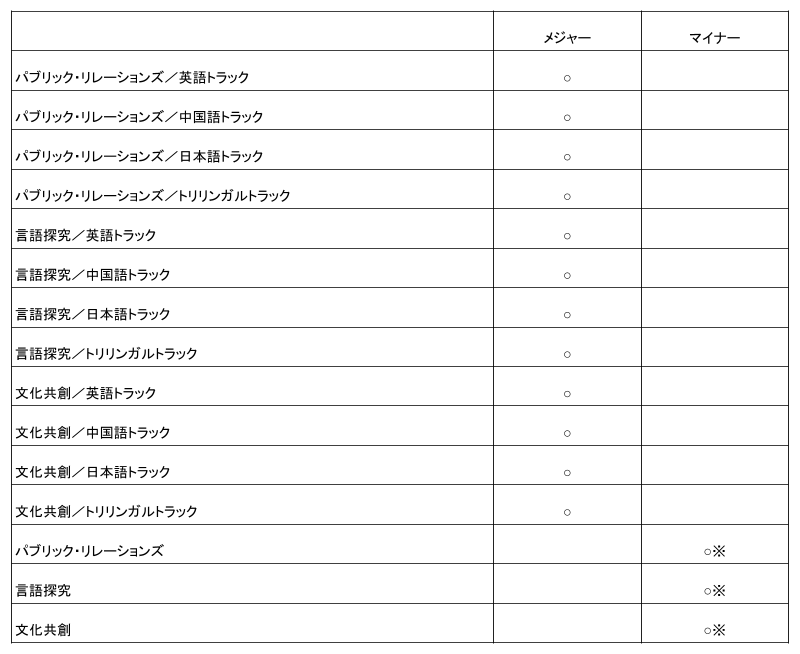
- For required courses (or all elective courses) in your minor, if the "Enrollment by Students from Other Faculties" column on the course list page for a major program or course is marked with an "×", students from other faculties cannot register for that minor.
- Students from other academic faculties may not be able to take required courses (or all required elective courses) for their major, and therefore may not be able to complete their major, depending on the priority of the lottery-based courses for their major program or course.
- If you wish to register for a minor in another faculty, please consult with the academic affairs office at your respective campus beforehand. Registration for minors is accepted from the fourth semester onwards. Please obtain approval from your advisor and complete the procedure within the designated period. You can change your minor until the final day of the final examination period for the semester in which you wish to graduate.
[Public Relations Major]
Public Relations Major aims to train communication specialists who can represent various organizations such as companies, local governments, NGOs/NPOs, and schools. Based on the theory of public relations as a Area of interdisciplinary communication studies, we aim to acquire practical skills.
The curriculum begins with introductory courses in interpersonal and organizational communication and public relations, which form the foundation of communication studies. It then expands to a variety of other subjects, including organizational theory, international relations, business-related subjects, intercultural communication, and media literacy, which forms the basis of information dissemination, all with a view to business in a global environment. In addition to courses aimed at helping students better understand Japanese society and actively participate in it, students can also take practical courses that attempt to develop public relations strategies, and courses that provide hands-on training in skills such as persuasive speaking and writing in public forums, all designed to equip them with abilities directly applicable to the practice of public relations.
By completing the designated courses and submitting an application, you can obtain the "Social Research Specialist" qualification.
- major
To meet the requirements outlined in the graduation requirements, please complete the required Global Studies courses, including "Introduction to Public Relations."
* College of Global Communication can only be selected as a raw option.
- minor
Please earn at least 20 credits in the Public Relations Major course group, including the required course 'Introduction to Public Relations.' The language of instruction is not limited.
* College of Global Communication Raw cannot be selected.
[Language Inquiry Major]
Language Inquiry Major aims to train language experts who serve as bridges between cultures in a global society. To achieve this, students further hone the skills to apply the language skills honed during their first and second years in real-world settings, deepen their understanding of the target language's cultural sphere, and gain academic knowledge in languages such as English, Chinese, Japanese, and Korean.
To help you acquire specialized language skills, practical classes are provided to learn interpreting and translation techniques, and to deepen your understanding of the cultures and societies of each language region, you can also take courses focused on cultural studies, social studies, and literature. Furthermore, to gain academic knowledge about languages, we offer several courses ranging from major Area of linguistics and applied linguistics to representative fields. While taking courses in different fields under the common theme of "language," aim not only to excel in language skills but also to become a true language expert with deep insight into language and a broad understanding of multicultural society.
- major
Please complete global studies courses, including the compulsory 'Language Studies,' to meet the requirements listed in the graduation requirements.
* College of Global Communication can only be selected as a raw option.
* College of Global Communication can only be selected as a raw option.
- minor
Please earn at least 20 credits in the language inquiry Major course group, including the required course 'Language Studies.' The language of instruction is not limited.
* College of Global Communication Raw cannot be selected.
* College of Global Communication Raw cannot be selected.
[Cultural Co-Creation Major]
Cultural Co-Creation Major aims to nurture individuals with cross-cultural understanding, tolerance, and high communication skills and expertise that transcend language barriers, so they can thrive in today's multicultural society. Students deepen their learning through lectures and social participation activities in areas such as multicultural understanding, international relations, and regional studies, aiming to grow as key contributors.
The subject group of this Major consists of three Area: "Social Participation," "Ethnicity Studies," and "Arts and Culture." First, in the Social Participation Area course, students deepen their understanding of others through theory and practice, cultivating a broad perspective and foundational skills for a symbiotic society. Next, in the Ethnicity Studies Area subject, students deeply study group identity formation and social structure, laying the foundation for collaborating with people from diverse backgrounds. In the Arts and Culture Area subject, students focus on the relationship between art and society through fine arts, video, and traditional performing arts, exploring the role of art in active society.
Through these studies, students of Cultural Co-Creation Major grow into professionals in multicultural coexistence and understanding others in a global society. In the future, they are expected to play active roles as representatives in multicultural coexistence and international cooperation projects for companies and local governments.
By completing and applying for the designated courses, you can obtain the qualification of 'Cultural Exchange Creation Coordinator.'
The subject group of this Major consists of three Area: "Social Participation," "Ethnicity Studies," and "Arts and Culture." First, in the Social Participation Area course, students deepen their understanding of others through theory and practice, cultivating a broad perspective and foundational skills for a symbiotic society. Next, in the Ethnicity Studies Area subject, students deeply study group identity formation and social structure, laying the foundation for collaborating with people from diverse backgrounds. In the Arts and Culture Area subject, students focus on the relationship between art and society through fine arts, video, and traditional performing arts, exploring the role of art in active society.
Through these studies, students of Cultural Co-Creation Major grow into professionals in multicultural coexistence and understanding others in a global society. In the future, they are expected to play active roles as representatives in multicultural coexistence and international cooperation projects for companies and local governments.
By completing and applying for the designated courses, you can obtain the qualification of 'Cultural Exchange Creation Coordinator.'
- major
- To meet the requirements outlined in the graduation requirements, please complete the required Global Studies courses, including the mandatory course "Social Participation."
- * College of Global Communication can only be selected as a raw option.
- minor
- Please earn at least 20 credits in the group of Cultural Co-Creation Major courses, including the required course 'Social Participation.' The language of instruction is not limited.
- * College of Global Communication Raw cannot be selected.
Admissions Policy
In today's rapidly globalizing society, there is a need for individuals who possess advanced foreign language communication skills as a foundation, and who can proactively address and solve the various challenges facing the communities they are involved in.
College of Global CommunicationThe program aims to cultivate individuals who can acquire the fundamental advanced foreign language skills necessary to improve the functioning of multicultural communities, which are increasing in our globalized society. These individuals will be able to think and analyze problems and challenges faced in the process of realizing a truly multicultural society, based on a multifaceted perspective and specialized knowledge. Leveraging their strong communication skills that transcend language barriers, they will become indispensable members of the community, reliably fulfilling their roles in collaborative work toward problem-solving.
[Desired Student Profile]
We seek individuals who resonate with our academic philosophy and desire to grow through learning and experience, regardless of their country, region, or background.
Furthermore, those who wish to begin their studies here are expected to possess the following qualities, and these qualities will be assessed during each selection process.
(1) Those who possess the basic academic skills that should be acquired by the time they reach high school (especially foreign language proficiency)
(2) Those who have a strong desire to learn on their own initiative and a sense of independence.
(3) Persons who have a strong interest in countries and regions around the world, as well as their own country.
(4) Those who have the desire to actively challenge themselves in learning and experiences in a global society and who have a strong interest in and desire to realize multicultural coexistence.
(5) Those who understand the founding principles of the school, are willing to serve others, and have the desire to improve together.
Characteristics of the academic group
Open list of subpages
Content of learning
Student life/environment
Open list of subpages
Career paths, qualifications, and achievements