Japanese Track
Index
Features of the Japanese Program
The basic policy is to learn multiple languages. In the Japanese track, students whose native language is not Japanese learn Japanese and aim for Japanese skills that can be applied in the broader society. Additionally, you will gain the ability to deeply study Japanese society and culture, contributing to multicultural communities. Specifically, in the first year, students take about 8 Japanese lessons per week, including compulsory and semi-compulsory courses, to intensively improve their Japanese skills. From the second year onward, students will take Major subjects while improving their Japanese skills. In the third and fourth years, you mainly learn specialized knowledge about the chosen Major in Japanese. In the fourth year, you take practical courses in Japanese, which can be linked to your career after graduation.
Language test scores required for taking specialized courses
These are the language test scores required to take the compulsory specialized subjects (Global Studies courses) from the second year onward. Since graduation is impossible without meeting these requirements, we provide education to raise all students to the language scores listed below. Furthermore, students will study specialized subjects for each Major in the language of their chosen track to deepen their expertise.
Japanese Track
- Japanese Language Proficiency Test N2 (110 points or higher)
*Of the N5 to N1 levels, N1 is the most difficult.
Class Featured
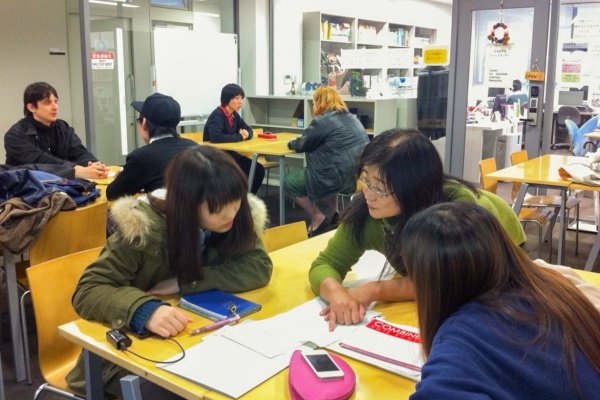
Japanese exercises (tutorial)
This class allows students to learn with the support and advice of an instructor, following individually set learning goals and plans that address areas of weakness or areas of particular interest in Japanese language learning. Students can engage in a variety of learning activities, including conversation practice with class guests, anime and manga translation, cultural understanding through dramas and discussions with class guests, and kanji learning. Through this class, students can become aware of their own learning style and cultivate an autonomous learning attitude that will be useful for future studies.
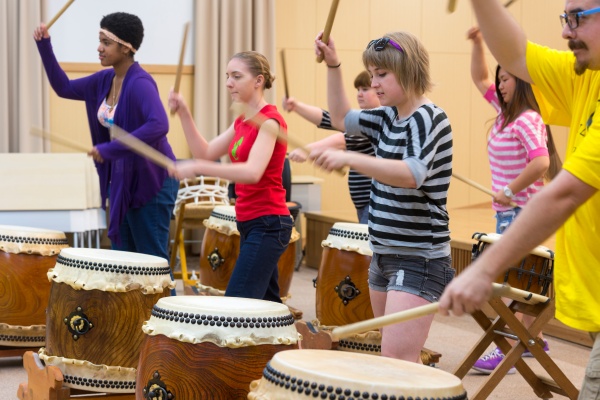
Japanese Language Practice (Beginner/Intermediate/Advanced - Experiential Activities)
This subject focuses on activities outside the classroom. Its goals include exposure to diverse forms of expression, exposure to real-world society and culture, building confidence in using Japanese in Japan, and exploring methods for learning Japanese outside the classroom. Through these experiences, students can gain knowledge that cannot be obtained through lectures alone.
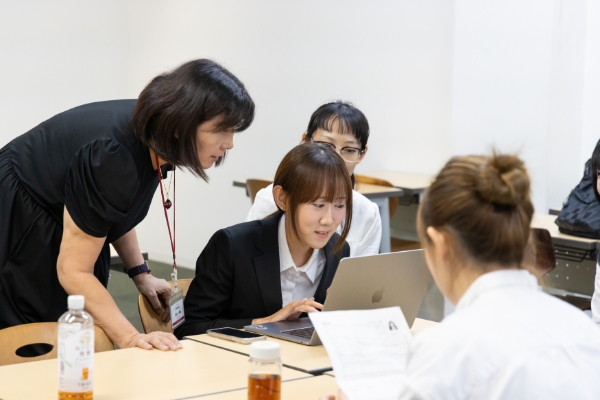
Japanese Language Practice (Advanced/Career Communication)
This course will teach you the knowledge and skills necessary for better communication in professional life, including business Japanese in the office, Japanese for part-time jobs, and Japanese for job hunting.
Various learning support
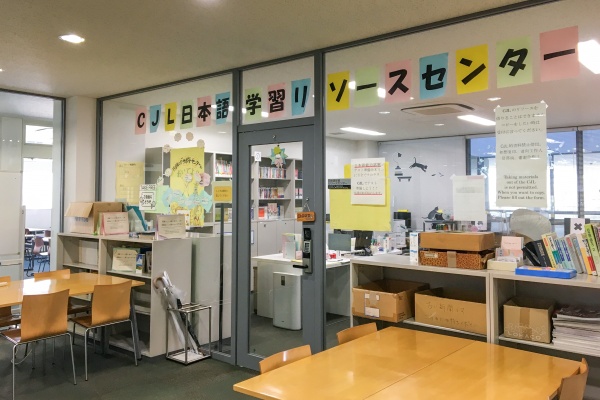
Japanese Language Learning Resource Center
We offer a wide variety of Japanese language learning resources, including textbooks, reference books, workbooks, dictionaries, novels, CDs, and DVDs. We also provide learning consultations. These resources can be used after classes or during breaks between classes.

Japanese Class Guest
Japanese students volunteer to participate in Japanese language classes. They support international students' Japanese language learning by acting as conversation partners and participating in discussions. This is also a valuable learning opportunity for the participating student volunteers.

Writing Support Center
This service provides online support for writing in Japanese and English as foreign languages. A tutor will provide one-on-one support from the drafting stage onwards for reports, presentations, PowerPoint presentations, and other writing tasks.

International Exchange Center / Student Affairs Office
The International Exchange Center provides support for international students after university enrollment in collaboration with the Student Affairs Division. We also collaborate with Global Supporters and Buddy's to organize international exchange Events within the university, creating an environment where international students can adapt to the university.
Characteristics of the academic group
Open list of subpages
Content of learning
Student life/environment
Open list of subpages
Career paths, qualifications, and achievements