Curriculum
Index
Four years of learning that connects theory and practice and paves the way for the future.
The "Foundation Program" helps students acquire the basic knowledge necessary for diverse research, while the "Practical Program" deepens their understanding of various phenomena occurring in society. Building upon this foundation, students broaden their perspectives and cultivate the ability to accurately grasp and analyze situations through "learning that moves back and forth between campus and society." This series of learning is designed to cultivate the practical skills necessary to continue researching throughout their lives.
Four years to cultivate advanced skills and practical abilities
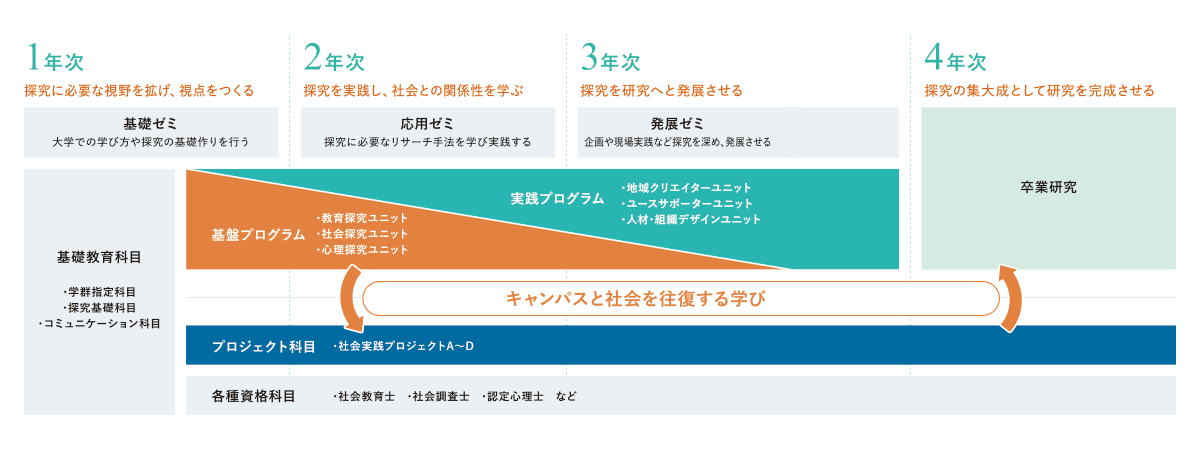
Years 1 & 2: Building a foundation for inquiry and broadening perspectives
In the first year, students thoroughly learn the fundamentals of "inquiry-based learning." By taking a wide range of introductory courses in both the foundational and practical programs, they explore their interests from multiple perspectives. Project-based courses, which can be taken from the first year, allow students to experience the "present" state of society firsthand and gain insights into formulating their own research questions. In the second year, students choose a "main unit" from among six units that will form the core of their inquiry theme. In applied seminars, they acquire specialized research methods and begin to connect theoretical learning on campus with practical application in society.
Third and fourth year: Deepening expertise and implementing it in society
From the third year onward, students develop their previous inquiries into more advanced "research." While taking courses in the practical program units, they deepen their individual themes in advanced seminars with the support of faculty and peers. They also participate in projects related to their inquiries both domestically and internationally, honing their ability to find answers to their own questions about complex real-world issues, and to propose and implement solutions. In their "graduation research," the culmination of their four years of study, they give form to the results of their inquiries in the form of a paper or project. Through this process, they grow into reliable "inquiry-oriented individuals" who can support the growth of others and create new value.
A four-quarter system that promotes well-structured learning and encourages inquiry-based learning.
While many universities and faculties use a two-semester system, College of Education and Social Transformation adopts a four-semester system, allowing students to focus on a single course. Additionally, to support inquiry and learning, we have established a two-week by-week period between the 1st and 2nd quarters, and between the 3rd and 4th quarters. Buy Week is positioned as a period focused on inquiry activities, projects, and learning reflections outside the school, without conducting classes.
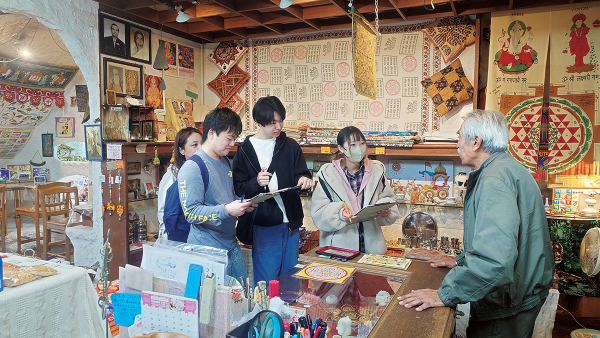
What are project-based courses?
This program begins by questioning societal norms and involves practical learning outside of campus, collaborating with companies, local communities, and NPOs to find answers to self-defined questions in real-world settings. Students freely design activities according to their interests, repeatedly conducting research and proposing improvement measures. They gradually develop the ability to view various social issues from multiple perspectives and the practical skills to create new value.
Characteristics of the academic group
Open list of subpages
Content of learning
Career paths, qualifications, and achievements
Open list of subpages
Student life/environment