A special lecture entitled "Behind the scenes of increasingly strict foreigner policies—the current situation of 'children on provisional release'" was held.
Main content
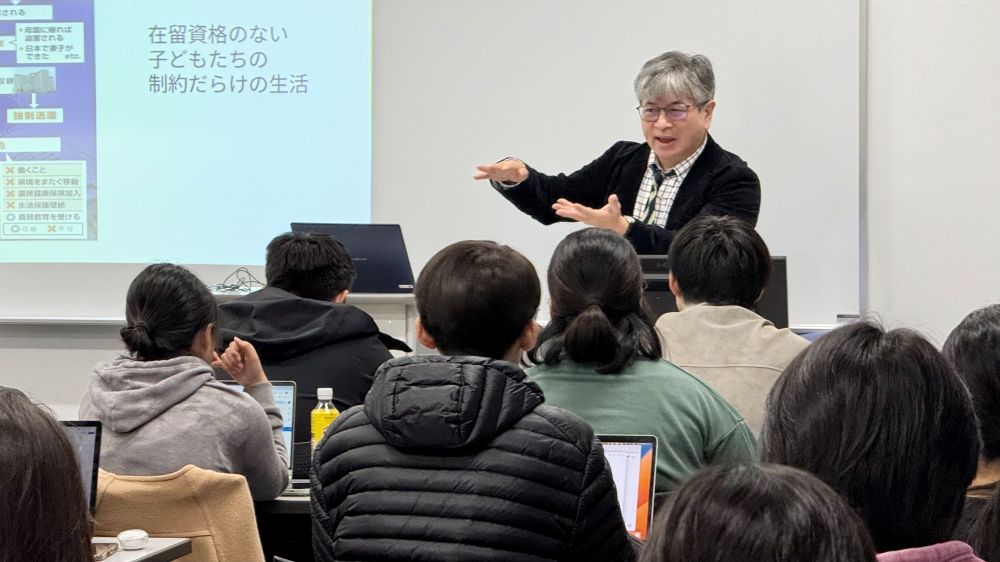
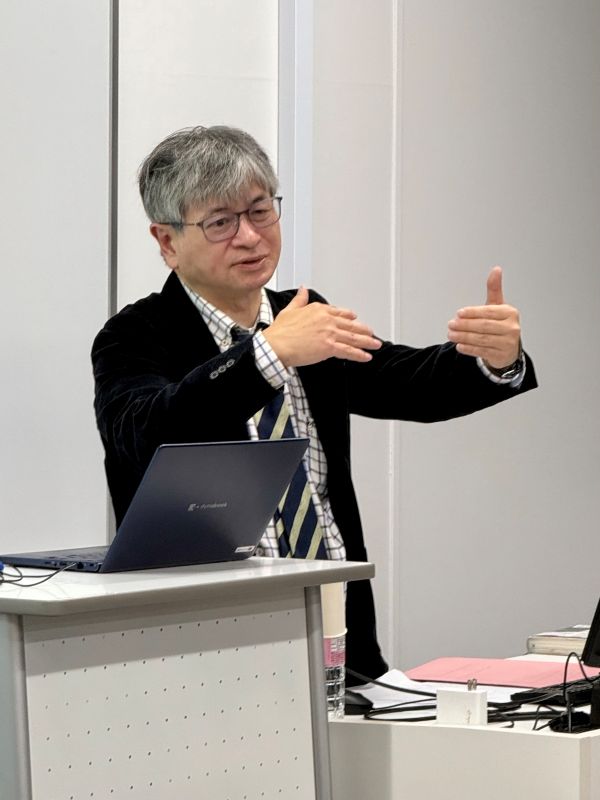
On Thursday, November 5th, at College of Global Communication 's "Language and Society (Multicultural Coexistence and Language)" class, we welcomed Shinichi Ikeo, editorial board member of the Tokyo Shimbun, as a guest lecturer for a special lecture titled "Behind the Strictening Foreign Policy—The Current State of Children on Temporary Leave."
This course examines, from various angles, the diverse members of society who will be the main actors in Japan's goal of "multicultural coexistence," and the circumstances in which they find themselves. Starting with the flow of Japan's policies for accepting "foreigners," we have learned about a variety of topics, including Japanese language learning support for students with foreign connections and language services provided by local governments. In this special lecture, in order to learn about people who are generally largely unknown, we invited Ms. Ikeo, who has conducted extensive field research on immigration administration and coexistence with foreigners, to speak, focusing on the issue of "provisional release." Ms. Ikeo is also the author of "Children on Provisional Release: Targets of 'Japanese First'," published by Kodansha in January of this year.
The lecture began by highlighting, through numerous examples, the harsh reality faced by children born and raised in Japan who lack legal residency status. It then moved on to the revision of the Immigration Control Act and the resulting increase in hate speech against Kurds, social media posts that incite discriminatory attitudes, Japan's remarkably low refugee recognition rate, problems with refugee screening, discrepancies between Japan's ratified international human rights treaties and the current situation, and concrete examples of the increasingly stringent management of foreigners since last year. Finally, recognizing the necessity of efforts to realize a multicultural society amidst a declining birthrate and aging population, the lecture concluded with a question: what can citizens, the majority of society, do?
Photography: Associate Professor Wakako Kusumoto
During the Q&A session after the lecture, many active questions were asked regarding comparisons with the situation in Europe and the appropriateness of refugee recognition. Many attendees learned the term "provisional release" for the first time and were shocked to learn that those in this position, especially children, are deprived of their basic human rights and dreams. At the same time, they realized that being able to think about their own future dreams is not something to be taken for granted, and that foreigner policy is also an issue for Japanese people living in the same society. In addition to the students enrolled in the course, many students and faculty members interested in this topic also attended the lecture, and it was a valuable opportunity for them to learn the facts and to deeply consider the situation of people living in the same society and relate it to their own lives.
Inquiry
J. F. Oberlin University and Affiliated Schools General Planning Department, Public Relations Section
- webadmin@obirin.ac.jp
Latest News
-
2026.11.18
We co-hosted the international forum "1976: 50 Years Since That Turbulent Year" with Waseda University.
-
2026.11.5
Nishiyama Seminar holds workshop on industry-academia collaboration in advertising expression.
-
2026.11.5
A public lecture entitled "Japan's Multicultural Society as Seen Through Authentic Chinese Cuisine" will be held at the Shinjuku Campus.
-
2026.10.23
Students from the BM (Business Management) program will participate in the "Okubo Festival" by exhibiting and cooperating with promotions, etc.
-
2026.10.16
[Course Introduction] Here's a look at the "Basic Seminar - Specialization-Specific Sessions" that deepen learning and connections!