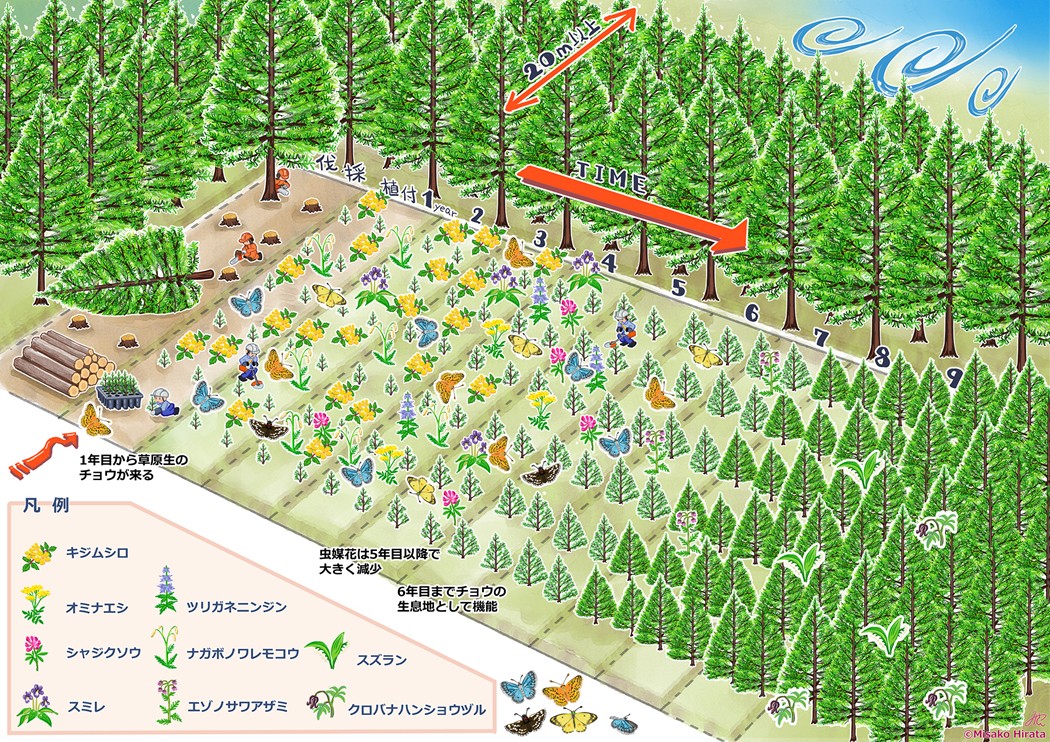
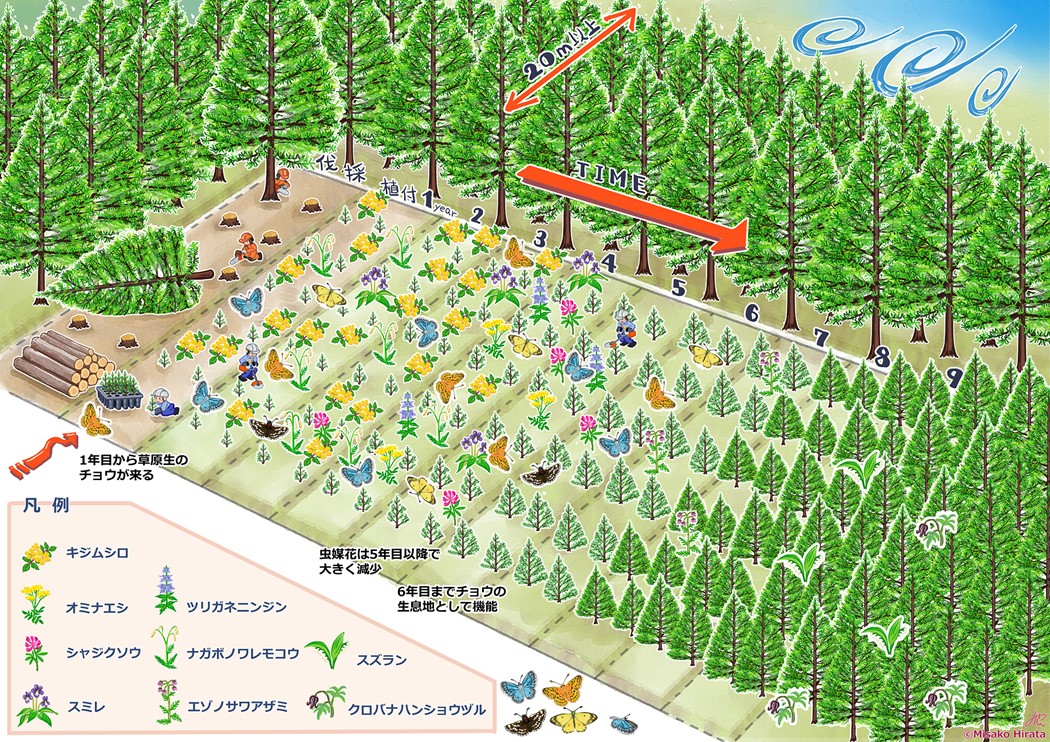
In windbreak forests in the Tokachi region of Hokkaido, it has been discovered that young forests 2 to 6 years old function as habitats for grassland butterflies, including endangered species, and a variety of flowering plants.
Main content
Atsushi Ohwaki (J. F. Oberlin University), Masato Hayami (Hokkaido National Research Organization), Masamune Sakakibara (Graduate School of University of Hyogo), and Naoyuki Nakahama (currently Osaka Metropolitan University, formerly Hyogo Prefectural University and Hyogo Prefectural Museum of Human and Nature) have clarified how many years windbreak forests can function as habitats for grassland plants and butterflies.
Overview
It is known that logging areas for reforestation can temporarily become habitats for grassland organisms, but the exact number of years these areas can sustain themselves as grassland habitats remained unclear. In this study, we investigated flowering plants and butterflies in young reforestation areas that had been planted 2 to 12 years prior to logging. As a result, we found that the diversity of grassland butterflies and flowering plants is high for up to 6 years after logging, but declines rapidly thereafter, and that endangered grassland butterflies also utilize young reforestation areas up to 6 years after planting.
This research represents a significant achievement that contributes to the development of concrete management methods for conserving grassland organisms in windbreaks that are regularly replanted. Grassland organisms are rapidly disappearing in connection with the recent decline of grasslands. By creating new logging areas around young windbreaks that have been replanted before six years have passed since planting, it is expected that grassland plants and butterflies can be sustainably conserved in the windbreak landscape while maintaining the original function of the windbreak. The results of this research were published in the international journal "European Journal of Entomology" on January 19, 2026.
1. background
Since the 20th century, the significant decrease in grassland area due to changes in human lifestyles has led to a rapid decline in grassland organisms, with many species now listed as endangered at the national and prefectural levels. In this context, recently, areas such as logging sites, firebreaks, grasslands under power lines, and ski resorts have been attracting attention as habitats for grassland organisms. In the case of logging sites, trees are replanted after logging, so they only function as habitats for grassland organisms temporarily. However, the exact number of years after replanting that these areas function as habitats for grassland organisms has been unknown until now.
The vast agricultural landscape of the Tokachi region of Hokkaido features windbreaks (mostly planted trees) planted in rows or grids. To prevent large dead branches from falling onto fields and roads, these windbreaks are regularly cut down and replanted. This landscape is also known to be home to endangered grassland butterflies. Due to these characteristics, the windbreaks of the Tokachi region of Hokkaido are an ideal environment for investigating how long after planting they function as habitats for grassland organisms. Furthermore, in order to conserve endangered grassland butterflies in this windbreak landscape, it is necessary to clarify whether these endangered butterflies utilize the young plantations of the windbreaks, and if so, for how long after planting they do so.
This study aimed to determine the detailed duration for which the diversity of grassland butterflies and flowering plants, as well as the populations of endangered grassland butterflies, remain high after afforestation. Various environmental variables were also measured to evaluate whether forest age or environmental variables explain plant and butterfly characteristics.
2. method
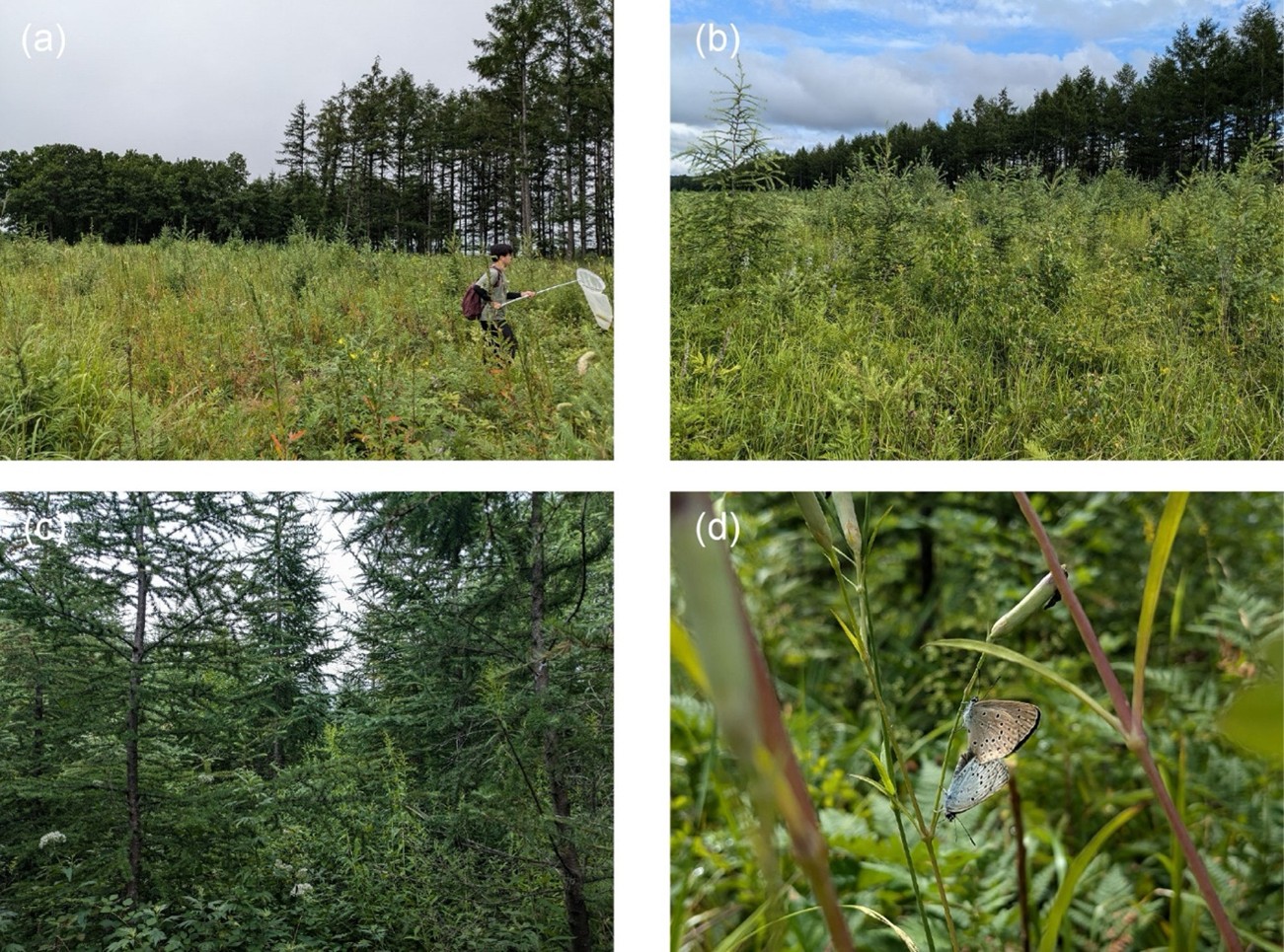
In the Tokachi region of Hokkaido, a 30-meter survey route was established in eight young plantations, ranging from 2 to 12 years after planting (2 years x 2 locations, 3 years, 5 years x 2 locations, 6 years, 9 years, and 12 years), and surveys were conducted once each in May and August (Figure 1). The surveys counted the number of insect-pollinated flower species and inflorescences, as well as the number of butterfly species and individuals. Environmental variables such as tree height, sky opening, grass height, and soil moisture were also measured. Note that soil moisture did not differ significantly between locations and was therefore not used in the analysis.
3. result
For both plants and butterflies, the number of species and individuals (in the case of plants, the number of inflorescences) decreased with increasing forest age. The number of insect-pollinated flowers decreased significantly after the 5th year following planting, but the number of butterfly species and individuals remained high until the 6th year, before declining sharply from the 9th year onward. Several endangered grassland butterfly species were also observed. All of these were observed until the 6th year, but were not observed from the 9th year onward. When evaluating whether forest age or environmental variables explain the number of plant and butterfly species and individuals, as well as the individuals of the two endangered butterfly species, the model using only forest age yielded a better fit than the model using only environmental variables in all cases.
4. Future Outlook
This study revealed that windbreaks can serve as habitats for grassland butterflies and plants, including endangered species, for 2 to 6 years after planting, but cease to function as habitats after the 9th year. Therefore, in order to conserve grassland butterflies and plants, including endangered species, in windbreak landscapes, it is necessary to create logging areas within the range of butterfly migration before 6 years have passed since planting. This finding provides important guidance for developing windbreak management plans at the landscape scale, determining where and how to replant in order to conserve grassland organisms in windbreak landscapes.
Furthermore, the finding that plant and butterfly diversity can be largely determined solely by forest age, without measuring environmental variables, is considered useful for forestry managers in developing management plans that take biodiversity into account. Measuring environmental variables is time-consuming, but if management plans for windbreaks can be developed based solely on forest age, it is expected that management plans can be constructed more efficiently based on forest compartment maps.
This study focused solely on larch plantations, the most commonly planted windbreak forest in the Tokachi region of Hokkaido. However, Sakhalin spruce is also frequently planted. Since growth rates differ among tree species, the duration of grassland development may vary depending on the species. Furthermore, we were unable to survey plantations 7-8 years after planting, so the state of forest age during this period remains unknown. In addition, there was variability in vegetation and butterfly communities even in young plantations. We believe that clarifying these points in the future will enable the development of more detailed windbreak forest management plans that balance windbreak function with biodiversity.
About the research project
This research was supported by the Pro Natura Fund 33rd term, the Hokkaido Research Organization, and the Japan Society for the Promotion of Science Grants-in-Aid for Scientific Research (B) (Project Numbers 21H02221/23K21209).
joint researcher
Atsushi Ohwaki J. F. Oberlin University College of Arts and Sciences
Masato Hayami, Forestry Research Institute, Hokkaido Research Organization
Masamune Sakakibara, Graduate School of Environmental and Human Studies, University of Hyogo
Naoyuki Nakahama, Graduate School of Agriculture, Osaka Metropolitan University (formerly affiliated with: Institute of Natural and Environmental Sciences, University of Hyogo and Department of Natural and Environmental Restoration, Museum of Nature and Human Activities, Hyogo Prefectural Museum of Nature and Human Activities)
*Oowaki and Hayami's contributions to this research are equal.
Partner organizations
Forestry Bureau, Fisheries and Forestry Department, Hokkaido Prefectural Government; Sarabetsu Village, Kasai District, Hokkaido
Reference diagram
Paper Information
【title】
Clearcut areas aged 2-6 years in shelterbelts support high diversity of butterflies and flowering plants, including endangered grassland butterflies, in the Tokachi District of Hokkaido, northern Japan
Title Translation | Logging areas in windbreak forests in the Tokachi region over a 2-6 year period retain high biodiversity of butterflies, including endangered grassland species, and flowering plants.
【author】
Atsushi Ohwaki (Atsushi Ohwaki), Masato Hayamizu, Masamune Sakakibara, Naoyuki Nakahama
[Magazines, Volumes, etc.]
Journal: European Journal of Entomology
Volume: 123
Pages: 1–12
Publication year: 2026
DOI: 10.14411/eje.2026.001
Inquiry
Research Inquiries
J. F. Oberlin University College of Arts and Sciences
Associate Professor Atsushi Ohwaki
- TEL
- 042-797-8573
- ohwaki_a@obirin.ac.jp
Hokkaido Research Organization (a local independent administrative agency)
Forestry Research Institute, Planning and Coordination Department, Extension Group
- TEL
- 0126-63-4164
- forestry@hro.or.jp
Press inquiries
J. F. Oberlin University and Affiliated Schools General Planning Department, Public Relations Section
- TEL
- 042-797-9772
- webadmin@obirin.ac.jp
Hokkaido Research Organization (a local independent administrative agency)
Forestry Research Institute, Planning and Coordination Department, Extension Group
- TEL
- 0126-63-4164
- forestry@hro.or.jp
Latest News
-
2026.10.10
東京都立千歳丘高等学校と高大連携協定を締結
-
2026.10.8
We held a send-off ceremony for the 2026 Hakone Ekiden qualifying race.External link
-
2026.10.8
J. F. Oberlin University ・Graduate School Japanese teacher training and practical training courses registered as 'Registered Practical Training Institutions' and 'Registered Japanese Teacher Training Institutions' by the Ministry of Education, Culture, Sports, Science and Technology
-
2026.10.2
Positive Psychology Fair 2026External link
-
2026.10.1
We have started accepting reservations for the online general entrance examination and the entrance examination information session utilizing the Common Test for University Admissions.External link