Curriculum
Index
Four years to cultivate problem-solving skills
In the first year, students will recognize themselves as independent learners through 'basic education subjects,' and by focusing on the Area chosen at admission and taking 'specialized foundational subjects,' they will solidify their learning foundation and prepare for major and minor selections. In the fall semester of the second year, students choose between major and minor and deepen their studies toward completion in the third and fourth years. Through major seminars, service learning, and graduation theses, students experience the process of identifying problems and considering solutions on their own, and acquire inquiry and practical skills to apply what they have learned to society.
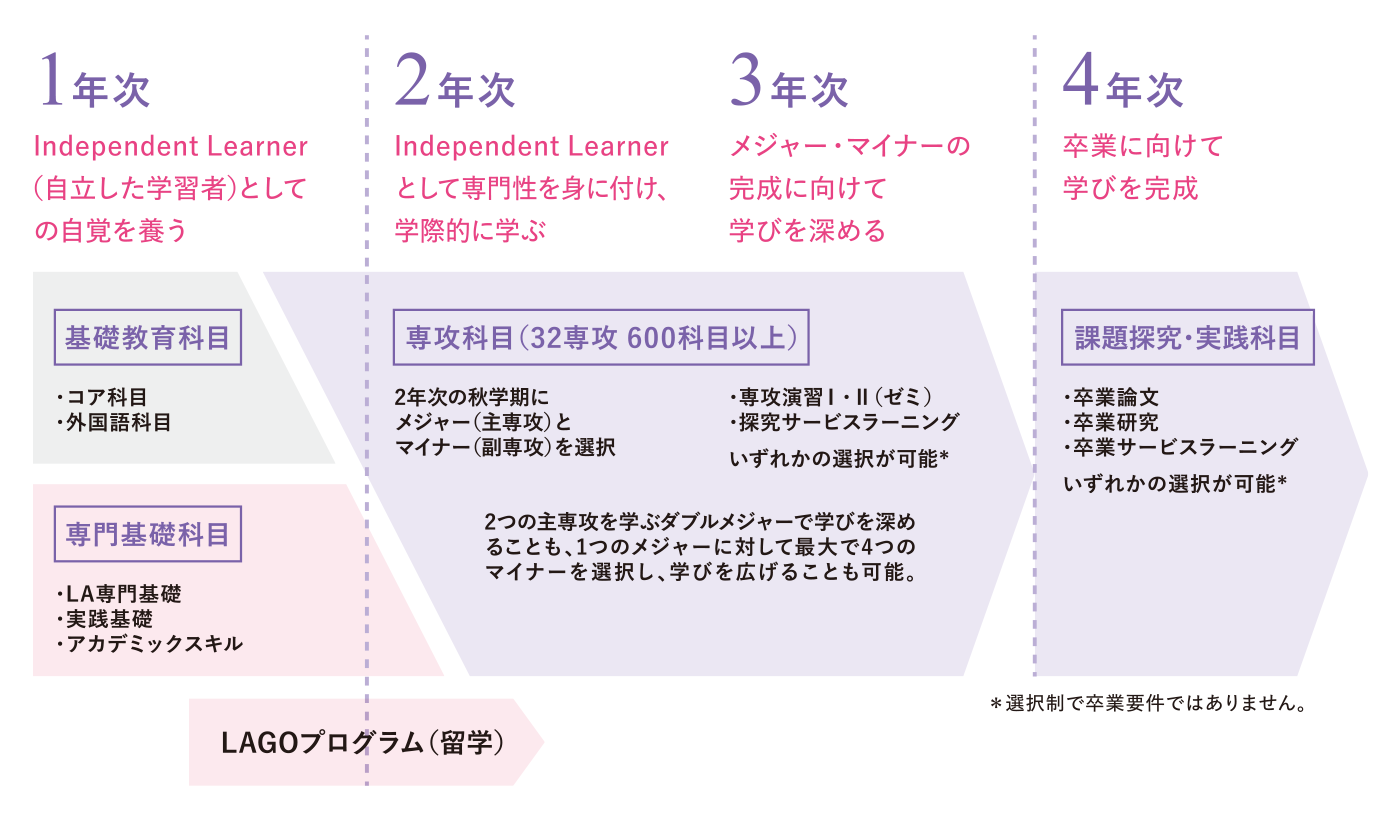
Year 1: Developing awareness as an Independent Learner
The starting point of university studies is basic education subjects that develop thinking skills, writing skills, and information gathering abilities, including liberal arts seminars. At the same time, students will study specialized foundational subjects centered on the Area of 'Humanities, Social Sciences, and Nature' selected at the time of application, building the 'foundation' necessary for university studies. You can also broaden your horizons through diverse experiences such as studying abroad or obtaining certifications.
LAGO Program (Study Abroad)
This is a one-semester study abroad program. Through language learning, living experiences, international exchange, and community activities abroad, this program helps students to learn about diverse worlds, reflect more deeply on themselves, and support them in realizing their dreams. Furthermore, the LA (Learning and Learning) program aims to help students acquire not only language skills but also international perspectives and flexibility through studying abroad and participating in volunteer activities at an early stage of their university life.
Second year: Develop expertise and engage in interdisciplinary learning as an Independent Learner.
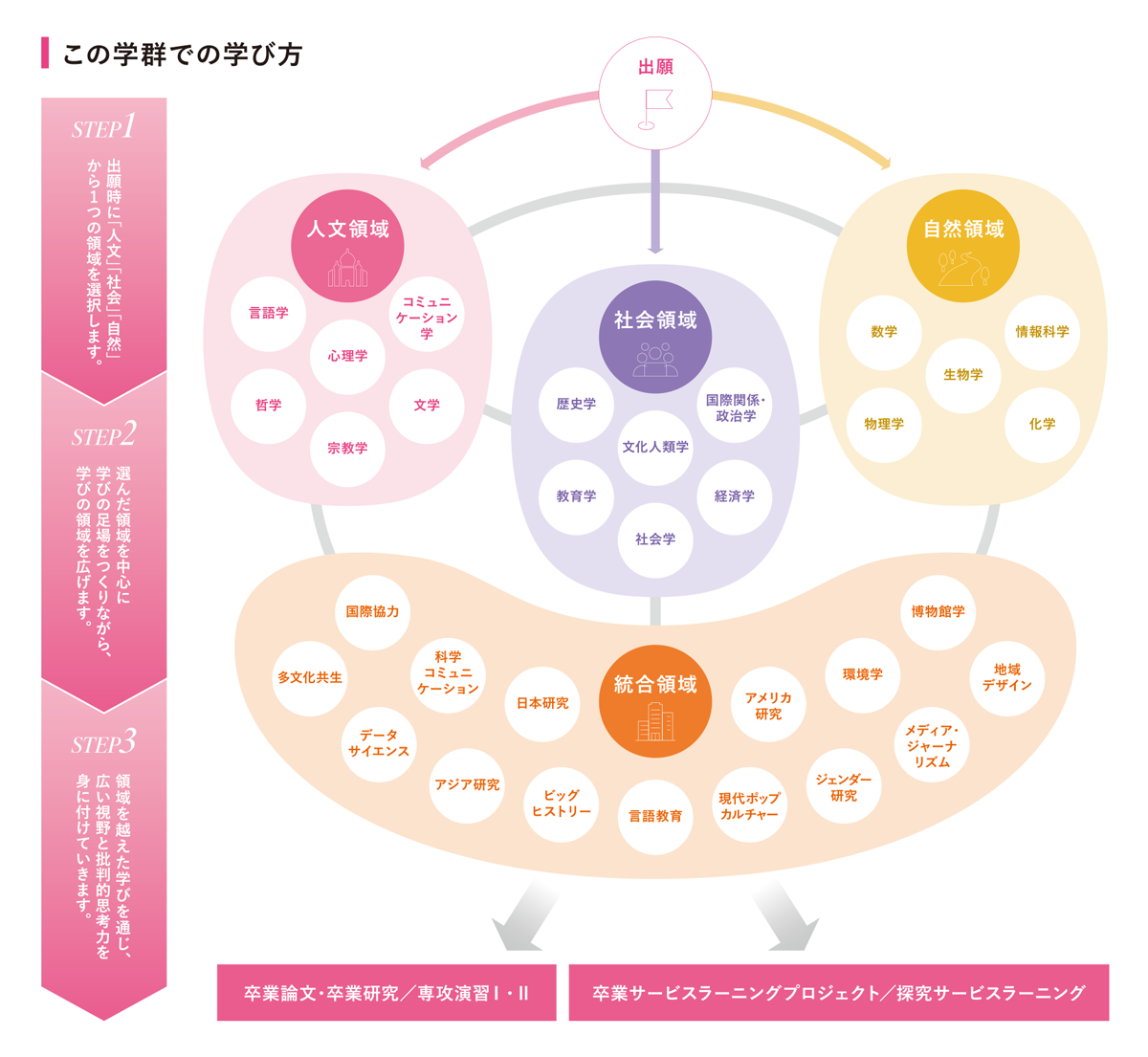
Choose a major (major) and a minor (minor) from four Area (Humanities, Social Sciences, Sciences, Integration) according to your interests. Not only will you deepen your expertise, but by combining different fields, you can gain a multifaceted perspective and flexible imagination.
This combination of learning will form the foundation for your third year and beyond.
Third year: Deepening our learning towards mastering major and minor keys.
In the third year, students participate in specialized seminars (seminars) in small groups, honing their critical thinking, analytical, expressive, and execution skills while delving deeply into their chosen field. In the inquiry-based service learning program, students develop the ability to identify and solve problems, as well as their initiative and collaborative thinking skills, through practical experience in real-world settings.
Major/Minor System
You can create your own original learning experience tailored to your interests and aspirations. The "Major-Minor System" makes this possible. While completing a major program or course within your affiliated academic group is a graduation requirement, you can combine it with other areas of study as a minor. Expand your learning possibilities and aim for your own unique goals.
4 Area 32 programs, with over 600 combinations!
J. F. Oberlin University College of Arts and Sciences offers programs across 32 academic fields—four Area of humanities, social sciences, nature, and integration—covering almost every academic Area available at the university. Students can choose and combine subjects they want to study in these fields, majors and minors, and proactively create their own "unique learning" tailored to their interests and future goals.
During the preparation period from your first year to the spring semester of your second year, when you're deciding on your major and minor, try exploring programs in a variety of fields.

Integrated Program
We study cross-sectional themes that go beyond just one Area of humanities, society, or nature such as the SD Area Gs, as well as more specific social issues, and consider solutions.

Humanities
It mainly consists of programs belonging to the humanities Area. The humanities are fundamental studies of humanity that pursue the question of what it means to be human.

Social Sciences
We will learn about the society in which we humans live. We will acquire inquiry-based approaches to unravel various aspects of society and tackle various challenges.

Natural Sciences
You will learn about the profound laws of nature and mathematics. We value the question "why" and, step by step, unravel the mysteries of nature. Through this knowledge and experience, you will be able to view society more clearly.
Major seminars and inquiry-based service learning
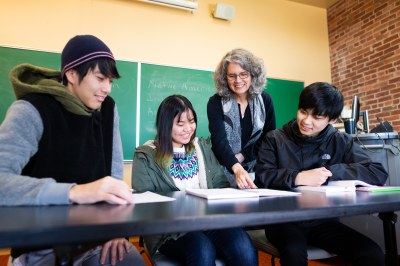
The "Major Seminar" is a course where, under the guidance of a specific faculty member, students study their specialized field in small groups, set their own themes, conduct research, presentations, and discussions, and enhance their thinking and expressive abilities while leading to graduation research. "Inquiry Service Learning" is a course for third-year students who deepen learning by alternating between classroom learning and field activities College of Arts and Sciences.
Fourth year: Completing your studies in preparation for graduation.
Students will work on their graduation theses and research projects, delving deeply into issues in their respective fields to complete their learning in preparation for graduation. In addition, the "Graduation Service Learning Project" will help them hone their ability to identify problems and devise solutions through learning, and acquire the action and thinking skills required in society.
Characteristics of the academic group
Open list of subpages
Content of learning
Open list of subpages
Career paths, qualifications, and achievements