What are liberal arts?
What are liberal arts?
It is possible to tackle all kinds of social problems from various angles.
That's what "learning" in the liberal arts is all about.

Global economic inequality and environmental problems, information overload, prejudice and discrimination, intercultural issues that give rise to conflict and war...
Modern society faces many complex problems. These problems cannot be solved with a narrow perspective or limited expertise.
For example, suppose a region has the challenge of attracting more tourists. What should be done to solve this? For instance, an economic analysis to examine the flow of money; measures to prevent the environmental impact of increased tourism; and selection of media to more widely promote the region's positive aspects. While the objective is the same—to attract tourists—the approaches to achieving it are diverse. However, even if experts from various fields come together, if they act independently, it will be difficult to find a solution.
That's where liberal arts come in. Rather than focusing on a single specialty, by learning and integrating multiple Area, students develop comprehensive skills capable of tackling complex real-world problems from various perspectives.
Learn about liberal arts
Knowledge that originated in ancient Greece to liberate people from bondage, distinct from specialized academic subjects or vocational courses.
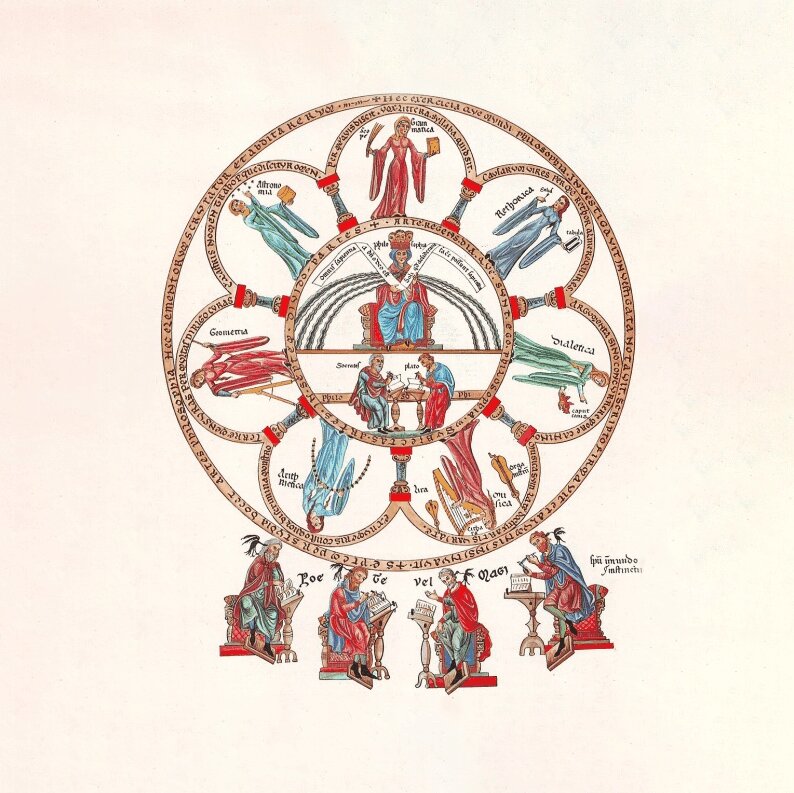
Originally, liberal arts referred to knowledge and methods for acquiring the skills necessary to live, liberating people from constraints in a positive sense. This concept, which originated in ancient Greece, was later adopted by ancient Rome and defined as the seven liberal arts, consisting of three linguistic disciplines (grammar, logic, and rhetoric) and four mathematical disciplines (arithmetic, geometry, astronomy, and music).
Subsequently, this tradition was passed down through 17th-century Britain to America, and current American liberal arts colleges emphasize small class sizes to cultivate foundational knowledge and logical thinking skills.
Liberal arts education is needed now
We cultivate multifaceted thinking, critical thinking, and practical thinking skills that are essential in the real world.

In today's society, where social issues are becoming increasingly complex, there is a demand for talent with broad and comprehensive knowledge, advanced expertise, and precise judgment and execution skills. For this reason, conventional narrow Area that focuses on learning one thing cannot be handled by single-track specialized education.
This is where liberal arts education is needed. By learning about diverse Area and developing the ability to synthesize them, students will develop multifaceted thinking that transcends academic barriers, critical thinking that questions meaning from a broad perspective, and practical thinking that actively works toward problem-solving, thereby developing the ability to accurately judge matters and lead them to solutions. This power is exactly what society needs right now.
Learning from J. F. Oberlin University College of Arts and Sciences
Covers all academic Area to be studied at university, and learns freely and independently.
To realize liberal arts learning, learning that transcends academic disciplines is necessary. J. F. Oberlin University College of Arts and Sciences offers programs spanning 32 academic fields—four Area of humanities, social sciences, nature, and integration—covering nearly every academic Area available at the university. Students can choose and combine subjects they want to study in these fields, majors and minors, and proactively create their own "unique learning" tailored to their interests and future goals.
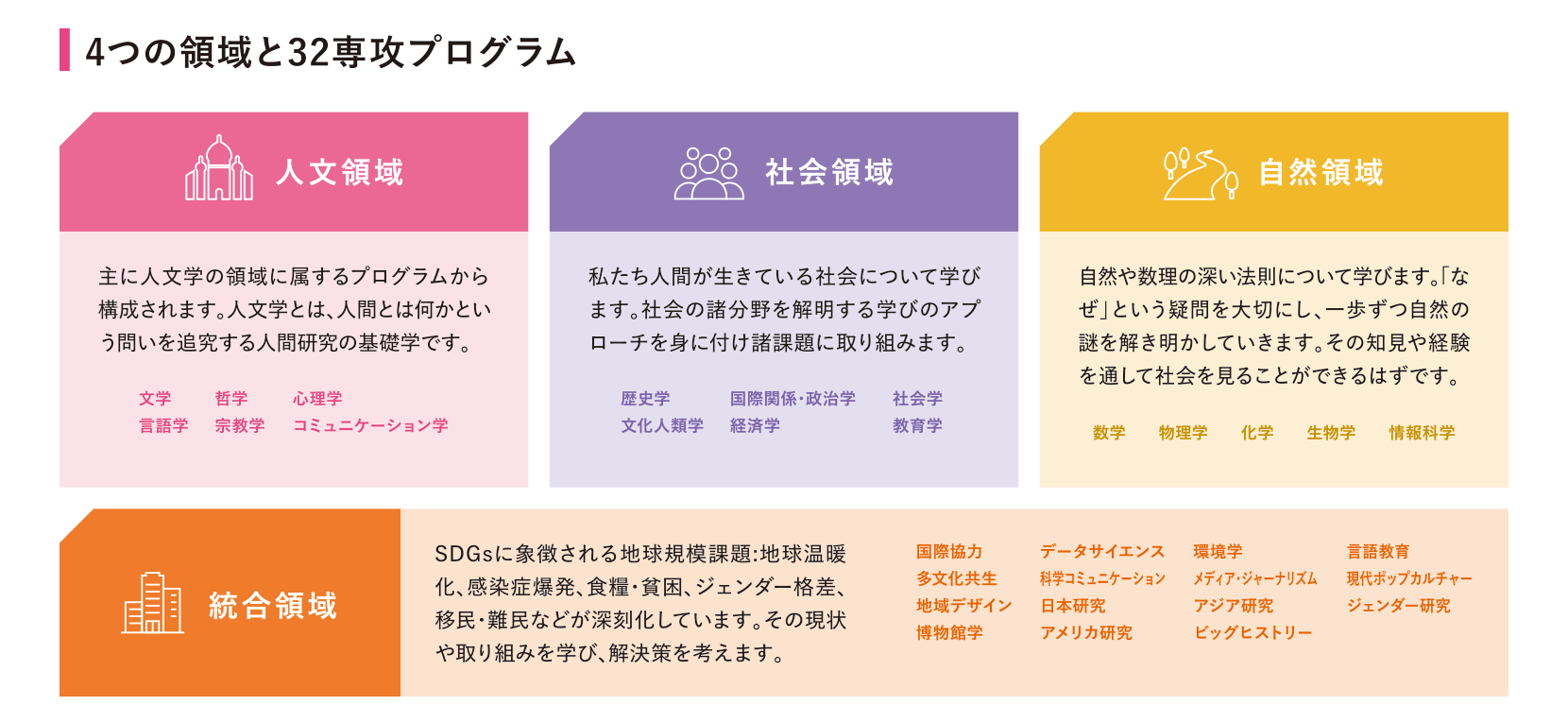
Moreover, to succeed in society, it is important not only to learn multiple Area but also to acquire many "skills" such as judgment and logic to integrate and utilize these skills. College of Arts and Sciences In this course, to cultivate these "skills," you can progress in a step-by-step and practical manner of learning: (1) learning how to learn, (2) interdisciplinary learning, and (3) applying what you have learned.

During the first and second years, students will focus on building a strong foundation for university learning by studying a wide range of subjects across disciplines, including foreign languages, academic skills, logical thinking, and areas of interest.

Students select a major and a minor in their chosen academic field, and then delve deeper into their specialized area, primarily from their third year onward.

From the third year onward, students will develop research and practical skills by experiencing the process of identifying problems and considering solutions on topics of interest.
Within a program that covers a vast academic Area, students learn broadly, deepen their understanding of what they truly J. F. Oberlin University want to learn, and acquire foundational skills and general knowledge. Even if you haven't decided what you want to study at the time of enrollment, you can find what suits you as you attend university. The school also offers comprehensive learning systems to improve language skills, including its own overseas training program (LAGO program).
Characteristics of the academic group
Open list of subpages
Content of learning
Open list of subpages
Career paths, qualifications, and achievements