18 massive star "cradles" captured — Structure and evolution of W49A's hot molecular cloud core —
Main content
Ryosuke Miyawaki (J. F. Oberlin University), Masahiko Hayashi (National Astronomical Observatory of Japan/Japan Society for the Promotion of Science Bonn Research Liaison Center), and Tetsuo Hasegawa (National Astronomical Observatory of Japan) conducted a detailed study of Area W49A (Note 2), a particularly active and massive star formation within the Milky Way, using publicly available data from the radio telescope group ALMA (Note 1) in Chile, South America.
Massive stars, which have more than eight times the mass of the Sun, grow rapidly in a short period of time, making it difficult to observe their formation process in detail. Baby massive stars grow within a "hot molecular cloud core" (Note 3), which is deeply enveloped in surrounding gas and dust. A hot core is a warm, dense clump of gas exceeding 100 K, and many molecules emit radio waves. In this study, we used these molecular radio waves as a clue to investigate the changes that occur as massive stars grow and begin to ionize their surroundings.
The research team investigated the distribution and velocity of acetonitrile (CH₃CN) (Note 4), a molecule that is well-known for indicating high temperature and high density gases, and found 18 hot cores within W49A. In addition, they confirmed 20 compact celestial objects using a 1.3 mm continuous wave.
By comparing 12 types of molecular emission lines with the hydrogen recombination line H30α, we found that five components with different properties coexist around the hot core: "high-temperature, high-density gas," "outflow," "enveloping gas," "extended gas," and "ionized gas." In other words, it appears that the hot core is not a simple, uniform mass of gas, but rather a complex structure combining disks, tori, gas ejected from the star, and surrounding gas.
Furthermore, the amount of CH₃CN was strongly related to temperature. Observations revealed that particularly high temperatures of approximately 200-300 K or higher were necessary for CH₃CN to be abundant. This indicates that the chemical composition of the hot core is not the same above 100 K, but rather changes continuously as the temperature increases. CH₃CN is not only a marker for finding the hot core, but also a clue to understanding the internal temperature and chemical evolution.
When dividing the 18 hot cores into evolutionary stages, 10 have not yet shown HII Area (Note 5) at the center, 4 have already formed HII Area, and the remaining 4 are intermediate or difficult-to-determine objects. More objects need to be examined to be statistically definitive, but these results suggest that the hotcore stage before stars begin ionizing the surrounding gas may last about 100,000 years longer than previously thought. On the other hand, the stage after HII Area forms at the center is thought to be about 10,000 years.
Regarding how massive stars grow, there are representative concepts: the "core accretion model," where one or a few stars grow from large gas clumps, and the "competitive accretion model," where multiple stars within a cluster absorb gas and grow. While it is impossible to determine one over the other based solely on the time scale obtained in this study, complex star formation Area like W49A may have both mechanisms at work depending on the environment and the conditions of each celestial object. This study depicted the formation process of massive stars by comparing numerous hotcores.
The results of this research were accepted by the Publications of the Astronomical Society of Japan (PASJ) on July 27, 2026, and were published online on September 14, 2026. They are scheduled to be published in the October 2026 issue.
Paper title: Hot molecular cores in the W49A molecular cloud complex
Authors: Ryosuke Miyawaki, Masahiko Hayashi, Tetsuo Hasegawa
Note 1: ALMA (Atacama Large Millimeter/submillimeter Array) is a millimeter-wave and submillimeter-wave interferometer installed in the Atacama Desert of Chile. This study is a reanalysis of publicly available ALMA archive data.
Note 2: W49A is a very active massive star formation Area in the direction of Aquila, one of the most active within the Milky Way. In this study, Area including W49N were observed by ALMA, with a distance of 11.11 kiloparsecs.
Note 3: Hot Molecular Core (HMC) is a typically compact, high-density (n(H₂)≳10⁶ cm⁻³) high-temperature (≳100 K) gas Area around massive protostars, typically less than 0.1 parsec. It exhibits abundant molecular emission lines containing complex organic molecules.
Note 4: CH₃CN (acetonitrile) is a representative molecule for tracking high-temperature, high-density gases. In this study, the hot core was identified using the radiation of CH₃CN, and the rotational temperature was determined from multiple transitions.
Note 5: HII Area Area ionized hydrogen gas by ultraviolet radiation emitted from hot, young, massive stars. The very small early stage develops into Hypercompact HII Area (HCHII), followed by Ultracompact HII Area (UCHII).
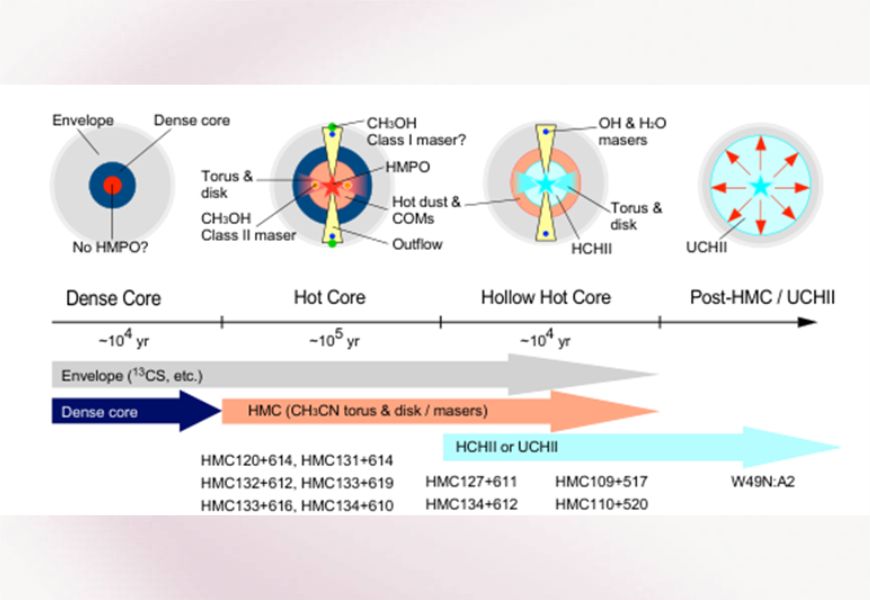
This diagram schematically illustrates how hot molecular cloud cores (HMCs), the sites where massive stars are born, change over time.
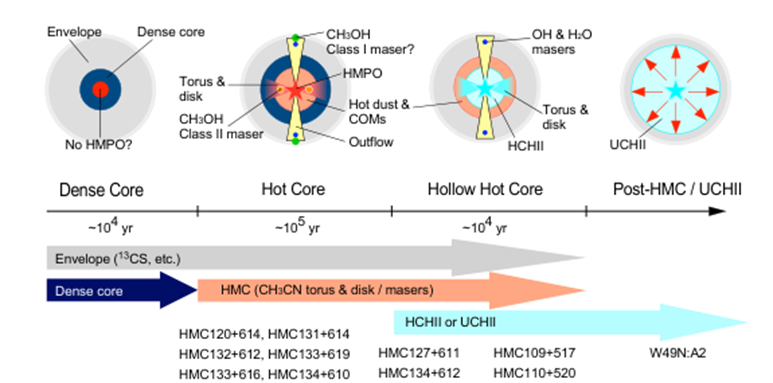
・From left: The "Hollow Hot Core," with a cold high-density core → hot core → featuring a HII Area at the center→ shows the evolution of HII Area further expanding.
The 18 hot cores identified in this study can be broadly categorized into "Hot Core," "Hollow Hot Core," and intermediate stages.
During the hot core stage, the young, massive star at the center grows by incorporating material from the surrounding disk or torus, while simultaneously ejecting outflows.
・As the central star grows and emits strong ultraviolet rays, the surrounding hydrogen gas is ionized, causing HII Area to form and expand.
Inquiry
J. F. Oberlin University College of Arts and Sciences Professor Ryosuke Miyawaki (Ryosuke Miyawaki)
- TEL
- 042-797-4736
- miyawaki@obirin.ac.jp
Latest News
-
2026.10.16
[Course Introduction] Here's a look at the "Basic Seminar - Specialization-Specific Sessions" that deepen learning and connections!
-
2026.10.16
Hiroki Makino Special Lecturer of Visual Arts Major Wins the 'Mazda Award' at the 69th Shinkyo Art Exhibition
-
2026.10.16
College of Arts and Sciences Ikko Tanaka Humanitext, with Professor Participation, Selected for the International Research Program HAVI
-
2026.10.14
A screening of the documentary film "The Collectors" and a lecture by researchers.External link
-
2026.10.10
We have concluded a high school-university collaboration agreement with Tokyo Metropolitan Chitosegaoka High School.