Natural Area / Physics Program
Program Overview
We believe that there are laws behind phenomena. These laws can be discovered by observing phenomena, formulating hypotheses, and testing those hypotheses. This is the research method in physics. In this program, you will acquire this method by tracing past research and conducting actual experiments. Main subjects include "Mechanics I & II," "Electromagnetism I & II," "Thermodynamics," "Quantum Mechanics I & II," "Statistical Mechanics," and "Physics Experiments I & II."

Class Featured
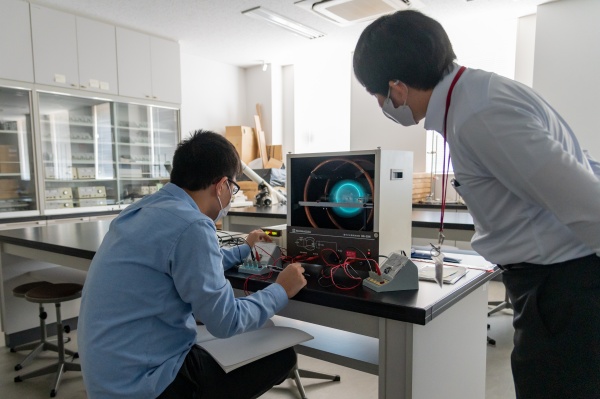
Physics Experiment II
Experiments are essential for explaining new phenomena and experimental facts using knowledge of physics. Experiments require the ability to set problems based on independent and flexible thinking, as well as creative thinking skills. Physics Experiment II cultivates these abilities. Building on the techniques acquired in Physics Experiment I, we will conduct experiments such as ultrasonic wave experiments, electron charge-to-charge ratio measurements, and atomic spectrum wavelength measurements.
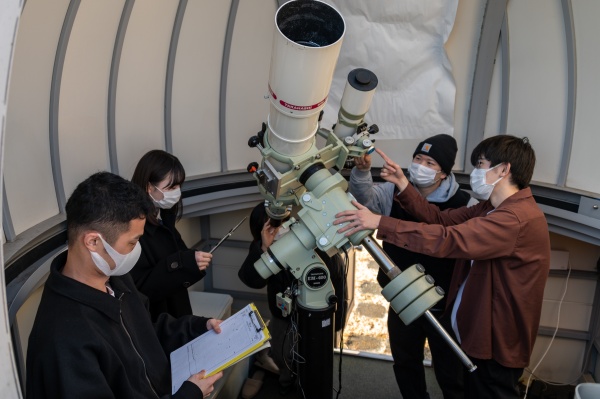
Specialized Seminar II
In Specialized Seminar I, after understanding the properties of celestial bodies through literature, students will acquire, analyze, and interpret data through actual observations. Specifically, they will photograph variable stars with a CCD camera, determine changes in magnitude, and discuss them in comparison with past observational data and literature.
The results are presented annually at a joint presentation meeting with other seminars. These activities serve as preparation for the graduation research project.
Other classes and subjects
Mechanics I & II / Electromagnetism I & II / Vibration and Waves / Thermodynamics / Quantum Mechanics I & II / Statistical Mechanics / Experimental Physics I & II / Cosmology and Modern Physics / Advanced Physics / Differential and Integral Calculus I & II / Linear Algebra I & II / Geophysics / Astronomy / Meteorology, etc.
How seniors learned

Physics & Chemistry/Environmental Studies
Experience the fascination of understanding the laws behind phenomena through physics.
Hiyori Abe
I am impressed and fascinated by how the laws I learn in class align with phenomena around me, and how we can understand how natural phenomena occur based on these laws. Although I would say I am by no means good at physics, I chose the physics program as my major because of the close relationship between professors and students, and the environment where I can easily ask questions about things I don't understand. I am still thinking about my future prospects. In the meantime, I would like to continue to enjoy learning physics and deepen my understanding of it.
The environment for learning physics is excellent, so even if you're not particularly good at physics, if you're interested in it, why not choose the physics program as your major or minor and learn physics with us?
Characteristics of the academic group
Open list of subpages
Content of learning
Open list of subpages
Career paths, qualifications, and achievements