Humanities Area / Philosophy Program
Program Overview
The philosophy program addresses traditional issues in philosophy and ethics, as well as contemporary problems, fostering deep insight into the world and humanity, and the ability to express thoughts accurately. The goal is for students to develop the ability to construct their own arguments through not only reading texts, but also through discussions and presentations. Main subjects include "History of Western Philosophy and Thought," "Problems in Ethics," "Logic," "History of Social Thought," and "Aesthetics and Art Theory."

Class Featured
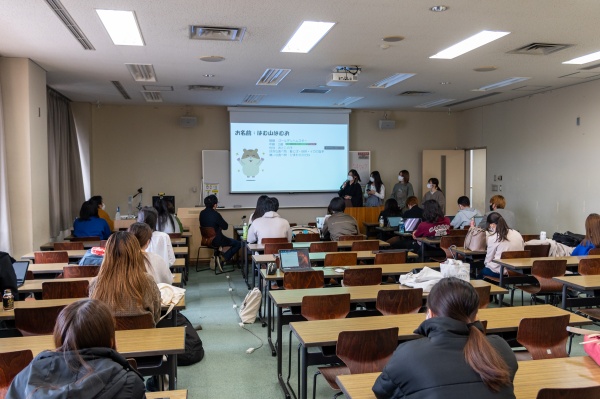
Problems of Philosophy
No matter how sad or depressed we may be, we sometimes laugh unexpectedly. Why is that? How is falling in love with a 2D character different from falling in love with a real person? Is it wrong to use extreme expressions in shonen and shojo manga? Even in our ordinary daily lives, we can find the seeds of philosophy if we just change our perspective. The goal of this class is to help you discover philosophical questions that only you can find and to deepen your own unique way of thinking.
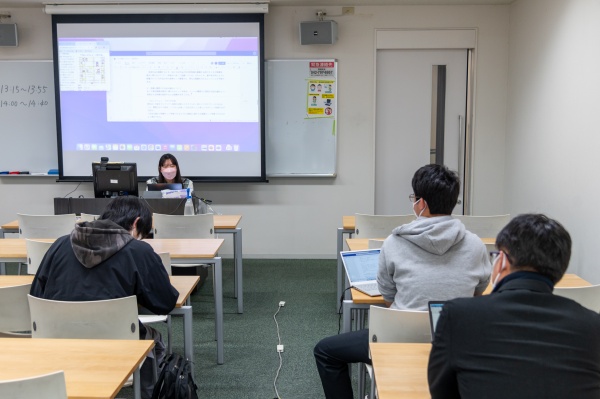
Specialized Seminar
The intellectual pursuit known as "philosophy" originated in ancient Greece and has been pursued by various people for over 2,000 years, driven by intellectual curiosity. The issues discussed throughout its history have been relevant to humanity in every era, encompassing knowledge, technology, art, the state, nature, law, life and death, and in modern times, even animals and robots are subjects of discussion. While it may seem like an elusive field of study at first glance, you will participate in this philosophical endeavor by reading texts, discussing, using devices, and writing together with your peers.
Other classes and subjects
Western Philosophy and Intellectual History A / Western Philosophy and Intellectual History B / Western Philosophy and Intellectual History C / Reading of Fundamental Philosophical Texts A / Reading of Fundamental Philosophical Texts B / Logic / Applied Philosophy / Problems in Philosophy / Advanced Topics in Philosophical Research A / Advanced Topics in Philosophical Research B / Aesthetics and Art Theory / Reading of Fundamental Ethics Texts A / Reading of Fundamental Ethics Texts B / History of Social Thought A / History of Social Thought B / Environmental Ethics / Fundamentals of Normative Ethics / Metaethics / Research in Applied Ethics / Problems in Ethics A / Problems in Ethics B, etc.
How seniors learned

Philosophy & Media and Journalism
New discoveries that reveal the connection between philosophy and media
Yuiko Arakawa
Since I was little, I have been wondering, 'Why?' There were many children. When I thought I might be a little different from everyone else, I was exposed to ethics and philosophy classes in high school, which made me strongly want to study philosophy at university. In university lectures, I can learn a wide range of topics from pop topics to specialized ones, and every session is really enjoyable! In the minor media journalism, I took classes in advertising and newspapers. By studying journalism, you learn about the movements of countries around the world, and when you try to match them with philosophical thinkers of the past, you find commonalities and connections, and when you realize that, it's very interesting. Many J. F. Oberlin University students are unique, talking about fashion and their favorite bands—every day is full of excitement! While studying is a student's duty, I also want to keep playing and maintain balanced input every day! Philosophy may seem difficult, but since it is the root of all learning, choosing a minor approach is also a good option.

Philosophy & Environmental Studies
My studies, which I chose with my future in mind, expanded to include environmental studies.
Karin Izutsu
"What do I want to become after graduating from university?" This was the most important question for me when choosing a university. I chose philosophy as my major because I wanted to become someone who could think flexibly without being bound by preconceived notions. I enjoyed the many discussions in class and realized the joy of broadening my perspective. The ability to respect individual opinions and accept various values, which I learned during my time studying in the United States, where diversity is embraced, was also put to good use. Through my time studying abroad, I learned that environmental issues are intertwined with everyday life in any country, so I chose environmental studies as my minor. It's difficult to envision the future, but I think that by studying while thinking specifically about what you want to become in a few years, you will gradually begin to see what you want to do.
Characteristics of the academic group
Open list of subpages
Content of learning
Open list of subpages
Career paths, qualifications, and achievements