Integrated Area / Language Education Program
Program Overview
The language education program aims to equip participants with the skills to participate in today's diverse society through language teaching. To engage in language education, specialized knowledge of linguistic and cultural characteristics, as well as language teaching methods, is necessary. This program combines studies in linguistics and psychology with training in English and Japanese language teaching, Japanese language teacher training, and Chinese language education, thereby cultivating individuals who can thrive in language education settings both domestically and internationally.
Class Featured
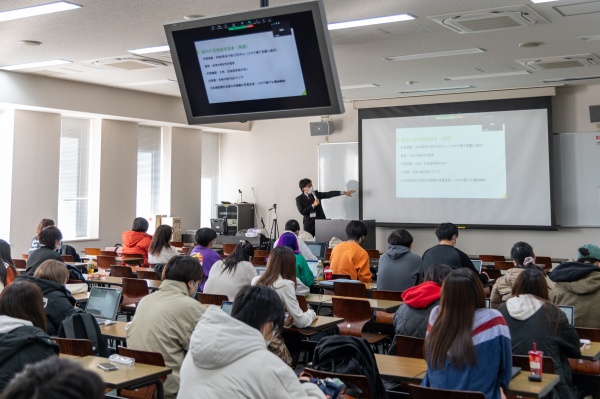
Principles of Language Teaching
Teaching a language is deeply intertwined with the historical and cultural background of the country or region where that language is spoken, as well as evolving educational perspectives and societal challenges. This course will examine Japanese language education in schools, as well as English, Chinese, and Japanese language education as foreign languages. Through learning about the linguistic and cultural aspects and teaching methods required in each language education setting, we will deepen our understanding of "learning and teaching languages." We will also consider the qualities, abilities, and roles required of language teachers.
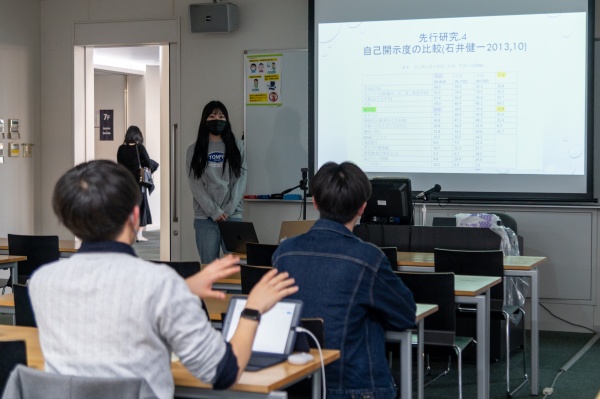
Specialized Seminar I & II: Language, Culture, and Communication (Tatara Seminar)
This seminar explores how the language and communication methods we use unconsciously are related to culture and society, using various examples from English and Japanese. Students analyze linguistic expressions and communication styles observed in films, dramas, manga, music, novels, media reports, and everyday conversations, as well as examples of subtitle and dubbing translation, to investigate the relationship between language and culture. Some students are also considering how the characteristics of various languages and cultures can be utilized in language education, while others are researching language education both domestically and internationally.
Other classes and subjects
Principles of Language Teaching Methodology / Second Language Acquisition Methods / International Communication / Educational and School Psychology / Introduction to English Linguistics / History of English and American Literature / Oral Communication Skills / Written Communication Skills / English for Academic Purposes / British Culture / American Culture / Introduction to Chinese Linguistics / Introduction to Chinese Literature / Chinese Linguistics Research / History of Classical Chinese Literature / History of Modern and Contemporary Chinese Literature and Chinese-Speaking Literature / Chinese Communication Techniques / Chinese Expression Techniques / Introduction to Chinese Culture / Introduction to Japanese Linguistics / History of the Japanese Language / Multicultural Coexistence and Easy Japanese / Diversity of the Japanese Language and Society / Japanese Culture from a Linguistic Perspective / History of Classical Japanese Literature / History of Modern Japanese Literature / Introduction to Classical Chinese and Classical Chinese / Japanese Language Education Grammar / Japanese Language Teaching Methodology / Japanese Language Assessment Methods / Multimedia Japanese Language Education / Japanese Language Teaching Practice, etc.
How seniors learned

Language Education & law/politics
Learning Japanese language education and human rights
Mari Ogami
Because I am interested in Japanese language education, I majored in a language education program. Furthermore, because I have an interest in law, particularly international human rights law, I majored in law and political science as my minor. I believe that combining the language education program and the law and political science program will greatly benefit me if I become involved in Japanese language education in the future. This is because, in addition to sharing the language with Japanese language learners, I believe that having knowledge of law and human rights will allow me to better assist foreigners who are often in vulnerable positions within Japan.

Language Education & linguistics
To teach English, I explore language from multiple perspectives.
Kokomi Tsushima
Since I aspired to become an English teacher, I have been taking courses in linguistics and language education since my first year of university. I came to strongly believe that in order to teach English, one must not only be able to speak English but also have knowledge of the history of the English language and the societies and cultures of English-speaking countries, so I chose the Language Education program as my major. I also had a strong interest in linguistics, a field in which there are still many aspects that remain unexplained despite the fact that we use the language every day, so I chose the Linguistics program as my minor. By combining these two programs, I hope to become a teacher who can examine the English language from various angles and convey its characteristics and the cultures of English-speaking countries to my students.
Characteristics of the academic group
Open list of subpages
Content of learning
Open list of subpages
Career paths, qualifications, and achievements