Integrated Area / Data Science Program
Program Overview
Modern society, driven by the widespread use of information and communication technology, operates with vast amounts of diverse data, including personal histories, humanities and social science data such as sociology and economics, and network information. Our goal is to treat this data mathematically and statistically, based on mathematics, statistics, physics, and information science, and to enable discussion from various perspectives.
Class Featured
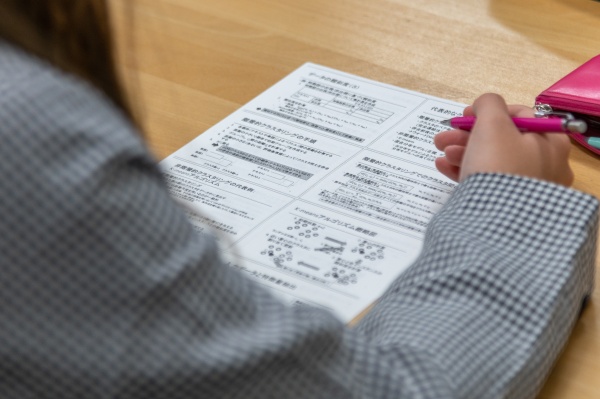
Introduction to Data Science
Leveraging the characteristics of College of Arts and Sciences, this course serves as an entry point for learning the application of data science across a wide range of fields. This course covers the characteristics of each data environment and problem Area domain, the foundation for implementing analytical methods, an overview of analytical methods, and evaluation methods for application.
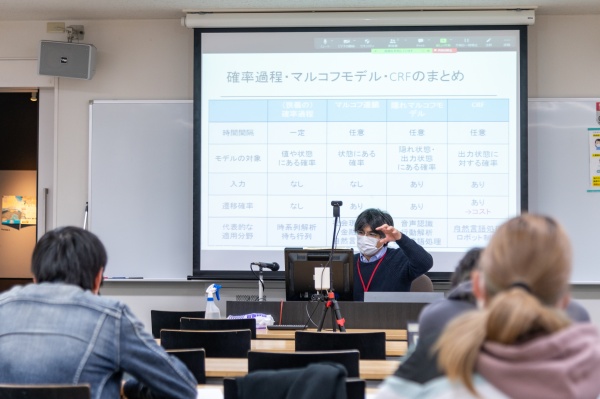
Mathematical Statistics I
This course will cover various regression analyses and stochastic models using linear models that have developed alongside data analysis. Through lectures and exercises, you will learn about methods for obtaining models from data, as well as refinement techniques and evaluation metrics based on model plausibility.
Other classes and subjects
Mathematical Statistics I, Mathematical Statistics II, Exercises in Mathematical Statistics, Probability and Statistics I, Probability and Statistics II, Computer and Data Analysis, Applied Statistics, Advanced Topics in Statistics, Machine Learning, The Science of Decision Making, etc.
How seniors learned

Psychology & Data Science
Approaching data science with a humanities mindset: A new approach
Airi Kataoka
I was originally interested in data analysis because I was in the science club in high school and used Excel. I'm a humanities student and I'm not good at calculations on paper. However, I realized that by understanding and applying functions in spreadsheet software, I could gain various insights from vast amounts of data, and I wanted to master data analysis. In the future, I want to become a data scientist. Even if I can't compete with people with a science background, I think that humanities students like me can fill in the gaps in areas where they struggle. As the name "science" suggests, data science requires taking science and math subjects. Some subjects are difficult for humanities students. However, the teachers make the lessons easy to understand with well-designed materials, so I feel very reassured.
Characteristics of the academic group
Open list of subpages
Content of learning
Open list of subpages
Career paths, qualifications, and achievements