What the voices of people living in a multicultural and multilingual environment can tell us
Main content
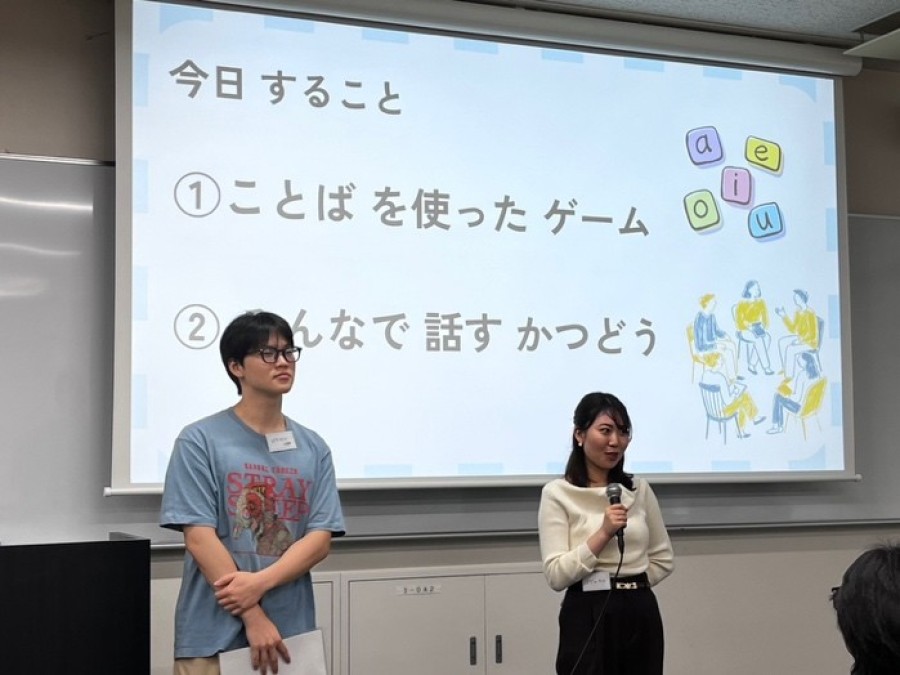
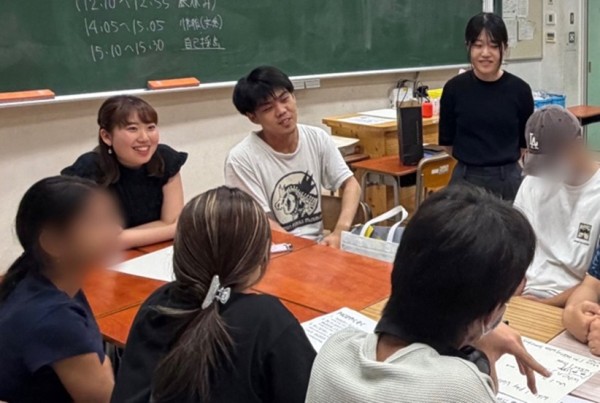
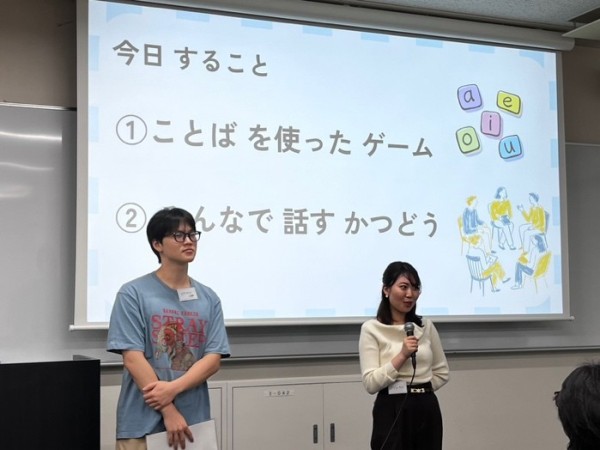
In the "Graduation SLP" (Instructor: Maki Kawada), under the theme "Considering Equitable Education and Support for Multicultural and Multilingual Children," we focus on structural issues in Japanese society involving linguistic and cultural diversity, and are engaged in Critical Service-Learning*2. As part of this, the practice of the "Multilingual Philosophical Dialogue" through high school-university collaboration between the part-time course of Tokyo Metropolitan Machida High School and our university was featured in the Asahi Shimbun on June 22. This activity is usually held at Machida High School, but on Saturday, September 12, it was also held at our university as a community event. Below are messages from graduate SLP students who have deepened their learning through these initiatives.
College of Arts and Sciences 4th year: Yuina Kokumi (Major: Language Education, Minor: Psychology & Multicultural Coexistence)
College of Arts and Sciences 4th year: Michika Tatewaki (Major: Language Education, Minor: Psychology & Multicultural Coexistence)
Some students may keep their inherent potential (such as their strengths and interests) hidden within themselves, but building trust is necessary to unlock that potential once it has been closed off. And that takes a very long time. Nevertheless, we are willing to dedicate the time to this process because this initiative is a valuable learning experience that will have a significant impact not only on the high school students but also on us university students who are involved.
We strive to create an "equal relationship" where we can share values, inspire each other, and gain new perspectives, thereby drawing out the strengths of high school students. Through these interactions, we ultimately hope that high school students will realize their own potential and build confidence.
College of Arts and Sciences 4th year: Takashi Kashiwazaki (Major: Museum Science & Information Science, Minor: Education & Data Science)
My own Chinese roots and past experiences have taught me the importance of listening to the voices of the heart that lie beyond language barriers. The multicultural, multilingual high school students around us today possess a rich culture, unique values cultivated through their lives, and profound thinking abilities that cannot be measured by superficial Japanese language proficiency alone. What I have come to realize through my seminar is the significance of education as a "hub" that connects diverse talents across national borders. Smartphones are widespread and they all own them, but do they truly have a diverse range of future options before them, and an environment where they can freely choose from them? Can they utilize not only material resources but also linguistic resources to vibrantly forge their future? How can education become a hub that expands their potential, driven by their own roots and originality? We need to continue asking ourselves these questions.
College of Arts and Sciences 4th Year John Yumin (Major: Language Education, Minor: Communication & Linguistics)
This is what I realized most strongly while participating in the philosophical dialogues held at Machida High School. The philosophical dialogues at Machida High School are activities that utilize one's native language and experiences in one's home country, and make full use of one's entire linguistic repertoire (including both one's native language and Japanese) to question philosophical themes. For example, on a day when the theme was "What is 'normal'?", various questions arose such as "Is it normal to use polite language with teachers?", "Can one person's opinion be called 'normal'?", and "How many people are needed to call something 'normal'?". Through these questioning sessions, we were able to hear about the cultures of other students' countries and share what things are like in our own countries.
Despite being born and raised in different countries and cultures, I was surprised to find common ground and experienced situations that challenged my preconceived notions. Through these experiences, I was able to enjoy both empathy for shared interests and new discoveries from different perspectives. I believe that cherishing one's own culture and language in this way can be an opportunity to re-evaluate and positively assess one's own inherent abilities while living in Japan.
College of Arts and Sciences 4th year: Tasuku Kakamimi (Major: Psychology, Minor: Multicultural Coexistence)
In philosophical dialogues, I am often made to think by the students' innovative opinions. For example, in response to the question, "When did 'normal' begin?", one student suggested, "Perhaps 'normal' began when there were two people?" If I had forced them to think and speak in Japanese, I might not have received such an opinion. From this experience, I believe that culture and language are not limitations, but rather enrichment of thought and expression. I hope to continue this activity so that all children, not just those from multicultural and multilingual backgrounds, can reach their full potential.
*1 College of Arts and Sciences About the 4th-year assignment inquiry and practical subject: 'Graduation Service Learning Project'
*2 Critical Service-Learning: In Service-Learning (SL), which involves learning through the interplay of theory and practice, this refers to a particular approach to SL practice that seeks to explore the root causes of social structural problems, critically questions the nature of volunteering itself, and works toward the realization of a just society while building better relationships with the people involved.*3 Related article: [Asahi Shimbun] I'm talkative in the Philippines, but... Supporting children with foreign roots through high school-university collaboration (June 22, 2026)
Inquiry
J. F. Oberlin University and Affiliated Schools General Planning Department, Public Relations Section
- webadmin@obirin.ac.jp
Latest News
-
2026.10.8
We held a send-off ceremony for the 2026 Hakone Ekiden qualifying race.External link
-
2026.10.8
J. F. Oberlin University ・Graduate School Japanese teacher training and practical training courses registered as 'Registered Practical Training Institutions' and 'Registered Japanese Teacher Training Institutions' by the Ministry of Education, Culture, Sports, Science and Technology
-
2026.10.2
Positive Psychology Fair 2026External link
-
2026.10.1
We have started accepting reservations for the online general entrance examination and the entrance examination information session utilizing the Common Test for University Admissions.External link
-
2026.9.30
"Kenpuku Cafeteria" and "Childcare Fair" to be held in fiscal year 2026.