Applying university learning to local biodiversity conservation
College of Arts and Sciences Toyama Seminar Jointly Implements 'Kakitsubata' Transplantation Project with Hachioji City Nakayama Elementary School
Main content
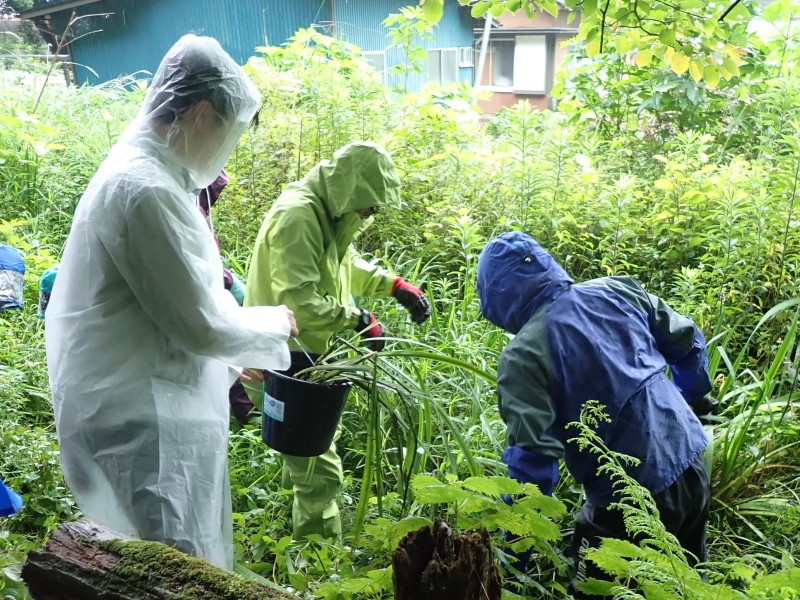
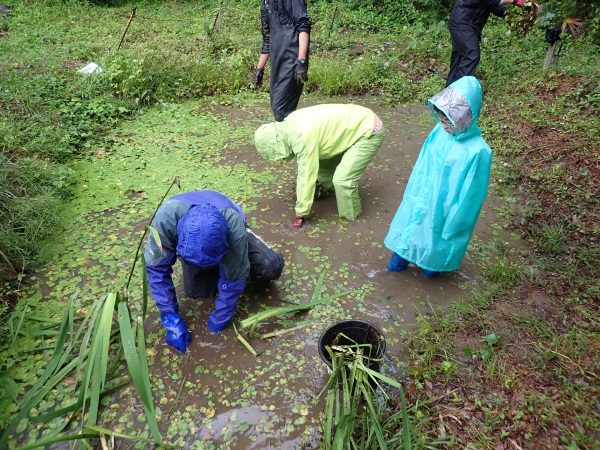
On Saturday, June 20, 2026, a transplantation project for 'Kakitsubata' was held at the biotope of Nakayama Elementary School in Hachioji City, where students from the College of Arts and Sciences & Hironori Toyama seminar and students from Nakayama Elementary School were held. Kakitsubata, a wet plant in the iris family, is designated as 'Near Threatened' on the Ministry of the Environment's Red List, and in the Minamitama region of Tokyo (including Hachioji City), where wetlands are drying due to development, it is classified as 'Endangered IA (CR)', the most concerning species for extinction. In this project, with the aim of 'lineage preservation' to protect genetic resources left in the region, transplants were carried out from wetlands in the Nakayama area to the biotope of the elementary school.
On the day of the event, with prior permission, we collected Japanese irises from a privately owned wetland in the Nakayama area and carried out transplanting work in close cooperation with the students of Nakayama Elementary School, their parents, and members of the school management council. Prior to the work, we introduced the invasive alien species yellow iris, which grows nearby and threatens the native habitat of the Japanese iris. We explained to the children the morphological characteristics, such as the presence or absence of a midrib in the leaf, and the differences in their growing environments. We then asked them to consider "what kind of aquatic environment should the plants be transplanted to in order to protect the native Japanese irises?"
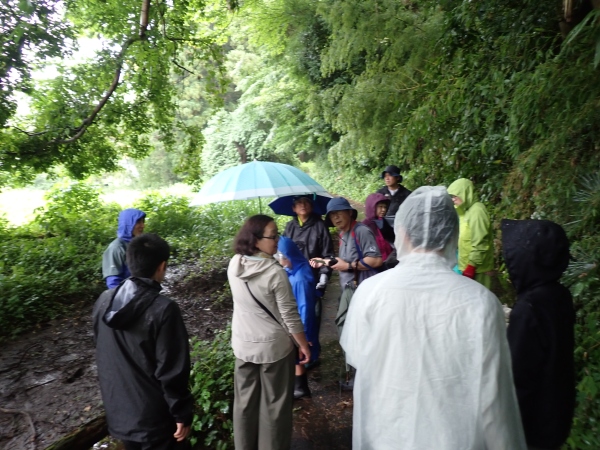
Because collecting plants from unstable wetlands buried deep up to knees is dangerous, adults such as J. F. Oberlin University teachers, students, and local parents took the lead in carrying out the work. Some children observing nearby even got into their boots, which was a rare opportunity to experience the nature of the water.
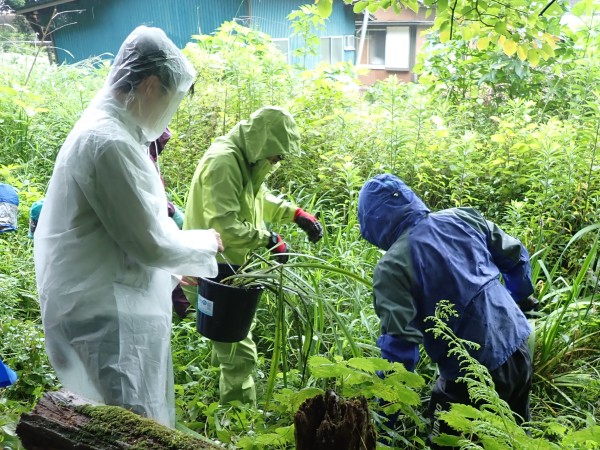
When transplanting the collected plants to the biotope at Nakayama Elementary School, faculty, students, parents, and children from the university worked together to transplant them according to the layout designed by the children, resulting in a collaborative effort that transcended generations. Participating students commented, "It was a very valuable experience to transplant irises. Through activities in the biotope, I hope to think about ways to conserve biodiversity," and "I had the impression that transplanting would be difficult, but it was easier than I thought. If transplanting can protect the future of species, I would like to contribute in the future."
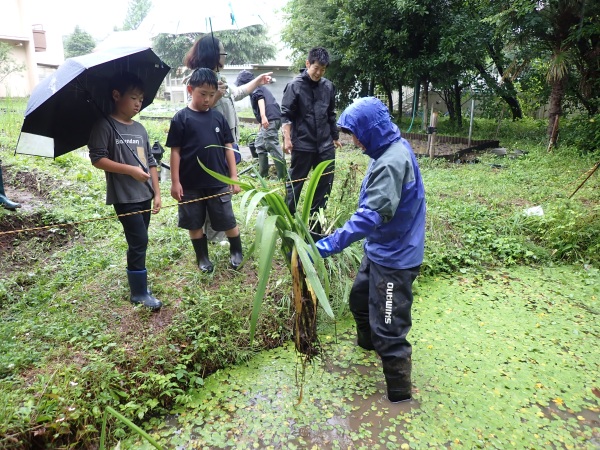
This initiative not only marked a significant step forward in effective environmental conservation activities to prevent the extinction of wild plants in the Minamitama region, but also provided students with valuable learning opportunities to actively apply their university research and expertise to solve regional issues. Our university's College of Arts and Sciences and Toyama seminars plan to continue their efforts to pass on the richness of the natural environment to future generations, based on trust with local communities.
Inquiry
J. F. Oberlin University and Affiliated Schools General Planning Department, Public Relations Section
- TEL
- 042-797-9772
- webadmin@obirin.ac.jp
Latest News
-
2026.10.10
東京都立千歳丘高等学校と高大連携協定を締結
-
2026.10.8
J. F. Oberlin University ・Graduate School Japanese teacher training and practical training courses registered as 'Registered Practical Training Institutions' and 'Registered Japanese Teacher Training Institutions' by the Ministry of Education, Culture, Sports, Science and Technology
-
2026.10.2
Positive Psychology Fair 2026External link
-
2026.9.30
"Kenpuku Cafeteria" and "Childcare Fair" to be held in fiscal year 2026.
-
2026.9.25
Onaka Seminar participates in joint seminar of universities in the Tokyo metropolitan area.