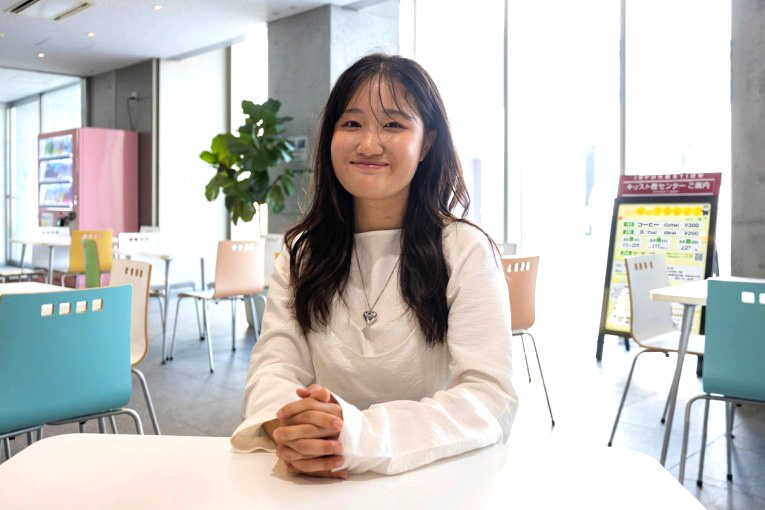
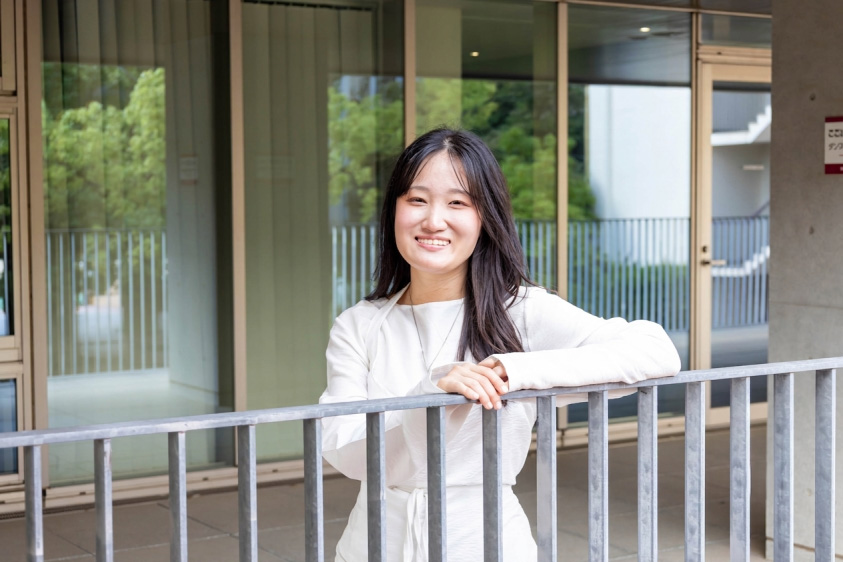
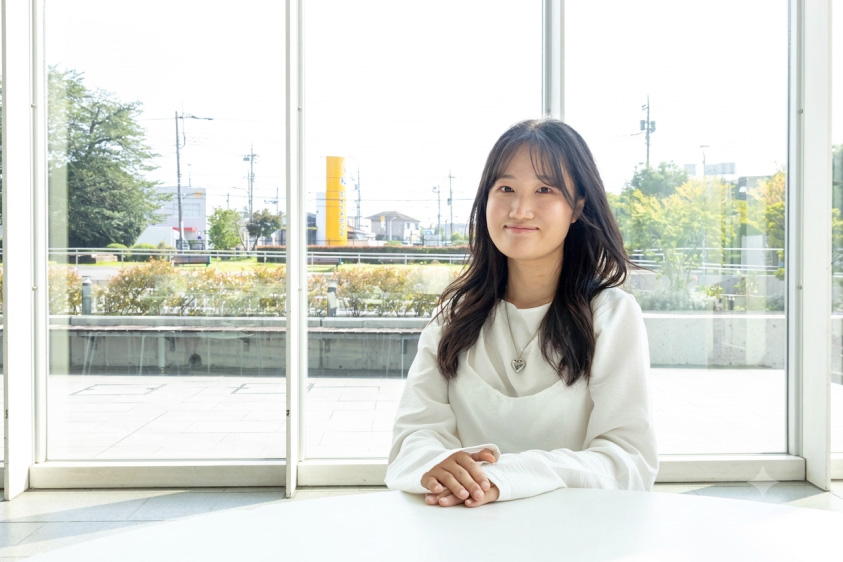
Overcoming language barriers: The power of writing opens the door to a career in psychology.
Graduate School Psychology Practical Research Degree Program, Clinical Psychology Field, 1st year master's student / *Graduated in 2026 J. F. Oberlin University College of Arts and Sciences
Jia Yubin (from Jeju Island, South Korea)
Main content
Drawn by the 'School Group System,' to J. F. Oberlin University
In Japan, there is a national qualification called "Certified Clinical Psychologist," which allows individuals to provide psychological support in a wide range of fields, including healthcare, welfare, education, justice, and industry. Upon learning this fact, Jia Youbin was strongly drawn to Japan's unique perspective that emphasizes the connection between mind and body, and its approach to psychological support that views individuals within the context of group relationships, and decided to study in Japan.
The reason I chose J. F. Oberlin University was the 'academic cluster system,' which allows students to study not only psychology but also communication studies and multicultural coexistence. The desire to become a psychologist who can empathize with people from diverse backgrounds by leveraging the perspectives unique to being an international student was the deciding factor for my decision to enroll.
"I can't get my message across"—the struggles of writing reports in a second language
During my first year of university, I had to write a report every time in my Japanese class for international students. However, I was often told that "it's difficult to understand what you're trying to convey." At the time, I couldn't put my thoughts into Japanese without using a translation machine, which took an enormous amount of time. I also felt stressed because even a slight difference in nuance could drastically change the meaning I was trying to convey. I recall thinking back to that time, "I was only thinking about finishing the assignments."
One-on-one instruction at WSC transformed my writing skills and my attitude towards learning.
A turning point in those days came when I was introduced in a Japanese class required in my first year of university, the 'Writing Support Center (hereafter, WSC),' which provided writing support for foreign languages within the J. F. Oberlin University. Despite worrying whether even a small assignment would be reviewed, I decided to start using it.
At WSC, at Jia Youbin's request, he began having weekly sessions with his tutor, Junko Tanikawa. He practiced reading his class reaction papers aloud and attempting to correct them himself on the spot, practicing daily with Tanikawa.
She also actively read novels recommended by Tanikawa. At first, she wondered, "Why would he recommend books when I'm supposed to be practicing writing?" but Tanikawa's words, "To become a good writer, you must first start by reading," still resonate with her today.
———"What did you think after reading it yourself?"———
What I remember most from the session is how Mr. Tanikawa always asked, "What did you think after reading it yourself?" Instead of immediately giving the answer, he carefully taught me the importance of thinking for myself, and this experience has become a valuable asset for Jia Yubin today.
How "writing skills" changed my "attitude towards learning" and resulted in an outstanding thesis.
Through repeated training at WSC, I became able to identify areas for improvement in my own writing. Previously, I was so worried about whether I could write well that I only focused on finishing the assignments. However, now that I have gained confidence in expressing my thoughts in Japanese, I can reflect on what I learned and felt in class as I learn. The psychological barrier to attending classes has lowered, and I have become more proactive in my learning than before.
Then, in her fourth year of university, Jia Yubin's graduation thesis was selected as the best thesis of the 2026 academic year. "I never thought I could grow that much. I truly feel that this is the result of all the hard work I put in at WSC," she said, expressing her joy at the time.
My current graduate studies and the power of academic writing
Currently, Mr. Jia Yubin is enrolled in the J. F. Oberlin University Graduate School of Psychology Practical Research Degree Program in the clinical psychology field, where he is learning more specialized knowledge and practical skills to become a certified psychologist and clinical psychologist. In graduate school, he often has opportunities to write psychological test findings and reports, and he reads numerous papers and specialized books every week, but he says, "Thanks to developing writing and reading skills at WSC, I am able to summarize long Japanese papers in my own words." He also said that the logical writing skills he learned in his bachelor's degree helped in preparing research proposals for the graduate entrance exam.
I found myself amidst diversity
J. F. Oberlin University has a well-established system to support international students, including the International Department, WSC, and Japanese classes for international students. There are many opportunities for international and Japanese students to interact, such as Japan-Korea exchange events, welcome parties for new foreign students, and BBQ parties. Jia Yubin himself has experience hosting Japan-Korea exchange events. "At first, I was worried about fitting into the circle of Japanese people, but many students became interested in my culture and background and got involved. Through the experience of connecting as individuals across J. F. Oberlin University nationalities, I was able to truly experience a society where diversity is respected," he says.
To my juniors, and to all future Obirin students around the world
"Don't keep your Japanese language struggles to yourself. Actively utilize the support available at the university and use it to help you grow." —This is Jia Yubin's most important message to younger international students.
Regarding J. F. Oberlin University 's motto, "Learning and serving people," Mr. Jia Yubin said: "It doesn't mean doing something special for someone from the start, but first enjoying what you learn, taking on challenges, and gradually increasing what you can do. And now, I believe that sharing and enjoying that with those around you is what that means itself. Don't be afraid of failure, believe in your own potential, and try various things."