Features of graduate education
Index
Educational objectives
To cultivate researchers and highly skilled professionals required for the knowledge-based society of the 21st century.
We have organized a curriculum to acquire advanced professional skills and broad knowledge necessary to thrive in an era where predicting future changes is difficult. Rather than simply inheriting the traditional approach of the six graduate schools, this is a re-innovation that designs entirely new ways of learning.
It not only helps students acquire specialized knowledge and skills but also provides a flexible environment where students can choose adjacent or necessary academic Area and learn interdisciplinarily. It serves not only as a place for high-level vocational Area and to obtain qualifications, but also as a place for continuing education and retraining where those already employed or certified professionals can acquire advanced specialized knowledge and practical skills. Moreover, it inherits the traditional curriculum for training researchers and responds to the increasingly diverse demands of advanced specialized fields.
Responding to a rapidly shifting society characterized by accelerating globalization and diversification, and an era of continuous learning, is a strategic theme in business. Furthermore, there is a demand for individuals who can tackle increasingly complex and sophisticated issues and lead the way in solving various challenges. To this end, we cultivate professionals with specialized professional skills who can excel at higher levels of work and in higher-level positions by learning that connects real-world society with specialized theories, acquiring qualifications and degrees, and building diverse networks in the process.
What is a degree program?
Research to realize your ideal self
J. F. Oberlin University Graduate School International Graduate School of Advance aims not only to enhance each student's expertise but also to create an environment where multiple Area can be studied in multiple specialties, realizing advanced academic pursuits based on students' proactive awareness of challenges. To foster professional talent through interdisciplinary research activities, we have introduced a "degree program system," breaking down barriers between specialized fields and aiming to realize interdisciplinary learning tailored to learners' needs.
Research with Expanding Possibilities Area
Our degree program offers a wide variety of specialized fields and aims to minimize these barriers, providing students with more learning options. We focus on how to shape your future career and provide a learning environment that expands possibilities.
For example, when business administration students study gerontology beyond just business and management, the possibilities for research Area in addressing an aging society and managing nursing care facilities expand even further. Additionally, by studying positive psychology, you can discover the potential of psychology as a management weapon, such as developing psychological talent in industry Area and fostering leaders who can provide support rather than just managerial ones.
A diverse and unique program
It offers programs that are considered the only ones in Japan, including gerontology, university administration, and positive psychology. These programs are forward-thinking research Area expected to contribute to the next generation. Moreover, by integrating these programs, it becomes possible to engage in even more unique and original learning and research.
Careful guidance from a diverse range of instructors
Our faculty, each with extensive experience in their respective fields, provide meticulous instruction. Many of our faculty members are practitioners who have worked or are currently working on the front lines of business, offering practical guidance. Furthermore, we provide a higher quality learning experience through interactive instruction that strongly emphasizes matching students, society, and learning, rather than simply one-way lectures.
Lifelong learning and career advancement
People of all ages and backgrounds attend our programs for a variety of reasons and purposes, including career enrichment and advancement, job-related requirements, and academic curiosity and inquiry. It also serves as a place for continuing education and retraining for those already employed or qualified, allowing them to acquire more advanced specialized knowledge and practical skills.
Subject Units
Realizing learning tailored to your goals
Academic Area in graduate school are broadly divided by degree program, and 'units' are formed by combining related subjects. "Subject units" are labeled as the abilities that can be acquired by studying subjects. By combining and accumulating subjects that make up the "unit," students acquire outstanding abilities to engage in highly specialized professions.
The advantages of "subject units"
- The skills that can be acquired for each "subject unit" are clearly indicated, making it easy to choose which subjects to take.
- By incorporating a minor curriculum in addition to the degree program, students can customize their learning style individually.
- Because the characteristics of the subject are clear, it is suitable for skill development and reskilling for working adults.
A curriculum structure that utilizes "subject units" to create a "minor" subject.
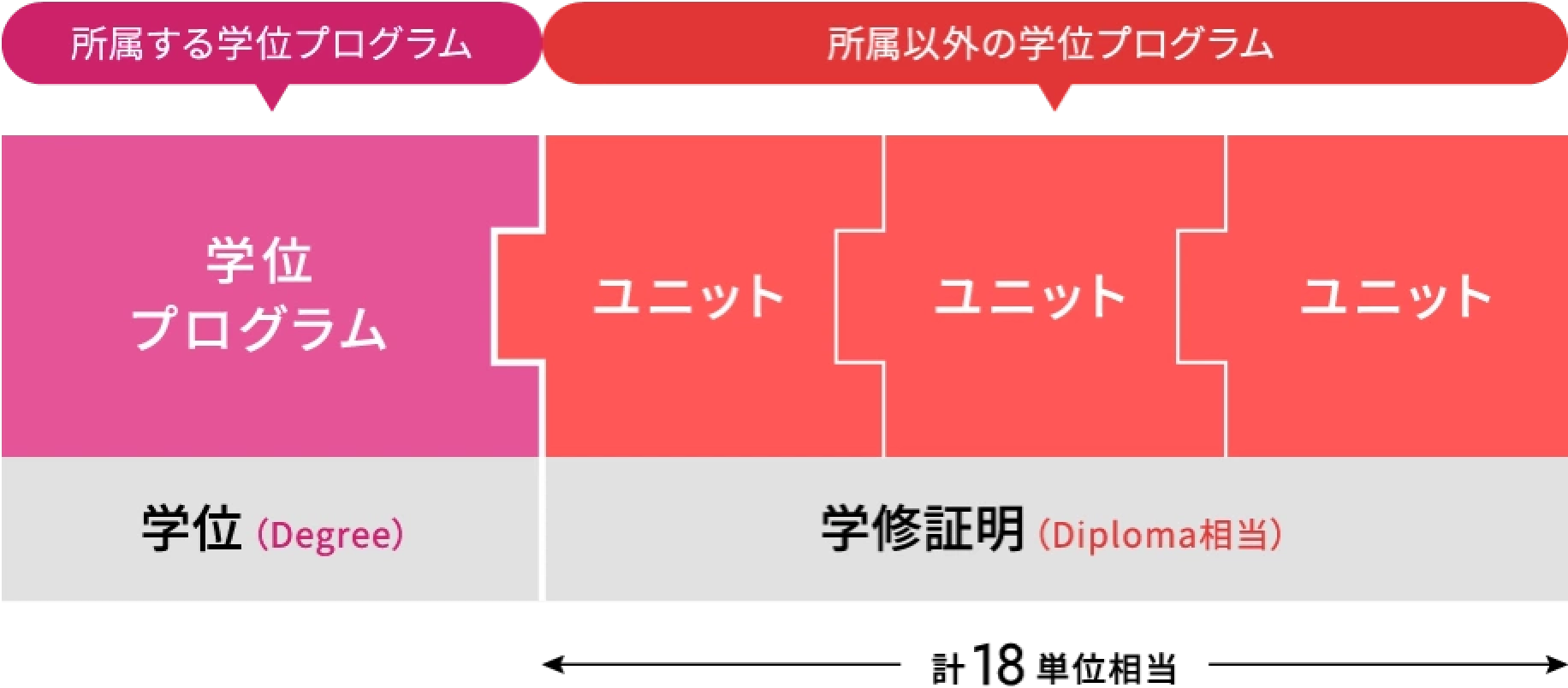
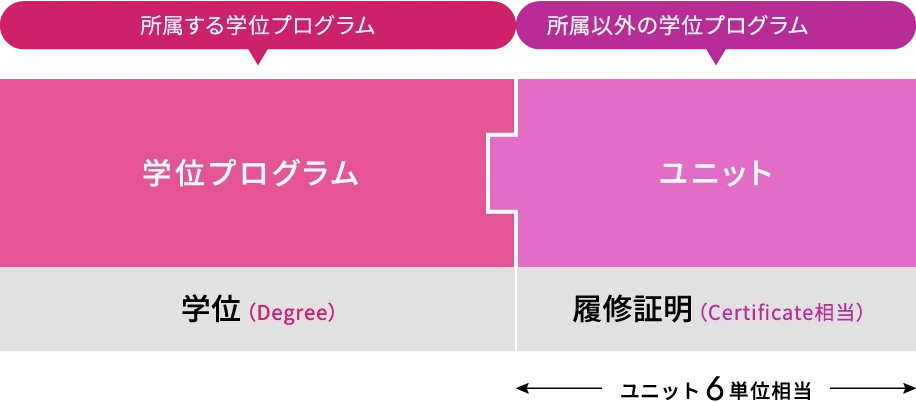
The introduction of "subject units" makes it easier to customize your learning style according to your goals and the skills you wish to acquire. By studying the content of subject units outside of your affiliated degree program and fulfilling certain completion requirements, you can obtain a certificate of learning and a certificate of course completion.
Degree + Certificate of Study
Degree + Certificate of Completion
A wide range of learning methods
J. F. Oberlin University The graduate school provides an environment suitable for skill development and reskilling for working adults. You can combine detailed lessons tailored to your goals, so you can acquire skills that suit you.
Long-term study program / Short-term study program

Flexible course schedule to accommodate work commitments.
The extended enrollment system allows students enrolled in a master's program or doctoral program who are also employed to remain enrolled beyond the standard period of study and continue their research without, in principle, having to repeat a year or take a leave of absence. While it is possible to enroll for up to eight semesters (four years), an application must be submitted after thorough consultation with the research advisor.
The short-term enrollment program allows students enrolled in a master's or doctoral program to complete the program in two semesters (one year) or three semesters (one year and one term), provided they meet certain requirements. Consultation with a research advisor regarding planned study and research is required.
Online classes

Creating an environment that widely accommodates working professionals and remote residents.
Starting with students entering in the 2024 academic year, lecture courses will be conducted online in principle (a hybrid of in-person and Zoom sessions), making it easier for students to attend classes while working or living in remote locations. Seminars and research guidance will be conducted in person to facilitate communication between faculty and students.
Course enrollment/auditing student system

It is possible to take courses on a subject-by-subject basis without enrolling in the program.
Auditors
Students may audit courses offered at this university, provided that it does not interfere with the education and research of regular students, and is approved by the university (with the exception of some courses).
Non-degree students
This system allows students to take courses offered at this university and earn regular credits. Students can take these courses if approved by the university, provided it does not interfere with the education and research of regular students (with the exception of some courses).
Education and training benefit system
This system aims to support the proactive skill development and career formation of workers, thereby promoting employment stability and job placement. It provides partial reimbursement of training costs upon completion of educational training designated by the Minister of Health, Labour and Welfare.