Environmental Initiatives
Index
To cultivate individuals who can view the future of the planet as their own responsibility and take action from multiple perspectives.
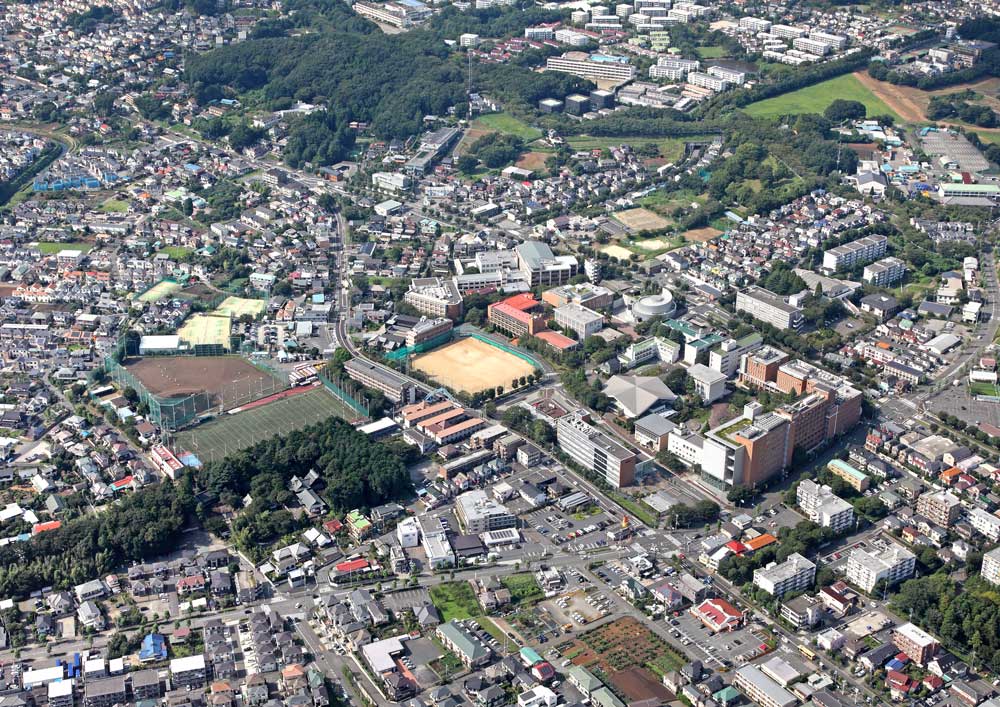
J. F. Oberlin University 's environmental initiatives are being promoted under the J. F. Oberlin University and Affiliated Schools 's overall medium- to long-term vision. The significance of visualizing activities aimed at realizing a sustainable society to society, such as strengthening SDGs initiatives in our business plans, is growing ever stronger.
In addition to these organizational activities, what our university values most is "the awareness of each individual student." In the educational setting of a university, it is the first step towards a sustainable society when students take environmental issues, such as waste, food loss, and multicultural society, as their own personal concerns and have the opportunity to reflect on their actions.
Just as there are 100 different ways of learning for 100 people, there are also different levels of interest in and approaches to the environment. Our university respects the diverse values of each individual and fosters an environment where students can think independently. In addition to the university's efforts such as energy conservation through facility improvements, it is the proactive actions of students in programs such as the "ECO-TOP Program" and the "Sakaigawa Cleanup Operation" that resonate with many people.
Leveraging our university's strength of allowing students to freely customize their learning, we aim to cultivate individuals who can dynamically broaden their learning horizons, approach social issues such as environmental problems from multiple perspectives, and take action.
Initiatives at the Machida Campus
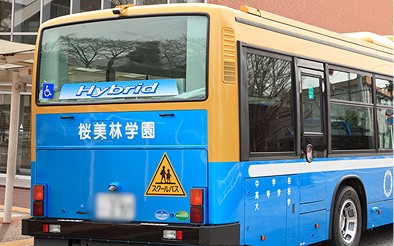
Hybrid bus
A "hybrid" bus that combines a diesel engine with batteries and an electric motor.
Compared to conventional buses, this eco-friendly vehicle emits fewer air pollutants and is more fuel-efficient.
Currently, three of these buses are in service as school buses.
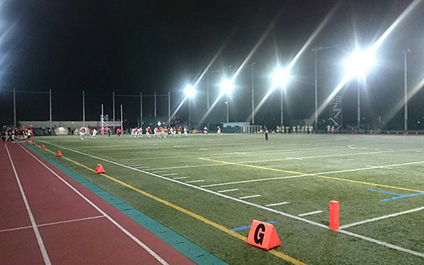
LED lighting
LED (light-emitting diode) lighting is used at the Sagamihara Campus, Shinjuku Campus, Tokyo Hinatayama Campus, and Tama Campus.
LED lighting is excellent not only for energy saving but also for resource conservation and waste reduction due to its high luminous efficiency (bright with less electricity) and long lifespan. At the Machida Campus, LED lighting has been installed in outdoor areas and inside the Meimeikan, Taiheikan, Rikagakukan, Tokubokan, and Sullenbergerkan buildings, and the lighting in other buildings is also being systematically updated.
LED lighting is excellent not only for energy saving but also for resource conservation and waste reduction due to its high luminous efficiency (bright with less electricity) and long lifespan. At the Machida Campus, LED lighting has been installed in outdoor areas and inside the Meimeikan, Taiheikan, Rikagakukan, Tokubokan, and Sullenbergerkan buildings, and the lighting in other buildings is also being systematically updated.
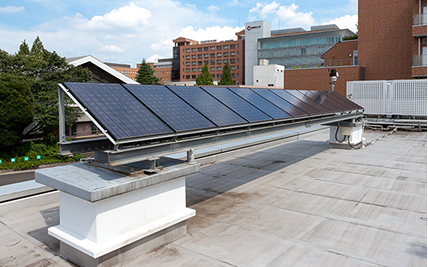
Solar power
The electricity generated by solar power is used in the electrical system of Ichiryukan.
Green Basic Plan
Our university is utilizing the "Green Basic Plan" provided by Tokyo Electric Power Company Energy Partner, Inc. to promote initiatives toward becoming an eco-campus.
The "Green Basic Plan" is an electricity menu derived from renewable energy that effectively achieves zero CO2 emissions, and is supplied at the Machida Campus (Machida Campus East Zone). Through this, we will contribute to reducing CO2 emissions and work to reduce the environmental impact in order to realize a decarbonized society.Motion sensor toilet
All restrooms at the Shinjuku Campus, Tokyo Hinatayama Campus, and Tama Campus, as well as the main restrooms in the major classrooms at the Machida Campus, use motion sensors and timers to turn the lights on and off and adjust the brightness.
Rooftop greening
The rooftops of the Gakujikan, Meimeikan, and Rikagakukan buildings are greened. Rooftop greening has several benefits, including lowering temperatures (a countermeasure against the urban heat island effect), improving building insulation (energy saving), increasing the city's water retention capacity, and absorbing and adsorbing air pollutants and restoring ecosystems.
Toilet paper made from recycled paper on campus
Paper, such as confidential documents, is collected on campus for recycling and becomes toilet paper at paper companies, which is then returned to J. F. Oberlin University. This volume exceeds approximately 48,000 rolls annually and is used in all toilets on campus.
Water-saving and energy-saving toilets
All toilets at the Shinjuku, Tokyo Hinatayama, and Tama campuses, as well as some toilets at the Machida campus, have been equipped with water-saving toilet products. These toilets automatically switch off the seat and water heater during off-time hours (nights and holidays) to conserve energy, and significant water savings are achieved through improvements to the ceramic surface and water flow.
Air Environment Station
On the rooftop of the Science and Technology Building, weather data, as well as the concentration of air pollutants such as nitrogen oxides (NOx), are automatically measured 24 hours a day.
Groundwater utilization system
Groundwater is used in the Meimeikan, Taiheikan, and Soteikan buildings on the Machida Campus, as well as in the toilets and for general-purpose water (for cleaning, etc.) on the Tama Campus. Appropriate use of groundwater conserves water and also serves as a water source during disasters such as earthquakes.
Gas heat pump
Gas heat pumps use city gas as an energy source for heating and cooling.
While electricity suffers energy losses due to transmission lines, preventing 100% utilization of generated electricity, city gas allows for the use of approximately 100% of its energy without loss, and also reduces electricity consumption, significantly contributing to the reduction of peak electricity demand during the peak seasons of summer and winter.
It is used in the following buildings on the Shinjuku Campus, Tokyo Hinatayama Campus, Tama Campus, Sagamihara Campus, and Machida Campus: Ichiryukan, Meimeikan, Suteikan, Eikokan, Rikagakukan, and Sullenbergerkan.
While electricity suffers energy losses due to transmission lines, preventing 100% utilization of generated electricity, city gas allows for the use of approximately 100% of its energy without loss, and also reduces electricity consumption, significantly contributing to the reduction of peak electricity demand during the peak seasons of summer and winter.
It is used in the following buildings on the Shinjuku Campus, Tokyo Hinatayama Campus, Tama Campus, Sagamihara Campus, and Machida Campus: Ichiryukan, Meimeikan, Suteikan, Eikokan, Rikagakukan, and Sullenbergerkan.
Atrium circulation system
In the Gakujikan and Rikagakukan buildings, the temperature difference between the first floor and the upper floors is utilized to circulate air in the open atrium space during heating and cooling, thereby improving the efficiency of the air conditioning system.
Geothermal use
Taking advantage of the fact that the ground maintains a constant temperature throughout the year (cool in summer and warm in winter), the Science and Technology Museum has buried the outside air intake pipes for the air conditioning units on the first floor underground to improve energy efficiency.
Rainwater usage
At the Machida Campus (including the Keikando and Rikagakukan buildings) and the Shinjuku Campus, rainwater is collected and used for flushing toilets and as fire hydrants. (When rainwater is insufficient, tap water is supplied.)
Visualization of electricity
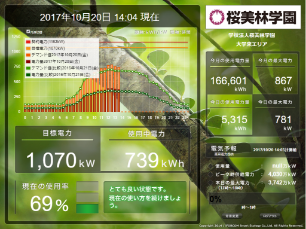
J. F. Oberlin University We have introduced a tool to visualize electricity usage status in the East Area, allowing anyone to view it.
Please log in with the ID and password below.
ID:obirin-machida-ps01
Password: n2YTmtX3
Please log in with the ID and password below.
ID:obirin-machida-ps01
Password: n2YTmtX3
environmental report
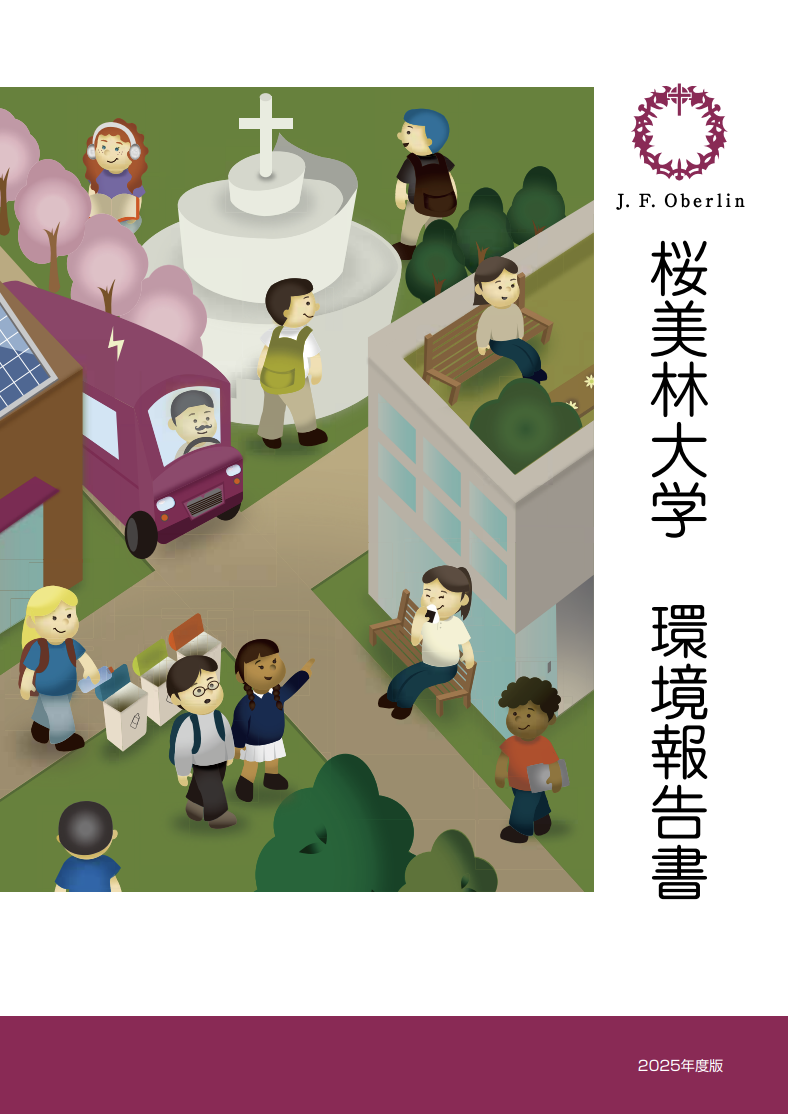
J. F. Oberlin University has published an environmental report in 2025, the first in seven years. During this period, society has been reconstructed due to the spread of COVID-19, and global climate change and resource constraints have become more severe. In this context, I believe it is important for universities to record and publicly disclose their efforts toward realizing a sustainable society.
Until now, environmental reports were edited and published by the J. F. Oberlin University Environmental Research Institute, but with the university's reorganization, the institute was abolished and the creation of environmental reports was also suspended. Therefore, this environmental report was planned and edited by students, with the cooperation of various departments and faculty within the university.
At our university, the Shinjuku Campus was opened in April 2019, the Tokyo Hinatayama Campus in April 2020, and the new Tama Academy Hills (Tama Campus) building was opened in April 2023, further decentralizing the academic clusters. Based on this, this report summarizes our university's environmental activities from multiple perspectives, including resource use, the current status and countermeasures of environmental impact across the entire J. F. Oberlin University, learning about the environment at universities, and social contribution, not just at the Machida Campus. We hope this report will serve as an opportunity to reflect on J. F. Oberlin University 's journey toward the environment and to consider a new step toward the future together.
Until now, environmental reports were edited and published by the J. F. Oberlin University Environmental Research Institute, but with the university's reorganization, the institute was abolished and the creation of environmental reports was also suspended. Therefore, this environmental report was planned and edited by students, with the cooperation of various departments and faculty within the university.
At our university, the Shinjuku Campus was opened in April 2019, the Tokyo Hinatayama Campus in April 2020, and the new Tama Academy Hills (Tama Campus) building was opened in April 2023, further decentralizing the academic clusters. Based on this, this report summarizes our university's environmental activities from multiple perspectives, including resource use, the current status and countermeasures of environmental impact across the entire J. F. Oberlin University, learning about the environment at universities, and social contribution, not just at the Machida Campus. We hope this report will serve as an opportunity to reflect on J. F. Oberlin University 's journey toward the environment and to consider a new step toward the future together.
Previous edition
- 2018 Environmental Report [7.8MB] (PDF file)
- 2018 Environmental Report Summary [2.8MB] (PDF file)
- 2018 Environmental Report [eBook] (TAMA eBooks)
- 2018 Environmental Report Summary [eBook] (TAMA eBooks)
- 2017 edition [6.5MB]
- 2017 summary version [2.5MB]
- 2016 Edition [6.9MB]
- 2016 summary version [3MB]
- 2015 Edition [5.21MB]
- 2015 Summary Version [2.37MB]
- 2014 edition [10.4MB]
- 2014 summary version [7.1MB]
- 2013 edition [4.7MB]
- 2013 Summary [3.6MB]
- 2012 edition [4.4MB]
- 2012 Summary [3.8MB]
- 2011 edition [6.1MB]
- 2011 Summary [1.6MB]
- 2010 Edition [9MB]
- 2010 Summary [1.8MB]