J. F. Oberlin University Internal Quality Assurance Policy and System
Index
J. F. Oberlin University To realize the founding spirit of 'fostering international individuals based on Christian principles' and our philosophy and educational objectives, we have established the following internal quality assurance system to continuously and continuously ensure and improve the quality of education.
1. Purpose of Internal Quality Assurance
We strive to ensure and improve the quality of our educational, research, and social contribution activities by appropriately implementing the PDCA cycle and other methods. Our aim is to explain to society, through our own responsibility, that our activities are at an appropriate level.
2. System for promoting and operating internal quality assurance
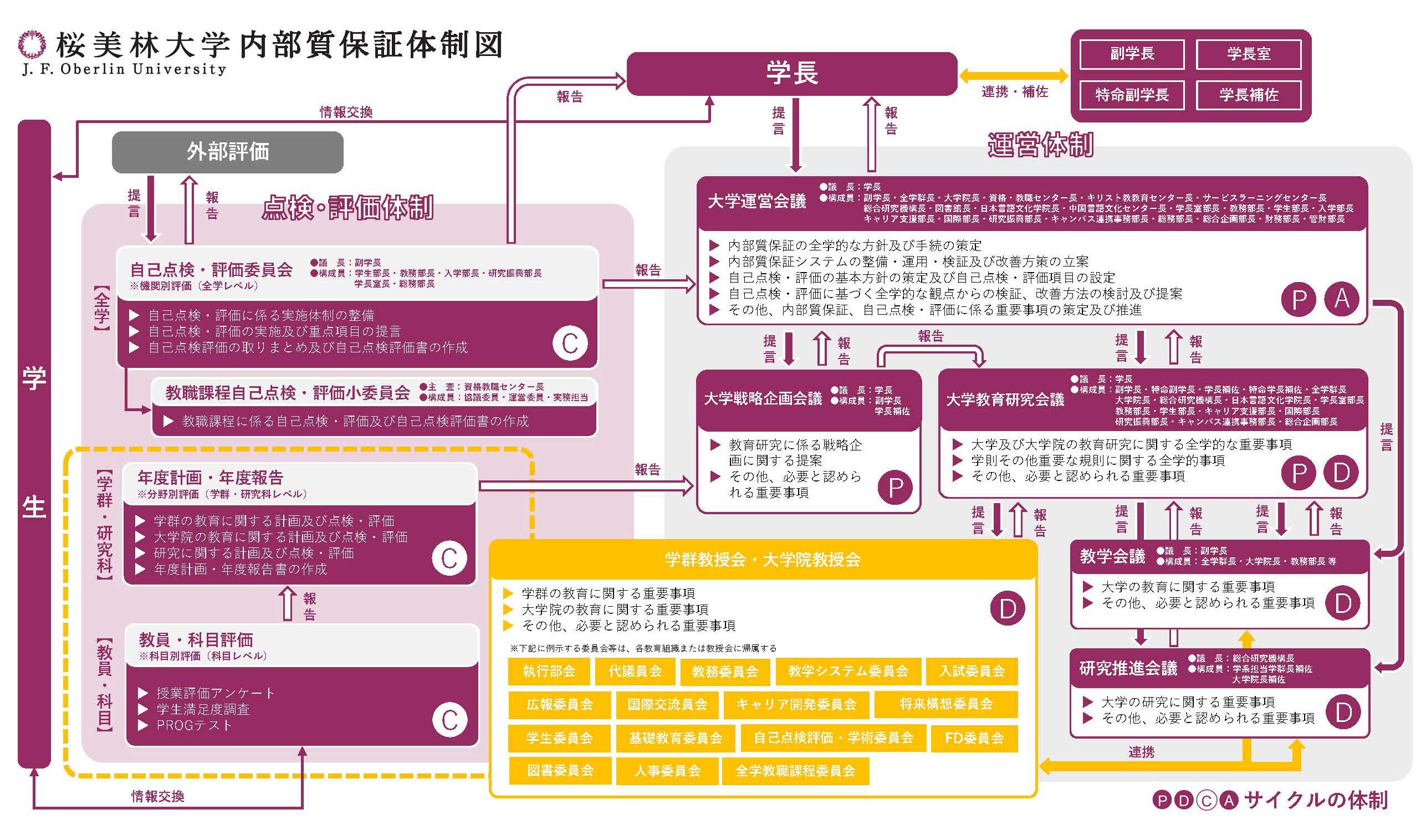
Our university's internal quality assurance system is closely integrated with its operational structure and inspection/evaluation system, systematically managing everything from university-wide decision-making to improvements at the operational level.
University Management Council (University-wide decision-making and promotion)
The President chairs this central organization, which is responsible for formulating university-wide policies and procedures for internal quality assurance, developing and operating the system, and formulating improvement measures based on self-assessment and evaluation.
University Strategic Planning Council / University Education Research Council (Substantive Deliberation)
As a subordinate organization of the University Management Council, it specifically considers strategic planning related to education and research, as well as important university-wide matters and quality assurance aspects related to education and research.
Academic Conferences and Research Promotion Meetings (Execution of Each Area)
Under the University Education Research Council, matters related to teaching are deliberated by the "Teaching Council," and matters related to research are deliberated by the "Research Promotion Council," each specializing in their respective fields, leading to improvements.
3. A multifaceted inspection and evaluation system (three-tiered structure)
Based on objective evidence, we conduct inspections and evaluations at the following three levels:
[University-wide level] (Institutional evaluation)
The Self-Assessment and Evaluation Committee will establish a university-wide implementation system, make recommendations on priority items, and prepare reports, which will then be reported to the University Management Council.
[Undergraduate/Graduate School Level] (Evaluation by field)
Each organization develops plans for education and research, and conducts reviews and evaluations through annual plans and reports.
[Teacher/Subject Level] (Subject-Specific Evaluation)
We use student course evaluation questionnaires, student satisfaction surveys, and PROG tests to check the quality of individual educational activities.
4. Autonomous quality assurance by faculty and staff (FD activities)
In addition to organizational improvements, we have established a system where each faculty member takes ownership of improving quality.
J. F. Oberlin University Establishment of the University-wide FD Committee
We have established the 'J. F. Oberlin University University-wide FD Committee' to formulate university-wide FD (Faculty Development) policies, plan and formulate, and promote educational and research awards.
FD Goals and Implementation
Based on the founding principles, faculty and staff strive to improve their "educational practice skills that meet the demands of society" and "ICT utilization skills." University-wide FD/SD training is conducted at least once a year, fostering a culture in which faculty and staff autonomously and regularly review and improve educational content and methods.
5. Ensuring objectivity through external evaluation
To ensure the effectiveness of our internal quality assurance system, we have introduced "external evaluations." The president will consider these recommendations and, through deliberations in university management meetings and other forums, will use them to drive further reforms and improvements.
KEI University Management Research Institute External Inspection and Evaluation of Severe Heat (External Evaluation)
Self-inspection and evaluation
J. F. Oberlin University regularly conducts self-inspection and evaluation activities.
Through this initiative, we aim to maintain the quality of education and research at our university, while simultaneously continuously reviewing and improving various activities. We will continue our efforts to become a university that can contribute even more to our students, as well as to the local community and society at large.
Self-assessment and evaluation (institutional accreditation of universities)
- Self-Assessment Report for Institutional Accreditation of Universities, Fiscal Year 2019 (Reiwa 1)PDF file
- Self-Assessment Report for Institutional Accreditation of Universities, FY2012 (Heisei 24)PDF file
- Self-Assessment Report for Institutional Accreditation of Universities, FY 2006 (Heisei 18)PDF file
Self-assessment and evaluation (selective evaluation by university institution)
Self-assessment and evaluation (proprietary evaluation)
- Self-Assessment Report for Fiscal Year 2025 (Reiwa 7)PDF file
- Self-Assessment Report for Fiscal Year 2010 (Heisei 22)PDF file
- Self-Assessment Report for Fiscal Year 2002 (Heisei 14)PDF file
Annual Report (Independent Evaluation)
- Annual Report for Fiscal Year 2016 (Heisei 28)PDF file
- Annual Report for Fiscal Year 2015 (Heisei 27)PDF file
- Annual Report for Fiscal Year 2014 (Heisei 26)PDF file
- Annual Report for Fiscal Year 2013 (Heisei 25)PDF file
Self-assessment and evaluation of teacher training programs
In order to improve the quality of teacher training, we have established specialized subcommittees separate from the university-wide system.
Teacher Training Program Self-Assessment and Evaluation Subcommittee
The Director of the Teacher Certification Center will serve as the lead supervisor, specializing in the implementation of self-assessment and evaluation related to the teacher training program, as well as the creation of self-assessment and evaluation reports.
Purpose and disclosure of the inspection
In accordance with the Enforcement Regulations of the Teacher Certification Act, we regularly publish the results of our self-assessments and evaluations to improve the quality of education related to teacher training, and we promote initiatives for improvement.
Self-assessment and evaluation of teacher training programs
- 2022 Academic Year Teacher Training Program Self-Assessment and Evaluation ReportPDF file
- Certificate of Completion of Self-Assessment and Evaluation of Teacher Training ProgramPDF file
University Institutional Accreditation
University Institutional Accreditation Evaluation for Fiscal Year 2019
As the previous evaluation expired in fiscal year 2018, we applied to the Japan Higher Education Evaluation Organization (JEEK) to undergo evaluation from fiscal year 2019 onwards, and we have now undergone the evaluation.
On March 11, 2020, the organization determined that we "meet the university evaluation standards" and also gave us the following high evaluation.
"The university has established specific educational goals based on its founding principles and mission, and operates based on three policies. The academic and administrative organizations are appropriately structured, ensuring smooth decision-making. Furthermore, the results of self-assessment and evaluation are used to implement appropriate and efficient initiatives rooted in medium- to long-term plans for internal quality assurance, along with an established system of accountability."
We will carefully examine the points raised in this evaluation, and we will also actively work towards improvement in the areas we have set for ourselves. As a higher education institution, we will continue to strive to maintain and improve the quality of our services.
FY2016 Institutional Selection Evaluation of Universities: "Selection Evaluation Item C: Status of Internationalization of Education"
J. F. Oberlin University underwent the evaluation of "Selection Evaluation Item C: Status of Internationalization of Education" conducted by the National Institution for Academic Degrees and Academic Programs, an independent administrative institution, in fiscal year 2016 (Heisei 28). After submitting the self-evaluation form to the organization, and following written and on-site surveys, we were able to receive the following high evaluation as of March 23, 2017 (Heisei 29).
"The achievement of the objectives is extremely good." "Regarding 'establishment of an international educational environment,' it is outstanding above the general standard. Regarding 'acceptance of foreign students,' it is outstanding above the general standard. Regarding 'sending of domestic students overseas,' it is outstanding above the general standard."
We humbly accept the valuable feedback we received in this evaluation and, keeping in mind our university's mission of "nurturing global citizens based on Christian principles," we will continue to actively work towards developing human resources from a global perspective.
University Institutional Accreditation Evaluation for Fiscal Year 2012
Although there is still one year remaining in the accreditation period based on the previous 2006 (Heisei 18) accreditation evaluation, J. F. Oberlin University applied to the Japan Higher Education Evaluation Agency to undergo the university-specific accreditation evaluation starting April 1, 2012 (Heisei 24).
On June 15, 2012, the organization determined that we "meet the university evaluation standards" and also gave us the following high evaluation:
"We are developing a system to integrate self-assessment and evaluation activities into the PDCA cycle of university management, rather than simply limiting them to the creation of reports. Overall, the university is appropriately engaged in education and research based on its founding principles, mission, and objectives. In 2005, we published our 'Mission Statement,' and in 2010, to realize this statement, we formulated the 'Obirin Gakuen Medium-Term Goals,' establishing 12 cornerstones, and continue our efforts to become an even higher quality institution of higher education."
Our university will not only take into account the suggestions and feedback provided in this evaluation, but will also actively work on improving and expanding our own challenges, striving to maintain and enhance the quality of our institution as a higher education institution.
University Institutional Accreditation Evaluation, FY2006
J. F. Oberlin University received institutional accreditation and evaluation by the Japan Higher Education Evaluation Organization in fiscal year 2006, and on March 29, 2007, it was certified that "J. F. Oberlin University meets the university evaluation standards set by the Japan Higher Education Evaluation Organization." The certification period is seven years, from April 1, 2006 to March 31, 2013.
In the overall review of the 'FY2006 University Institution-Specific Accreditation Evaluation Report,' our university's reforms in education and research were recognized as 'implementing distinctive innovations in curriculum systems and teaching methods to realize a flexible curriculum based on the founding spirit and broad learning based on student autonomy, and our proactive efforts in reforms, including the 'cluster system,' are highly commendable.' Additionally, the "Confucius Institute" project, which was signed with the Chinese government in November 2005 and opened in April 2006 with Tongji University as a partner, received high praise as an excellent project that nurtures the individuality and characteristics of the university.
Based on the results of this accreditation evaluation, and while humbly accepting the feedback we have received, our university will continue to fulfill its mission in accordance with its founding principles, with all faculty and staff working together as one.