

American Football Club


American Football Team Trainer: Makiko Goda
Unlocking the best performance – that's the trainer's mission.
American Football Club Trainer
Makiko Goda, College of Health and Welfare, 3rd year
Kanagawa Prefecture: Graduate of Yokohama Municipal Minami High School
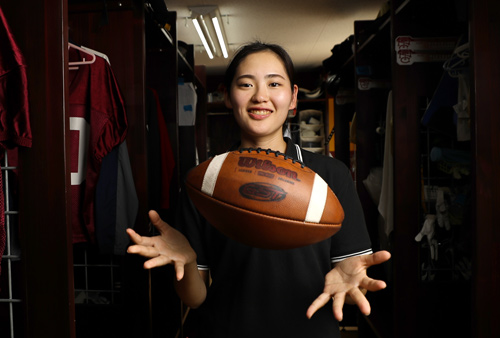
My interest in the American football team stemmed from my desire to work in a job that supports athletes.
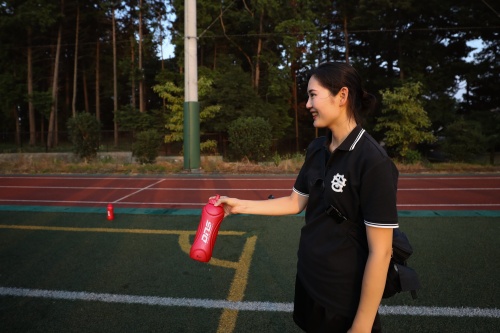
Until junior high, I played softball and swimming. When I entered high school, a friend invited me to start as the baseball team manager without thinking too deeply. The baseball team wasn't a strong team, but practice and discipline were strict, and the manager had a lot of work including cleaning, writing scores, and maintaining the players' environment, so it was tough. Even so, I found the job rewarding in supporting people who worked so hard.
At university, I wanted to study a field that would allow me to apply my future to a sports-related career. J. F. Oberlin University College of Health and Welfare enrolled because I learned that I could obtain qualifications such as sports leader, certified psychologist, and health psychologist, and that there were many options for various sports-related careers.
At the club introduction held at the freshman welcome party, I noticed the recruitment for trainers for the American football team. When I spoke with the staff, they explained that their job involves managing the players' health, taping before practice, stretching after practice, and constantly caring for the players to bring out their best performance. The introduction included words that were attractive to me as someone aiming for a sports-related career, such as "nutrition," "health management," and "stretching." Also, I found the refined atmosphere of the J. F. Oberlin University American football club and the cheerfulness of the staff appealing. I knew nothing about American football, but I decided to challenge the trainer for a peach-shaped match.
Trainer work is a combination of various knowledge and skills.
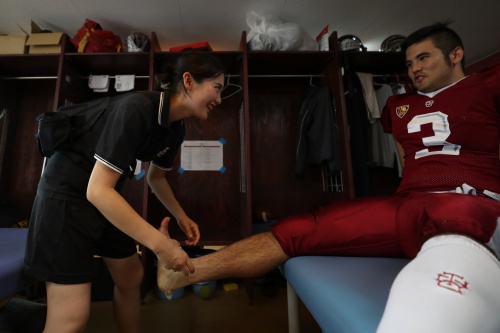
J. F. Oberlin University The American football club has a professional dedicated trainer, from whom we learn about the duties of a trainer. We received guidance on basic knowledge and techniques for taping and stretching, diet for weight management, and how to organize training menus. After that, we learned the details from seniors and researched on our own, honing our skills as a trainer. In American football, the way you train your body varies depending on the position. What they have in common is that to build a body that doesn't lose easily, many people have to gain weight and build muscle. I think it's a sport where you must prepare thoroughly to get seriously injured, while being overwhelmed by the intensity of people colliding up close, and the trainer's role also seemed important.
The knowledge required for trainer work is diverse. Medical knowledge related to weight management, first aid for injuries, and creating recovery plans for injured individuals; physical therapy knowledge such as taping and stretching, which is done based on understanding the structure of the human body; and nutritional management knowledge such as dietary recommendations. In addition, there is much to learn, such as strength to improve muscle strength and conditioning to improve physical fitness. When you pursue mastering one thing, an incredibly deep world unfolds beyond.
Moreover, even if you try to follow the example and put these into practice, it's hard to succeed. Even with stretching, each person's way of stiffening and loosening is different. There are muscles you can touch just because you have doubts about stretching, and areas you can't; through practice, I realized effective stretching methods for the first time, and I learned a lot.
I really liked how challenging it was. Because I felt that this knowledge and skills would definitely be useful somewhere in the future. College of Health and Welfare There are opportunities to grow greatly through hands-on experiences like teaching practicums and internships, but I feel like I'm doing a practical training every day. Moreover, the challenges that come my way into each day are different, and I feel like my problem-solving ability is being tested.
I have a responsibility to educate the players on their daily efforts so that they can perform well.
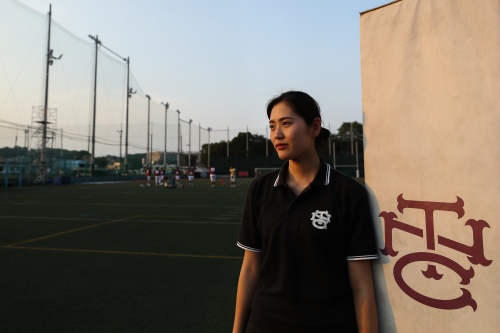
The interesting aspect of being a trainer is that it's not just about caring for the athletes. When abnormal movements are detected during weight measurements, there are many cases where the athlete has done something outside the planned nutrition management system. We need to identify this, point out the lack of self-management, and provide guidance. Also, regarding the recovery plans for injured athletes, we guide them based on the menu created by their dedicated trainers. We want them to return in better condition than before the injury. However, first and foremost, we believe that teaching from daily life things that can be done, such as stretching, is an important role for educators to prevent injuries before they occur.
"The position of educating athletes." That is the true role a trainer should have, and I am very proud of this role. Currently, there are eight trainers. Next year, as a fourth-year student, I will have to take charge of the trainers. When I joined, there were effectively only three of them, and there were really not enough hands. Because of that, I couldn't rely on the upperclassmen all the time, and I wanted to catch up somehow, so I worked hard to learn and absorb various things. Now, the trainer training system has also been established. Next year, I hope to showcase the excellence of the trainer job and welcome many new students.
Finally, I want to convey that the J. F. Oberlin University American football club has a very well-equipped training environment. Not only are the facilities well-equipped, but the team's relationships are also good, and I think it's an environment where everyone can exchange opinions and respect each other regardless of seniority or junior. In recent years, this team has been rapidly gaining strength. I think they have already developed enough to compete in the top 8. We want to be involved in their success as a contributing force.
This year, it made it into the top 8. The momentum of J. F. Oberlin University with rapid growth will continue from now on
American Football Club Captain
Ryuji Vandusen Michael College of Global Communication 4th year
Furthermore, we aim to strengthen our physical condition and become a team worthy of the Top 8.
American Football Club
Daiki Sakai, College of Arts and Sciences, 3rd year




