

Women's Volleyball Team


Women's Volleyball Team Analyst: Ryoka Kawabata
As an analyst, I aim to address the team's weaknesses and help them make a full comeback in the top league.
Girls' Volleyball Club Analyst
Suzuka Kawabata, College of Arts and Sciences, 4th year
He graduated from Kanagawa Prefectural Kamimizo Minami High School
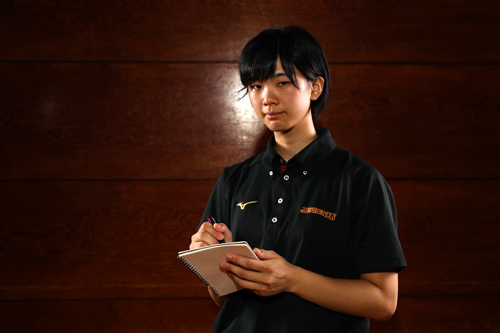
I wanted to study psychology and go to a university where I could play volleyball.
Kamigunan High School, where I studied, was weak at volleyball. It was barely enough to make it to the prefectural tournament. However, I had experience practicing tough volleyball until junior high, so I wanted to dedicate myself to volleyball again in university. At university, I was deeply interested in human psychology, so I wanted to major in psychology. Although I didn't know the details of psychology in detail, I was interested in using statistics to scientifically study the mind, and no matter which field I pursued in the future, studying psychology would be very useful for understanding people and organizations.
J. F. Oberlin University students can join volleyball clubs as well. I want to experience truly good volleyball while mingling with talented players from all over the country. I felt my heart racing. In fact, when I participated in practice, many of the students from high schools known for their names in the Spring High School volleyball tournament were among them. They were more elite than I had expected. Iguchi joined in his second year, and I thought he looked familiar, but I remembered that he was featured as a notable player on the cover of 'Standard Kanagawa,' a magazine specializing in high school sports in Kanagawa Prefecture. J. F. Oberlin University 's girls' volleyball team has many top players who endured intense training up to high school. Moreover, I feel that many students choose environments where they can balance studies and volleyball when considering future employment.
High-potential students naturally want to aim higher.
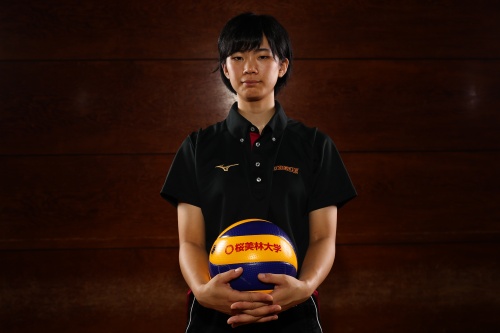
When I enrolled, I hadn't practiced very intensely in high school, so I could barely keep up with everyone. At that time, the J. F. Oberlin University girls' volleyball team had just begun strengthening up, and serious training aimed for the first division hadn't started yet. The students with potential were a bit overwhelmed by their abilities. While I was doing this, senior students one year above me stood up and gathered everyone for a meeting. The message was, "I want to seriously aim for the first division league. I want to seriously focus on winning." Originally, these were students with high potential. Their hearts became one with the idea of "Alright, let's aim for it." From that day on, the training became tougher, as if the color of their eyes had changed. However, what the students thought and hoped for. I was actually happy because I was given the opportunity to challenge my limits.
When our seniors became fourth-year students and our generation won the second division league in the spring of their third year, we also won the promotion/relegation playoff, and were able to compete in the first division in the autumn league. We struggled to win in the first division and finished last. Even so, we won the promotion/relegation match and managed to stay in the first division, but this spring, we lost the promotion/relegation match and were relegated to the second division.
Around this time, I was taking on the role of analyst to contribute to the team. Since I was playing less often, I began analyzing the team's strength and researching the weaknesses of opposing teams to support everyone.
I use the "Data Volley" software for analysis. In fact, that's what keeps me busy these days.
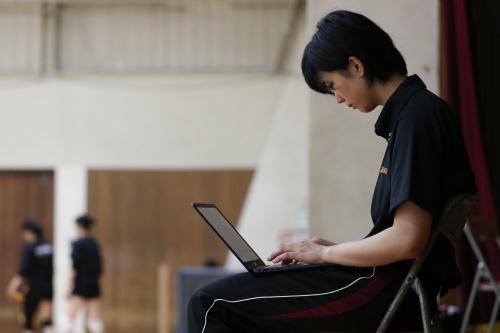
"Data Volley" is software for analyzing volleyball matches. By importing footage from "Data Video" and linking it with "Data Volley," statistical analysis and video analysis functions are synchronized. It is groundbreaking software that can analyze tactics through video, such as which players score the most points with which attacks and what habits they have. Teams in Italy and the United States started using it, and it is currently being used by the Japanese national team and in the top division of university leagues.
Top-level analysts can provide coaches and managers with data that allows them to make instant decisions about what tactics to switch to at each stage of the match, but we are not yet at that level of real-time response. However, while we input "1S" when player number 1 serves, we can improve accuracy by inputting more details, such as "Player number 1's jump serve went from area 1 to area 5, and opponent number 7 made an accurate return."
By taking data that I couldn't input during practice or games home, re-entering it, and analyzing the results, I can uncover individual characteristics and team quirks. For example, I might notice that a player is unconsciously aiming too much at the right corner, or that a change in rotation creates space in the number 4 area. This is incredibly useful. I dedicate a lot of time to analysis, striving to provide information that will be helpful to the team. Doing something for someone else—even if it takes time—is meaningful and never a waste. In fact, I enjoy the busy time I spend on analysis; it's a fulfilling experience.
The autumn league is about to begin. I'm looking forward to seeing how well the teams that have overcome their weaknesses by utilizing the results of their analysis will perform.
The captain who led his team to relegation to the second division. He is determined to redeem himself.
Captain of the Girls' Volleyball Club
Nono Sakaki, College of Business Management 4th year
We were relegated from the first division after just one year. This fall, we will definitely return to the first division.
Girls' Volleyball Club
Miku Iguchi, College of Health and Welfare, 3rd year




