

EKIDEN Ekiden Club


Track and Field Club, Ekiden Team Manager: Yuki Goto
Supporting everyone's motivation is the key to competing in the Hakone Ekiden.
Track and Field Club, Ekiden Team, Head Coach
Yuki Goto, College of Business Management, 4th year
Miyagi Prefecture: Graduate of Tohoku High School
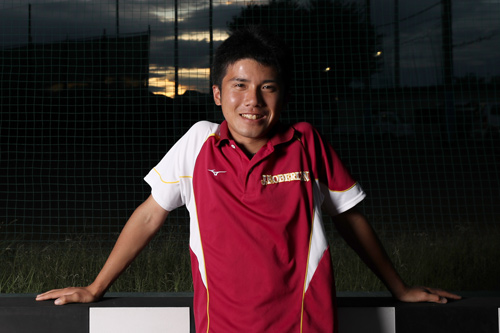
The "10,000-hour rule." I interpreted it as 10 years, and decided to try running long distances for 10 years.
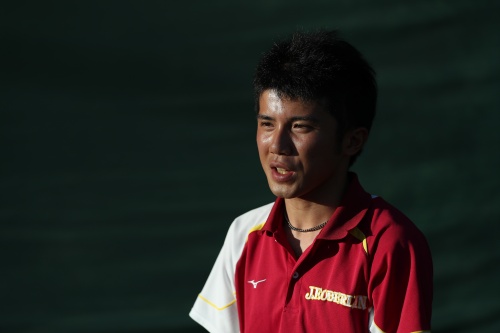
I excelled at long-distance running from elementary school. After middle school, I went on to Tohoku High School, which had a reputation for high-quality training, and my performance steadily improved until my second year of high school. However, in my second year, my records stopped improving, and I was troubled because I didn't know if it was a slump or if I had reached my limit. At that time, my high school track and field coach told me about the "10,000-hour rule." I later learned that it was a quote from Malcolm Gladwell's bestseller, "Outliers." The idea was that if a person spends 10,000 hours on something, they can become a specialist in that field, or a new path will open up for them. Strictly speaking, it would take 20 years if you spend 3 hours a day, but I interpreted it as 10 years, and decided to dedicate the 10 years until my fourth year of university to long-distance running. I participated in the regional qualifiers for the high school ekiden (long-distance relay race) in my second and third years, but there was a strong team in Miyagi Prefecture called Sendai Ikuei Gakuen High School, and I always fell just short of reaching the national tournament.
I decided to attend Obirin University because its ekiden (long-distance relay race) team was a specially designated elite club, and because I could study business and management there. I injured my leg at the end of high school, and participated in my first practice session while still recovering. The other teammates, while not having outstanding records, were a group of athletes who I believed would improve at the university level. They seemed to have been selected based on their talent rather than their records. I was confident I could keep up with the training, but the interval training menu to increase my maximum oxygen uptake (VO2Max) was incredibly tough, and I struggled desperately to keep up. The speed at the university level is definitely different. With a strong desire to continue long-distance running for 10 years, I gritted my teeth and persevered.
He was involved in a traffic accident while warming up for an intercollegiate competition. He was unconscious for 14 days.
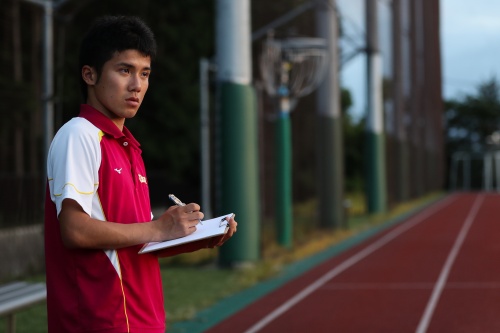
On July 14th of my first year, I participated in an intercollegiate competition with eight universities. I was scheduled to run 1500m in the first leg and 5000m in the second. During my warm-up for the second leg, I stepped off the sidewalk to avoid colliding with other athletes practicing, but at that moment, I was hit by a motorcycle coming from behind, hit my head on the curb, and fractured my skull.
I woke up two weeks later, on the 28th. I woke up without having dreamt anything. I was confused, not knowing what situation I was in. However, my consciousness was clear. It seemed I could move my arms and legs normally. I had a high fever and hives, possibly due to side effects from the medication, but there was no damage to my brain or bodily functions, which was said to be a miracle. Nevertheless, it was an injury serious enough to cause me to repeat a year of school.
After being discharged from the hospital, I returned to training, but the long break had left my body feeling like it had been reset. I couldn't achieve good times, and my performance remained stagnant. I also felt frustrated every day, as if something in my body wouldn't allow me to push myself. At this rate, the Hakone Ekiden seemed a long way off. I was at a crossroads where I had to make a decision. I was very hesitant to give up my goal of continuing track and field for 10 years, and quitting because of an injury seemed like a half-hearted choice.
I chose the path of a manager. Coach Mayaka never suggested I become a manager. He was a coach who would never suggest to someone who loved running that they choose not to run; he was very supportive of the athletes' feelings. After much thought, I came to the conclusion that I still loved ekiden (long-distance relay races) and that I wanted to take care of my teammates who would perform well in my place. I also felt that supporting them was one way of continuing track and field for 10 years.
Become a manager who is dedicated to listening and supporting each individual.
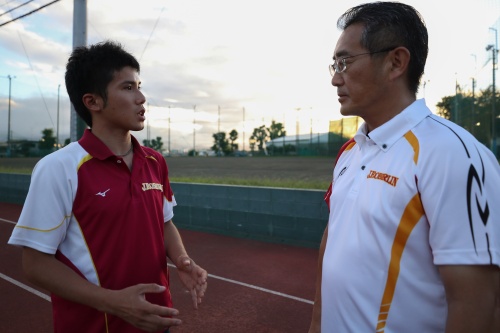
I became a manager and was enthusiastic. No, I was overly enthusiastic. I studied management by reviewing various materials, including my own experience, and tried to put that into practice. I was also sensitive to changes in my personal data. At first, I thought it was good and I was enthusiastic. However, there is no sport that looks the same or is more unique than running. Even with similar form, everyone gets tired in different ways. I thoroughly took on the role of listener, thinking about what kind of support would be best and what training routines to propose to the coaches, depending on what advice the coaches gave the athletes, how the athletes responded, and what kind of training routines to propose.
College of Business Management 's lectures were often useful for my work as the head of the department. Or rather, maybe I wanted to make use of them by listening to them. Oberirin excels in teamwork. She is strongly associated with fighting within the organization. The current Miyazaki captain is not someone who leads with strong leadership, but is a flexible facilitator who brings out the best in each individual. He often holds meetings without feeling hierarchical. Within that, I decided to take on the role of how to motivate everyone. For those with good times, instead of vague feelings about why they were good or how to keep going, I support them by searching for solid reasons and helping them make use of them next time. Conversely, when they hit a slump, I look for the reasons. I also made sure to discuss well with junior managers and share information so that the team could support the players.
J. F. Oberlin University Ekiden team lives in a dormitory. As the deputy dormitory director, I try to reflect as much as possible any requests from athletes in terms of daily life. The meals are also planned by the registered dietitian, and I believe the body is well developed through diet. In this privileged environment, the athletes work hard every day.
In autumn, the Hakone Ekiden qualifying race, where they should showcase their achievements so far. Every day, I think about how to approach that day as I act. Today, watching the athletes run beautifully in the sunset, I observe each person's progress by saying, "He's in great shape today," or "He's running relaxed without leaning his upper body." Wishing for the best possible results.
I want to compete in the Hakone Ekiden and create a new chapter in J. F. Oberlin University history.
Track and Field Club, Ekiden Team Captain
Junosuke Miyazaki College of Health and Welfare 4th year
Last year, despite being selected for the student federation team, I wasn't able to run in the Hakone Ekiden. This year, we'll all run together.
Track and Field Club Ekiden Team
Takashi Nagase College of Health and Welfare 3rd year




