
Baseball Club


Baseball team vice-captain: Satsuki Yasutaka
If you aspire to become a player like this, choose J. F. Oberlin University.
Baseball Club Vice-Captain Pitcher
Saki Yasutaka College of Health and Welfare 4 years
Graduate of Kasumigaura High School, Ibaraki Prefecture
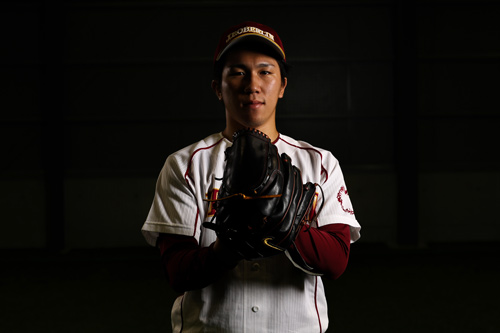
He was the second-string pitcher, but he had the experience of pitching on the mound at the Summer Koshien tournament.
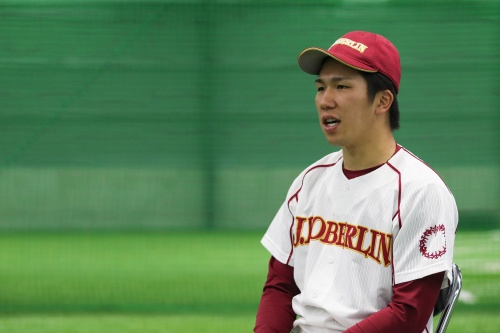
The Kasumigaura High School baseball team lost in the final of the prefectural tournament and missed out on a ticket to Koshien for years, so while locally considered a powerhouse, it was still not nationally known. I made the bench in the fall of my first year, became the winning pitcher in the prefectural tournament final, and advanced to the Kanto tournament, but I couldn't reach the spring invitational high school baseball tournament. In the summer of my second year, we lost to Fujishiro High School in the prefectural tournament final, and once again, the summer Koshien was postponed. The long-awaited first appearance at the summer Koshien was in the summer of my third year. I pitched against Hitachi Daiichi High School in the final and won.
My first opponent at Koshien was Hiroshima Shinjo High School. I took the mound as the second pitcher with the lead behind, but the game ended with the score unchanged. While Koshien was buzzing with buzz about Kiyomiya, Hirasawa, and Okoe, my high school baseball game ended.
I relied on a left-handed sidearm with a fastball and slider as my weapons. Although I wasn't very sure of my control, sidearm throws, which were difficult for batters to hit, were highly valued. Since the ace pitcher had gone pro, I practiced hard at university and wanted to aim for a pro shot.
Then, J. F. Oberlin University asked me to be a left-handed pitcher. To be honest, I didn't know about J. F. Oberlin University, but I heard there was a player aiming to go pro, so I went to observe his practice. There was Chihaya Sasaki (Chiba Lotte Marines), who later became a pro, and I thought he was an amazing pitcher. Hiroki Nomura, former ace of the Yokohama BayStars (now Yokohama DeNA BayStars), was in charge as a special coach. The facilities were well-equipped, and I was impressed by the J. F. Oberlin University baseball club's philosophy, which values player independence, and I wanted to play baseball here.
I watched the Meiji Jingu Tournament final from the bench. I thought to myself, "Next time, I want to come here as the ace pitcher."
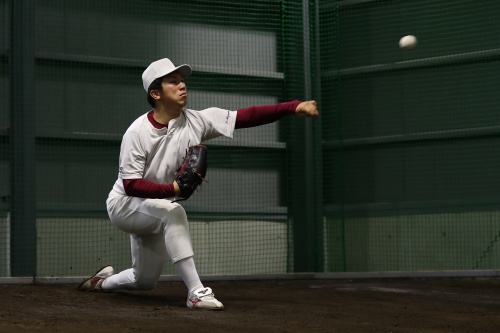
I joined the bench from the spring league games of my freshman year. The most nerve-wracking moment in my university life was, before or after, my first appearance in this spring league game. The opponent was Tokai University. I could pitch and shut down just two opponents, but it felt like I was experiencing college baseball for the first time. The players, who seemed to have been developed by gathering and nurturing members selected from high school, were not only skilled but also well-built and powerful. I was nervous about the high level at which they could catch the ball's core with a wooden bat. I had to climb up against these opponents. That was my first appearance, prepared for this.
The autumn league season for my freshman year marked the beginning of J. F. Oberlin University 's brilliant history. We won the league, then made our first appearance and first victory in the Kanto District University Baseball Championship, and reached the finals of the Meiji Jingu tournament, which decided the best university championship, finishing as runners-up. Although I didn't have any notable achievements myself, I could witness this remarkable progress from the bench. This experience later became a valuable asset for both me and the team. Throughout the game, it was very helpful to communicate to captain Yago and teammates what kind of game strategy should be made, what kind of atmosphere the bench needs when trailing, what kind of instructions the manager should give in situations, bench work, strong motivation from seniors, and how to develop a winning team.
I was not the ace in either my second or third year. In my second year, the ace was injured, so I took on the role of covering it, and in my third year, since there was no left-handed pitcher in the fourth year, my appearances increased. As a result, I was able to pitch in many games and gain experience. Gradually, my control stabilized, my pitching became more varied, and I increased not only fastballs and sliders but also several types of breaking balls like sinkers, and my technique for getting batters out with a combination of fastballs and breaking balls also improved.
J. F. Oberlin University 's training style mainly focused on teamwork during team practice, honing skills through practice in open games and intrasquad games. As a pitcher, I was able to receive guidance from ace Sasaki, one year above me Hayate Yasuda, and Special Coach Nomura. I received advice not only on pitching techniques but also on how to spend the week before games and ideas for self-practice. However, it wasn't imposed teaching; rather, it was advice that "I think and practice this way," and encouraged me to think and approach the rest for myself. That was the respect for autonomy unique to J. F. Oberlin University. Therefore, whether I worked hard or cut corners depended on my own will.
Effort doesn't always pay off. But there are also chances to turn things around.
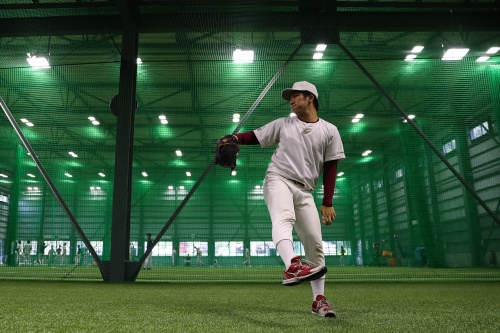
I entered the spring league of my senior year as the ace. I couldn't deliver results. The hard work I had built up steadily didn't pay off. There were many cases where I gave up a hit and was taken out, then lost after being hit on base, and I deeply regretted not being able to pitch until the end as the ace. There were also many games where I cried out with a one-run lead.
For the autumn league, pitching staff, including myself, need decisive strength in crucial moments. I think we need the mental strength to protect the one run scored by the fielders. From regular practice, we want to refine our mental state and build confidence. Then, by working together with the fielders, we can advance and lead the relegation to the second division we caused with our own hands to revive the first division.
J. F. Oberlin University Throughout my four years on the baseball team, I felt that neither the manager nor the coach overlooked the players who put in effort. There is no need to worry that I might be overlooked just because there are many members. The manager and coaches closely observe what kind of self-training and effort the players put in behind the scenes, and how they approach the scrimmage-and-white and preseason games.
J. F. Oberlin University Baseball clubs have coaches and managers who recognize their efforts, so I think it's an ideal place for students striving toward their own vision
They want to return to the Capital University Division 1 league and lay the foundation for a strong J. F. Oberlin University.
Baseball Club Captain
Arata Yago, College of Arts and Sciences, 4th year
I want to contribute to the team's goal of becoming the best in Japan from my position as team manager.
Baseball Club Manager
Kazuki Umehara College of Arts and Sciences 4th year




