

Baseball Club


Baseball team captain: Arata Yago
They want to return to the Capital University Division 1 league and lay the foundation for a strong J. F. Oberlin University.
Baseball Team Captain Infielder
Arata Yago, College of Arts and Sciences, 4th year
Kanagawa Prefecture, graduate of Yokohama High School

I want to work hard so that being the runner-up in the Meiji Jingu Tournament isn't considered my peak.
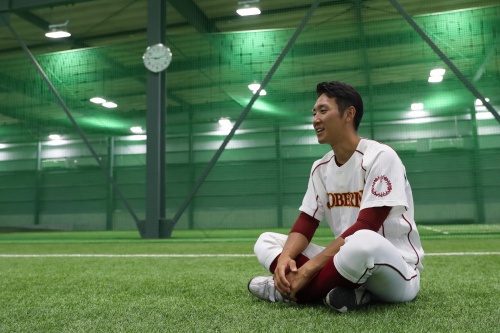
In the final against Tokai University Sagami High School, which was for the summer Koshien, Yokohama High School lost. In the bottom of the ninth, I heard the siren at the next batter's box signaling the end of the game. It was the siren signaling the end of high school baseball. Yokohama High School had about 80 members. That said, only about 30 people could actually practice on the field. So, unless you were among the 30, chances to make the bench were very rare. The baseball team members at Yokohama High School, who were in such an environment, focused on how to make it into the 30, constantly honed themselves, and showed great concentration to achieve results in the few opportunities. This spirit later helped them win the regular spots at J. F. Oberlin University.
I was selected for the J. F. Oberlin University where my seniors were present. J. F. Oberlin University 's baseball team was also supported by coach Fujiwara, a graduate of Yokohama High School. At that time, J. F. Oberlin University was a team in the Tokyo Metropolitan University Division 1 league, and there were plenty of players who could aim to become pros. By the time we enrolled, they were even told that becoming the national champion at university was not a dream. Later, in my first year, the J. F. Oberlin University, with pitcher Chihaya Sasaki (Chiba Lotte Marines) and hitter Sho Yamanobe (Saitama Seibu Lions), advanced to the finals of the Meiji Jingu tournament to determine the university championship, and finished as runners-up. To ensure that this glorious history is not called the peak of J. F. Oberlin University, our generation has become more determined to work harder.
J. F. Oberlin University was thought to be a university where training was not strict because it emphasized independence and the overall group practice time was short. However, upon enrolling, I realized that to become a regular player, you had to practice independently and work seriously to win. In that sense, the idea that practice was not strict was mistaken.
How to become a regular player depends on how you view the importance of self-reliance.
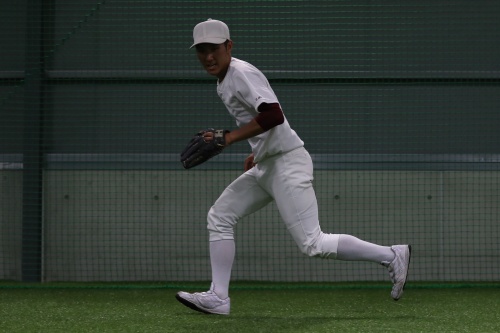
If asked which is better at batting or defense, I would say defense. I felt a sense of crisis that if I didn't improve my batting, I might end up just as a defensive substitute or a pinch runner. When I first enrolled, I was confused because I couldn't immediately get used to the wooden bat. I consulted Coach Fujiwara and received advice on batting, so I practiced independently. Even now, in my fourth year, I still remember those words and continue to work hard. Here, I want to talk about what it means to "think independently." When we talk about thinking independently, people tend to think about batting based on our own creativity from the start, but I believe that "thinking independently" means receiving appropriate instruction and exploring how to practice and approach challenges to overcome the challenges gained from that instruction. If you don't listen carefully, I think autonomy won't thrive.
Also, it is important to carefully listen to the coach's advice when speaking to players from the bench. Within those words are thoughts such as, "What does the coach expect from the players?", "How does the coach want the players to act?" and "What kind of team does the coach want to build?" To respond to this, what actions should be taken—such as actively incorporating what can be developed through self-training—that is the answer to "thinking independently."
For example, suppose you receive advice about baserunning. If you understand that the manager wants to build an offensive team where you want to advance aggressively and boldly, even if you narrowly get out in a red-stricken game, even if you narrowly get out, the manager will notice you. I believe that responding to the manager's wishes is the foundation of team building.
J. F. Oberlin University are divided into groups 1~3 for practice, but since the coach oversees all intrasquad games, players who are working hard have many chances. For example, even if the coach thinks "I'm fast and solid on defense but weak at batting," if I can get a hit in the scrimmage-squad games, my hitting will catch my eye. Because of this, I get closer to the bench and regular spots. To make the most of the few opportunities, I work on self-training and work on programs to build up muscle strength. How well I make the most of those chances and how well I understand the coach's ideas determines the regular spot. In this regard, the hunger spirit I had at Yokohama High School came in handy.
I became captain and we got relegated to the second division. This fall, we're going to get back to the first division.
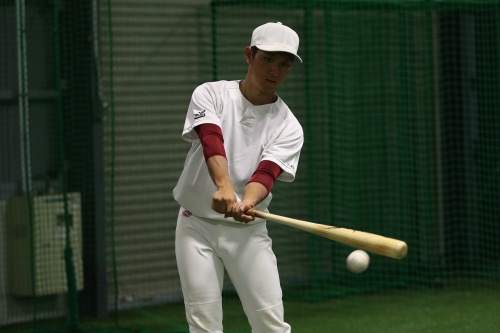
From my second year, I started making more of the bench, and there I had the chance to look over the whole team. Since I was a second-year, I couldn't get to reach out to anyone, but when I became a regular in my third year, I started actively reaching out to them. Maybe the manager thought I understood how to build a team, so I was appointed captain. I just wanted to do my best because I could play the baseball I love, but after being appointed, I wanted to meet those expectations.
After becoming captain, I ended up relegating J. F. Oberlin University to the second division in the spring first division league. I think there were still some shortcomings. As captain, everyone must be directed in the same direction. I have become more cautious about any disruptions in daily life. In the autumn league, I want to keep my guard down, win every match, and definitely bring the team back to the first division before graduating.
If you aspire to become a player like this, choose J. F. Oberlin University.
Baseball Club Vice-Captain
Saki Yasutaka College of Health and Welfare 4 years
I want to contribute to the team's goal of becoming the best in Japan from my position as team manager.
Baseball Club Manager
Kazuki Umehara College of Arts and Sciences 4th year




